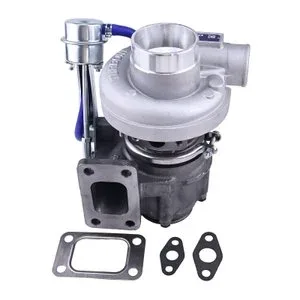
Matched Set Shipped — oil feed gaskets and exhaust manifold seals verified against Perkins 404C-22T engine serial before dispatch.
Technical Specifications
| Parameter |
Value |
| Part Number |
SBA135756170 |
| Product Type |
Turbocharger |
| Cross-Reference |
SBA135756170, M87772751, F41CAD-S0057BG, F41CAD-S0057G, 4T-507, VA420057, VB420057, VC40057, VC420057, VD420057, 135756170, 13575-6170, 87772751, 4T507, F41CADS0057B, F41CADS0057 (reference only) |
| Machine Fitment |
L170, LS170, S55, SL55B Skid Steer Loader |
| Turbo Model |
RHF4-46001P8.5NHBRL323CAZ |
| Condition |
New Aftermarket |
| Warranty |
3-12 months against manufacturing defects |
| Quality Standard |
ISO 9001 |
Application Suitability
| Engine System |
Related Components |
| Intake & Forced Induction |
Air filter housing seals, intake manifold gaskets, boost pressure hoses |
| Lubrication Supply to Turbo |
Oil feed line gasket, oil return line seal, engine oil filter |
| Exhaust Discharge |
Exhaust manifold gasket, exhaust clamp, heat shield fasteners |
| Engine Overhaul Kit |
Piston ring set, cylinder liner, main and conrod bearing shells |
| Emission Control Interface |
Wastegate actuator linkage, boost sensor connector |
Why a New Turbo Fails Weeks After Installation
A replacement turbo that fails prematurely usually points to an unresolved root cause in the adjacent engine system, not a defective unit.
When a turbocharger is swapped without tracing the original failure, the new unit inherits the same hostile conditions. Restricted oil feed lines starve the floating bearing of lubrication within seconds of startup [NEED_CITE: common root causes of turbocharger bearing failure in diesel engines]. Exhaust leaks upstream of the turbine raise local temperatures beyond housing tolerance. Oil-soaked air filters push contaminants past the compressor wheel into the charge air path, accelerating ring and liner wear downstream. I have seen rebuild shops replace the turbo on a Perkins 404C-22T and hand the machine back without inspecting the oil feed restrictor — the second RHF4 Turbocharger engine rebuild parts unit failed within the warranty window, and the engine was pulled again for a full teardown.

The Turbo's Position Inside the Perkins 404-Series Engine System
The turbocharger sits at the intersection of the intake, exhaust, and lubrication circuits. On Perkins 404C-22T and 404D-22T engines, oil is fed under pressure from the main gallery through a restrictor orifice, lubricates the journal bearings, then drains by gravity back to the sump. Any restriction in supply or drainage translates directly to bearing temperature rise. An RHF4 Turbocharger engine rebuild parts replacement must therefore be ordered alongside the oil feed line gasket and return line seal so the entire lubrication path is refreshed at the same service event.
Serial Number Variants That Change Port Orientation
Perkins 404-series engines span several build generations, and the 404C-22T, 404D-22T, and 404D-22TA variants differ in port orientation, gasket profile, and wastegate calibration [NEED_CITE: Perkins 404 series engine serial prefix and turbo variant differences]. A turbo that physically bolts on but has the oil drain port rotated a few degrees will create a pooling issue inside the bearing housing, leading to oil coking and eventual seal blow-by. Before confirming an order, the engine serial number must be checked against the port layout diagram to ensure the RHF4 Turbocharger engine rebuild parts unit matches the block configuration exactly.
Reading the Spec Sheet for What Matters in Service
The RHF4-46001P8.5NHBRL323CAZ model designation encodes the turbine trim, compressor wheel geometry, and bearing housing configuration. The turbine trim governs how much exhaust energy is extracted — a mismatch causes the engine to over-fuel or run lean under load. Dynamic balancing of the rotor assembly directly controls vibration transmitted to the bearing surfaces; imbalance at operating speed translates into accelerated journal wear. Heat resistance of the turbine housing matters on skid steer loaders that work under sustained high-load conditions such as trenching or heavy lifting, where exhaust gas temperatures remain elevated for extended periods. These are the parameters that determine whether the RHF4 Turbocharger engine rebuild parts unit will hold up in the field or require another teardown within months.
The Cost of Skipping Root-Cause Diagnosis
Fitting a fresh turbo without addressing the failure origin is the most common path to a second repair visit. If the original failure was caused by contaminated oil, the same contamination is already circulating through the main gallery and will attack the new bearing surfaces immediately [NEED_CITE: diesel engine oil contamination impact on turbocharger bearing life]. If exhaust back-pressure was elevated due to a blocked DPF or crushed exhaust pipe, the new turbine housing absorbs excess thermal load and the wastegate cannot regulate boost within its designed range. The machine returns to site, the operator notices smoke or low power, and the workshop faces a credibility problem along with a second warranty claim.
Why Buyers Source This Turbo Through XUNPO
The Guangzhou warehouse holds stock of commonly requested turbocharger references so dispatch does not wait for a production run. Self-produced lines and sourced supply from qualified manufacturing partners carry the same quality inspection process and warranty terms, consolidated under a single account. Cross-reference verification covers superseded and alternate numbers so buyers holding a worn nameplate or a legacy part number can still obtain a correct match. A sample unit is available for fitment confirmation before a fleet-level commitment, which matters when multiple machines share the same Perkins 404-series engine platform. Technical support confirms port orientation, gasket profile, and wastegate calibration against the specific engine serial number.
Documentation & Verification
- Commercial invoice listing turbocharger model RHF4-46001P8.5NHBRL323CAZ with matched gasket line items
- Part compatibility sheet showing Perkins 404C-22T and 404D-22T serial ranges with cross-reference numbers marked reference only
- Quality inspection record including dynamic balancing test result and housing dimensional check
- Warranty terms document specifying coverage period of 3-12 months against manufacturing defects
- Packing photographs showing oil port protection and turbine housing cushioning before crate closure
- HS code and customs documentation support for destination-country import classification
Installation & Rebuild Sequence
- Flush oil feed line and replace restrictor orifice gasket before connecting the new turbocharger oil inlet
- Verify oil drain port alignment with the block return passage — rotation mismatch causes oil pooling in the bearing housing
- Pre-lubricate journal bearings with clean engine oil by hand-rotating the compressor wheel before first startup
- Torque exhaust manifold studs to specification in sequence to prevent gasket creep under thermal cycling
- Run the engine at idle for the initial break-in period, monitoring boost pressure and exhaust smoke color
Request a System-Matched Quote
Provide the engine model, full serial number, and any previous rebuild history so the correct turbocharger variant and matched gasket set can be confirmed. If the engine nameplate is unreadable, a photograph of the oil port arrangement and exhaust flange helps the technical team verify the correct configuration.
Frequently Asked Questions
Q: What gaskets and seals should be replaced together with this turbocharger?
A: The oil feed line gasket, oil return line seal, exhaust manifold gasket, and intake connection seal should all be replaced during turbo service. Reusing old gaskets introduces leak paths that compromise oil supply or boost integrity, causing the new unit to fail prematurely. Request these as a matched set with the turbocharger order.
Q: How do I confirm the correct turbo variant for my Perkins 404C-22T engine serial number?
A: Share the full engine serial number so the port orientation, gasket profile, and wastegate calibration can be verified against the build record. Different serial prefixes within the 404-series may use different oil drain positions or compressor housing angles that are not interchangeable despite sharing the same base part number.
Q: What caused the original turbo to fail, and how do I prevent it from happening again?
A: Common causes include oil starvation from a restricted feed line, contaminated oil damaging journal bearings, and exhaust leaks raising turbine housing temperatures. Address the root cause during the replacement — flush the oil gallery, inspect the air filter housing, and verify exhaust system integrity before fitting the new turbocharger.
Q: Does the overhaul kit include all items my specific engine build requires?
A: Overhaul kit contents vary by engine serial number and previous rebuild history, particularly regarding bearing shell grade and piston oversize. Confirm your engine serial and any prior machining work so the kit is built to match the actual dimensions in your block, not just the standard catalog specification.
Q: How do I verify the engine model when the nameplate is worn or painted over?
A: Send a photograph of the engine block casting number location, oil port arrangement, and exhaust flange pattern. The technical team can cross-reference these visual identifiers against the engine family database to determine the correct turbocharger variant even when the data plate is no longer legible.