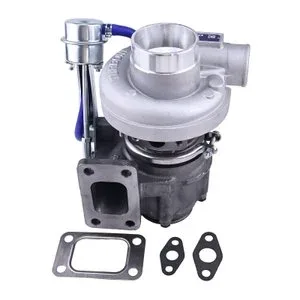
Technical Specifications
| Parameter |
Value |
| Part Number |
3592016 3800709 3593089 |
| Product Type |
Turbocharger |
| Cross-Reference |
3800709, 3592016, 3593089, 3593090, 4089476, 3536336, 3536337, 3537759, 3592118, 3802741, J592015, J592016, J536336, J802741, 76193234, 76193235, JR592015, JR802741, JC536336 (reference only) |
| Machine Fitment |
Dodge Ram Pickup Truck, Hyundai R140LC-7, CASE 570LXT, CASE 580L, CASE 580SL, CASE 590SL, CASE 686G, CASE 686GXR, CASE 688G, CASE 8825, CASE 8825HP, CASE 8860, CASE 8860HP, CASE 8870, CASE 960, New Holland DC100, New Holland DC80 |
| Part Name |
HX30W Turbocharger |
| Engine Fitment |
Cummins 4BT 110HP, 4B3.9, 6B5.9 |
| Condition |
New Aftermarket |
| Warranty |
3–12 months against manufacturing defects |
| Turbine Housing Material |
Ni-resist ductile iron |
| Compressor Wheel Material |
2618 aluminum alloy |
| Compressor Wheel Balance Grade |
ISO 1940 Grade G2.5 |
| Bearing Type |
Dual ceramic-coated journal bearings with integrated oil-cooling grooves |
| Sealing Standard |
SAE J1927 |
| Turbine Shaft Surface Finish |
Ra ≤ 0.4 μm |
| Operating Temperature |
Up to 750°C |
| Rotational Speed |
Exceeding 120,000 RPM |
| MOQ |
1 piece |
Application Suitability
| Engine System |
Related Components |
| Intake Air Delivery (Cummins 4BT / 4B3.9) |
Intake manifold gaskets, air filter element, boost pressure sensor |
| Exhaust Scavenging (Cummins 6B5.9) |
Exhaust manifold studs and nuts, turbine outlet gasket, flex pipe |
| Lubrication Feed Circuit |
Turbo oil feed line, oil restrictor fitting, oil return hose |
| Crankcase Ventilation |
Crankcase breather assembly, oil separator filter |
Why Replacing the Turbo Alone Keeps Bringing the Machine Back to the Bench
A failed turbocharger is almost always the symptom of a deeper system fault — swapping the unit without tracing the root cause guarantees a repeat teardown.
I have seen Cummins 4BT engines in Nigerian quarry sites go through two or three HX30W turbocharger replacements within a single season. The pattern is consistent: the old turbo failed from oil starvation caused by a collapsed feed line, or from abrasive dust that bypassed a cracked intake hose. Installing a new unit on the same compromised circuit simply feeds contaminated or restricted oil into fresh journal bearings. [NEED_CITE: turbocharger failure root cause analysis in diesel engine service manuals] Within weeks the replacement shows the same shaft play and black-smoke signature. The engine rebuild scope must address oil delivery pressure, intake air sealing, and exhaust back-pressure as one system, not treat the turbocharger as an isolated line item.

The Intake and Exhaust Loop This Turbocharger Belongs To
The HX30W turbocharger sits at the junction of three interacting circuits on Cummins 4BT and 4B3.9 platforms: pressurized intake air, hot exhaust gas, and the high-temperature oil feed that keeps the rotor shaft floating at over 120,000 RPM. Any degradation in one circuit transmits stress directly into the turbo bearing system. When planning an HX30W turbocharger engine rebuild replacement, the intake hose condition, exhaust manifold flatness, and oil restrictor orifice diameter all need verification in the same work order.
Sequence Variants Inside the Same Engine Family
Cummins 4B3.9 engines produced across different years carry internal differences that affect turbo port orientation, oil feed routing, and compressor housing clocking. A turbo that bolts to an early-build 4B3.9 may not align with the oil return flange on a later serial range, even though the base part number reads the same on both nameplates. We verify the engine serial and build code against the housing casting and flange pattern before releasing the shipment, ensuring the HX30W turbocharger matches the specific variant sitting on your rebuild stand. [NEED_CITE: Cummins 4B3.9 engine serial break-point documentation for turbocharger housing variants]
Reading the Specs That Actually Matter in the Field
The Ni-resist ductile iron turbine housing withstands the thermal cycling of continuous excavation duty without cracking along the volute tongue — a failure mode that appears in lower-grade housings after repeated cold-start-to-full-load transitions. The compressor wheel is machined from 2618 aluminum alloy, a material chosen for its retention of tensile strength at the elevated inlet temperatures common in tropical mine-site ambient conditions. Dual ceramic-coated journal bearings with integrated oil-cooling grooves maintain a stable hydrodynamic film even when oil supply pressure dips momentarily during high-angle machine articulation. The Ra ≤ 0.4 μm shaft surface finish keeps bearing clearance within tolerance, reducing the micro-vibration that otherwise accelerates seal wear. Balance verification to ISO 1940 Grade G2.5 prevents the harmonic shake that fatigues the thrust collar and compressor back-plate fastener over time.
What Happens When the Root Cause Is Skipped
When a rebuild replaces only the turbocharger without inspecting the oil feed line for internal collapse or the intake duct for dust ingress, the new unit inherits the same hostile environment that destroyed the previous one. Ceramic-coated journal bearings score quickly under abrasive oil contamination*l contact the housing bore. [NEED_CITE: journal bearing scoring mechanisms under contaminated lubricant conditions] The machine returns to the workshop with identical symptoms, the customer questions the part quality, and the real fault — a thirty-dollar hose or a cracked clamp — remains unaddressed.
What the Supply Side Actually Covers
Selected turbocharger lines are produced in our own Guangzhou facility, while complementary sourced items carry identical QC protocols and warranty terms. Eight product categories mean the gasket set, oil feed restrictor, and intake hose clamps ship under one consignment number rather than arriving on different schedules. Orders start at one piece for emergency rebuilds. Cross-reference verification covers superseded and alternate numbers so that discontinued references still resolve to the correct current housing variant. A sample unit can be dispatched for fitment confirmation before the fleet-level bulk commitment. The technical team confirms housing clocking, oil port orientation, and bearing grade suitability against the engine serial you provide.
Documentation & Verification
- Commercial invoice listing HX30W turbocharger part numbers and engine serial cross-reference
- Compatibility sheet noting cross-reference numbers as reference only for Cummins 4BT builds
- Quality inspection record covering rotational balance, oil seal integrity, and boost response
- Warranty terms specifying coverage period against manufacturing defects
- Packing photographs documenting crate condition and desiccant placement before sealing
- HS code and customs documentation support for destination-country clearance
Installation & Rebuild Sequence
- Verify oil feed line internal diameter is unrestricted and replace the restrictor fitting if carbon-scored
- Clean the oil return passage in the block before bolting the HX30W turbocharger down to prevent back-pressure on seals
- Pre-lube journal bearings with clean engine oil and confirm prime oil pressure before first crank
- Torque exhaust manifold studs to specification and re-check after the initial heat cycle
- Run the engine at idle for a minimum warm-up period to confirm stable boost and zero oil weep at the return flange
Rebuild Scope Confirmation
Provide your engine model, serial number, and any previous rebuild history — including whether the block has been line-bored or the crankshaft ground to an oversize — so we can confirm the correct turbocharger housing variant and the matched gasket and seal kit contents for your specific Cummins 4BT or 4B3.9 build.
Frequently Asked Questions
Q: What other engine components should be replaced alongside the turbo during a rebuild?
A: On Cummins 4BT and 4B3.9 platforms, we recommend replacing the turbo oil feed line, oil restrictor fitting, intake manifold gaskets, and air filter element in the same work order. Exhaust manifold studs should be inspected for stretch. Sourcing these as a matched kit ensures every sealing surface in the intake and lubrication loop is refreshed at once.
Q: How do I confirm the correct turbo variant for my specific Cummins engine serial number?
A: Send the engine serial number and, if available, a photograph of the existing turbocharger nameplate and oil port orientation. We cross-check the build code against housing clocking, flange pattern, and oil feed routing for your specific production run to confirm fitment before dispatch.
Q: What caused the original turbo to fail, and how do I prevent repeat failure?
A: Common root causes include oil starvation from a collapsed feed line, abrasive contamination from a breached intake hose, and exhaust back-pressure from a blocked catalyst or muffler. Addressing these upstream faults during the same rebuild cycle is essential; otherwise the replacement turbocharger operates in the same hostile environment and fails on the same timeline.
Q: Can I source a complete intake system kit in one order?
A: Yes. The HX30W turbocharger can be consolidated with matching mounting gaskets, oil feed and restrictor fittings, intake hose clamps, and an air filter element under a single commercial invoice. Consolidated dispatch avoids split freight costs and the scheduling gaps that arise when components arrive from different suppliers on different dates.