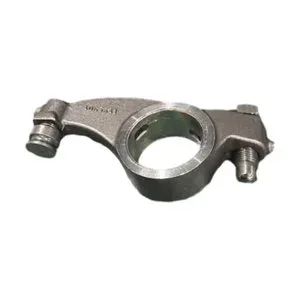
Engine Sequence Variants Verified — Each QSK60 CM2150, CM2250, or CM2350 build record is checked against the specific rocker lever variant before dispatch, ensuring the pivot bore and shaft interface match your engine's exact configuration.
Technical Specifications
| Parameter |
Value |
| Part Number |
4065633 |
| Product Type |
Rocker Arm |
| Cross-Reference |
4065633 (reference only) |
| Machine Fitment |
Komatsu AFE48-CQ, AFE48-CU, AFE48-CX, AFE48-DB, AFE48-DC, AFE48-DF; Cummins K19, QSK19 CM500, QSK19G, QSK45 CM500, QSK60 CM2150 MCRS, QSK60 CM2150 MCRS G, QSK60 CM2150 MCRS M, QSK60 CM2150 K132M, QSK60 CM2250 K112, QSK60 CM2350 K116, QSK60 CM2350 K117, QSK60 CM2350 K121, QSK60 CM2350 K135, QSK60 CM2350 K136, QSK60 CM2350 K149M, QSK60 CM500, QSK60 CM850 MCRS, QSK60 G CM2358 K110, QSK60G |
| Material |
Forged 42CrMo alloy steel |
| Surface Treatment |
Black oxide coating |
| Assembly State |
New Aftermarket |
| Warranty |
6-month standard warranty against manufacturing defects |
| MOQ |
1 piece |
| Standards |
ISO 9001, ISO 6892-1, ASTM E18, Cummins Engineering Specification CES 11107 |
Application Suitability
| Engine System |
Related Components |
| Valve Train — Overhead Cam Actuation |
Push rods, camshaft lobes, valve stems, valve guides, valve springs |
| Engine Overhaul — Top End Rebuild |
Cylinder head gasket set, valve cover gasket, rocker shaft seals, adjusting screws |
| Lubrication Circuit — Pivot Bore Feed |
Oil gallery passages, rocker shaft oil feed holes, lubrication pump output verification |
| Emission & Exhaust — Valve Timing Interface |
Valve seat inserts, exhaust valve faces, injector timing correlation |
Why Rocker Lever Failures Trace Back to the Rest of the Valve Train
Replacing the rocker lever without inspecting the cam lobe, push rod, and valve guide invites the same failure within the next service window.
In Nigerian mining operations running QSK60 haul trucks on continuous shifts, I have seen rocker lever 4065633 replaced three times in succession because each rebuild reused worn push rods and neglected camshaft lobe profile checks. The lever itself was not the root cause — it was the symptom of adjacent component wear propagating through the entire valve train. A proper Rocker Lever engine rebuild replacement demands that every interfacing surface is measured and judged during the same teardown. [NEED_CITE: Cummins QSK60 valve train inspection procedures during overhaul]
When a QSK45 or K19 engine arrives at the rebuild bench, the fault that destroyed the previous rocker lever is still present in the system. Cam lobe spalling creates irregular push rod travel, which hammers the lever pivot bore beyond tolerance. Valve guide clearance drift alters stem contact geometry, concentrating load on one edge of the lever tip. Addressing the lever in isolation means the new part inherits the same destructive forces from day one.

How This Rocker Arm Fits Inside the QSK60 Valve Train Hierarchy
The rocker lever 4065633 transfers motion from the camshaft through the push rod to the valve stem, serving as the final mechanical link before the valve opens. On QSK60 platforms, this lever operates under extreme cyclic loading at high-horsepower output levels, where even marginal wear at the pivot bore or valve contact tip cascades into timing errors and compression loss. Understanding its position in the system means recognizing that every component upstream and downstream shares responsibility for its service life.
Engine Serial Variants That Change the Rocker Lever You Actually Need
The QSK60 family spans CM2150, CM2250, and CM2350 control module designations, each carrying distinct valve train configurations that affect rocker lever geometry and pivot bore dimensions. A lever ordered for a QSK60 CM2350 K116 may share the same base part number as one for a K135, yet the shaft diameter, oil feed hole alignment, or adjusting screw thread pitch can differ between production runs. I have witnessed a Komatsu AFE48 haul truck sit idle for weeks because a rocker lever ordered against the engine model alone did not match the specific CM variant on the build plate. [NEED_CITE: engine serial number verification methods for Cummins high-horsepower platforms]
Cross-referencing the full engine serial against the build record eliminates this risk. When the nameplate is worn or painted over from years in a quarry environment, the engine data tag inside the ECM or the serial stamping on the block itself provides the definitive identifier. Matching the lever variant to the exact engine build prevents the costly teardown-repeat cycle that plagues fleet maintenance programs.
Material and Surface Engineering Behind the 42CrMo Forging
Forged 42CrMo alloy steel delivers the fatigue strength necessary for the rocker lever to endure millions of load cycles without pivot bore elongation or tip face spalling. The forging process aligns the grain structure along the lever's load path, which is critical because cast alternatives develop micro-porosity at the pivot-to-arm junction — precisely where cyclic bending stress concentrates. Black oxide coating provides a controlled corrosion-resistant surface that protects during storage and initial run-in without adding dimensional thickness that would interfere with shaft clearance or oil film formation.
The CES 11107 material specification governs hardness distribution and non-destructive testing requirements, ensuring each forging meets the microstructure standards expected in heavy-duty diesel valve trains. Dimensional verification under ISO 6892-1 tensile protocols confirms that the material batch maintains yield strength across the full cross-section of the lever arm.
What Happens When the Wrong Lever Variant Goes In
Installing a rocker lever with an incorrect pivot bore diameter or oil feed hole position leads to immediate lubrication starvation at the shaft interface, producing visible scoring within the first operating hours. A lever that fits physically but carries a different adjusting screw thread pitch prevents proper valve lash setting, which either leaves the valve partially open under combustion pressure or creates excessive impact loading on the valve seat. These misalignment failures are not gradual — they announce themselves through compression loss, exhaust smoke, and in severe cases, valve-to-piston contact. [NEED_CITE: valve train misalignment consequences in heavy-duty diesel engines]
The hidden cost extends beyond the lever itself. A forced fitment distorts the rocker shaft, damages adjacent levers on the same shaft assembly, and can bend push rods that were otherwise serviceable. The resulting teardown scope is significantly larger than the original repair, consuming additional gasket sets, seals, and labor hours that a verified match would have avoided entirely.
Why Procurement Accuracy Matters More Than Speed Here
Our production and sourcing lines operate under a unified quality and warranty framework, meaning the rocker lever 4065633 you receive carries the same six-month manufacturing defect coverage whether it comes from our own forging facility or a qualified partner. Engine parts across eight categories — from block internals to emission components — ship under one account with one warranty reference, eliminating the finger-pointing that occurs when valve train components arrive from separate suppliers with mismatched terms.
Part identification starts from whatever information you have: a part number, a machine model, a photograph of the old lever, or a shot of the engine nameplate. Our technical team verifies cross-reference numbers including superseded and alternate designations, and flags variant differences within the same base number before anything ships. Sample supply for fitment confirmation is available before you commit to a bulk order across a fleet overhaul program, and every order — even a single-piece emergency purchase — carries the same inspection documentation.
Documentation & Verification
- Commercial invoice listing engine serial and CM variant for each rocker lever line item
- Cross-reference sheet mapping 4065633 (reference only) against superseded and alternate numbers
- Dimensional inspection record covering pivot bore diameter, shaft clearance, and tip face geometry
- Six-month warranty certificate specifying manufacturing defect coverage from delivery date
- Packing photographs showing anti-rust oil coating and individual foam cushioning before sealing
- HS code classification and customs documentation support for international engine parts shipments
Installation & Rebuild Sequence
- Inspect camshaft lobe profiles and push rod ball seats before fitting the new rocker lever to identify root-cause wear patterns
- Verify oil feed hole alignment between the rocker shaft and the lever pivot bore during assembly to prevent dry-start scoring
- Set valve lash to engine manual specification after lever installation, then recheck after initial run-in cycle
- Confirm rocker shaft torque values and retaining hardware condition to prevent shaft rotation under load
Getting the Right Lever for Your Engine Build
Provide the full engine serial number and CM designation — for example, QSK60 CM2350 K116 versus K121 — along with any rebuild history that may have introduced oversize or variant components. If the nameplate is illegible, send a photograph of the serial stamping on the block or the ECM data screen. With this information, the correct rocker lever variant and any matched valve train components can be confirmed before the order is finalized.
Frequently Asked Questions
Q: What other valve train components should be replaced together with the rocker lever during an overhaul?
A: Push rods, adjusting screws, and rocker shaft seals should always be inspected and typically replaced alongside the rocker lever during a top-end rebuild. Valve guides and springs should be measured for wear; if they fall outside tolerance, replacing them in the same cycle prevents the new lever from inheriting destructive load patterns. A complete valve train kit ensures matched wear across all interfaces.
Q: How do I confirm which QSK60 CM variant my engine is, and does it affect the rocker lever I need?
A: The CM designation appears on the engine data plate and within the ECM configuration screen. Variants such as CM2150, CM2250, and CM2350 can carry different valve train geometries, including pivot bore sizing and oil feed alignment. Providing the full engine serial number allows us to verify the exact rocker lever variant required for your specific build configuration.
Q: What system-level faults cause premature rocker lever failure beyond the lever itself?
A: Camshaft lobe spalling, incorrect valve lash settings, lubrication starvation at the pivot bore, and excessive valve guide clearance all transfer abnormal loads into the rocker lever. Identifying and correcting these upstream faults during the same rebuild cycle is essential; otherwise, the replacement lever will experience the same failure mechanism within a shortened service window.
Q: How do I verify the engine serial number when the nameplate is worn or painted over?
A: The serial number is typically stamped directly on the engine block near the flywheel housing or oil filter mount. On electronically managed engines, the ECM stores the serial in its configuration data, readable via diagnostic tooling. A clear photograph of either source is sufficient for our technical team to confirm the correct rocker lever variant.
Q: Does the overhaul gasket kit include the seals and gaskets needed for valve cover removal during this replacement?
A: A comprehensive top-end overhaul gasket kit should include valve cover gaskets, rocker shaft seals, and cylinder head gaskets required for lever access and reassembly. Confirm kit contents against your specific engine serial and CM variant before ordering, as gasket profiles can differ between QSK60 production generations.