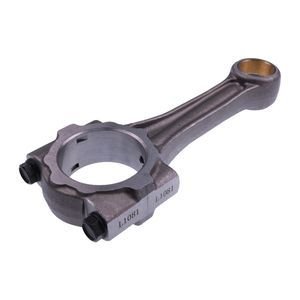
Matched Set Dispatch — Rod, piston, bearings, and gaskets verified against the same engine serial before packing, preventing tolerance mismatches in Cummins B3.3 and QSB3.3 rebuilds.
Technical Specifications
| Parameter |
Value |
| Part Number |
4956017 |
| Product Type |
Connecting Rod |
| Cross-Reference |
4956017 (reference only) |
| Machine Fitment |
Cummins B3.3, QSB3.3 |
| Material |
Forged 4340 alloy steel |
| Tensile Strength |
≥1,200 MPa |
| Big-End Bore Tolerance |
±0.005 mm |
| Surface Treatment |
Shot-peened |
| Heat Treatment |
Tempered at 580°C, quenched in polymer medium |
| Condition |
New Aftermarket |
| Warranty |
6 months against manufacturing defects |
| MOQ |
1 piece |
| Quality Standard |
ISO 9001 |
Application Suitability
| Engine System |
Related Components |
| Rotating Assembly |
Piston assembly, piston pin, snap rings |
| Bearing System |
Con rod bearing shells (STD / undersize grades) |
| Crankshaft Interface |
Crankshaft journal condition, regrind undersize verification |
| Lubrication Circuit |
Oil pump, oil filter, block oil gallery passages |
| Overhaul Gasket Set |
Head gasket, pan gasket, rod bolt seals |
Why the Same Connecting Rod Part Number Fails in Different Engine Builds
A connecting rod engine rebuild only lasts when the rod, bearing shells, and crankshaft journal are matched to the same dimensional grade.
I have stood in a workshop watching a freshly overhauled QSB3.3 seize within the first forty hours. The connecting rod was dimensionally correct, but the crankshaft had been reground to 0.25 mm undersize during a previous rebuild and the shop had installed standard-grade bearing shells. The oil film collapsed under load. This is not a rare mistake — it is one of the most common root causes of repeat connecting rod failure across B3.3 and QSB3.3 platforms [NEED_CITE: engine rebuild dimensional grade matching practices]. Shops that replace the rod without verifying the full rotating assembly history often find themselves tearing down the same engine a second time, absorbing the labor cost while the equipment owner absorbs the downtime.

The Rod Inside the B3.3 / QSB3.3 Rotating Assembly System
The connecting rod sits at the center of a tolerance chain that runs from the crankshaft journal through the bearing shell, into the big-end bore, up through the piston pin, and into the cylinder liner. Every interface in that chain must agree on the same rebuild grade. When a connecting rod engine rebuild is planned, the rod cannot be sourced in isolation — it must be coordinated with the piston assembly, bearing shells, and crankshaft condition to avoid clearance stack-up errors that lead to early wear or seizure.
Rebuild History Dictates What You Actually Need
Most B3.3 and QSB3.3 engines entering their second or third overhaul have a crankshaft that has already been reground at least once. If the journals are now 0.25 mm or 0.50 mm undersize, the bearing shells must match that undersize exactly. Supplying a standard-bore connecting rod with reground journals creates a clearance mismatch that no amount of assembly torque adjustment can correct. I always ask for the last overhaul record or a crankshaft measurement before confirming rod and bearing selection [NEED_CITE: crankshaft regrind undersize identification for diesel engines]. Skipping this step is how engines leave the shop running smoothly and come back on a flatbed a month later.
What the Specs Mean at the Big End and Small End
The 4340 forged alloy steel construction provides the tensile margin needed for continuous high-load operation in quarry crushers and port handlers. Shot-peening the surface introduces compressive residual stress that resists fatigue crack initiation at the bolt holes and big-end transition radii. The ±0.005 mm big-end bore tolerance ensures that bearing crush height falls within the engineered range, maintaining shell retention and heat transfer. Polymer-quench tempering at 580°C balances hardness with ductility so the rod can absorb combustion shock loads without brittle fracture. These properties matter most in equipment running at sustained 85–100% load factor, where thermal cycling and mechanical stress compound every operating hour.
The Cost of Missing the Root Cause
Replacing a failed connecting rod without investigating why it failed is the fastest route to a repeat failure. Common root causes in B3.3 and QSB3.3 engines include blocked oil galleries starving the big-end bearing, a faulty oil filter bypass valve allowing contaminated oil past the filter, and over-torque during a previous assembly that stretched the rod bolts beyond yield. If the lubrication fault is not corrected, the new connecting rod will experience the same oil-film breakdown and fail in the same way [NEED_CITE: diesel engine connecting rod failure root cause analysis]. The hidden cost is not the rod itself — it is the second teardown, the second set of gaskets, and the second round of equipment downtime.
What We Verify Before Your Rod Ships
Our own production lines and qualified sourced supply operate under one account with identical QC and warranty terms, so a connecting rod sourced alongside an overhaul gasket set carries consistent traceability. The technical team confirms engine serial variant differences — bolt specifications and big-end dimensions can shift across B3.3 power ratings — before the order is released. Batch inspection records covering dimensional checks and magnetic particle inspection are available on request. Single-piece orders ship from Guangzhou warehouse stock without minimum quantity barriers, and sample supply is supported for shops that want fitment confirmation before committing to a full engine set. Cross-reference verification covers superseded numbers so you do not receive a part that looks right but belongs to a different build variant.
Documentation & Verification
- Commercial invoice listing rod grade and matched bearing shell undersize
- Compatibility sheet confirming B3.3 / QSB3.3 serial-range fitment (reference only)
- Dimensional and magnetic particle inspection records per batch
- Six-month warranty covering material and manufacturing defects
- Packing photographs showing anti-rust treatment and individual boxing
- HS code and customs documentation for cross-border engine parts shipments
Installation & Rebuild Sequence
- Clean block oil galleries thoroughly before installing the rod to prevent immediate lubrication starvation at the big end
- Verify crankshaft journal undersize with a micrometer and match bearing shells to the measured grade
- Torque rod bolts in the sequence and stages specified by the rebuild manual — never reuse stretched bolts
- Confirm piston-to-rod clearance and pin snap ring seating before lowering the assembly into the bore
- Prime the lubrication system and verify oil pressure at idle before applying load during initial break-in
Before You Request a Quote
Send the engine model, serial number, and any available records from the last overhaul — specifically whether the crankshaft was reground and to which undersize. If the engine nameplate is worn, a photograph of the block casting number and any visible stamps on the existing rod helps us confirm the correct variant. With that information we can quote a matched set covering the rod, bearings, piston assembly, and gaskets together, eliminating the tolerance mismatches that cause repeat teardowns.
Frequently Asked Questions
Q: What else should be replaced when changing a connecting rod?
A: The bearing shells, rod bolts, piston rings, and the full overhaul gasket set should be replaced together. The piston pin and snap rings should be inspected for wear and replaced if out of specification. Reusing any of these components introduces unknown wear into a tolerance chain that depends on matched clearances throughout the rotating assembly.
Q: My crankshaft was reground last time — how do I know which bearing grade to order?
A: Measure the crankshaft journal diameter with a micrometer and compare it against the standard specification. The difference tells you the undersize grade. If measurement is not possible before ordering, share the last rebuild invoice or machine shop record — the regrind grade is usually documented there.
Q: Are B3.3 and QSB3.3 connecting rods interchangeable across all power ratings?
A: Not always. Different power ratings within the B3.3 and QSB3.3 family can use different rod bolt specifications or big-end bore dimensions. Confirmation by engine serial number prevents receiving a rod that physically fits but operates outside its engineered load margin.
Q: What caused the original rod to fail, and how do I prevent it from happening again?
A: Common causes include oil starvation from blocked galleries, contaminated oil bypassing a faulty filter valve, and rod bolt over-torque during a previous rebuild. Address the lubrication circuit and assembly procedure, not just the failed part, or the new rod will encounter the same conditions.
Q: Can you supply a matched overhaul kit with rods, pistons, bearings, and gaskets together?
A: Yes. We assemble matched overhaul sets based on your engine serial number and crankshaft condition, coordinating rod bore, bearing grade, piston size, and gasket contents so every component in the rotating assembly agrees on the same rebuild dimensions.