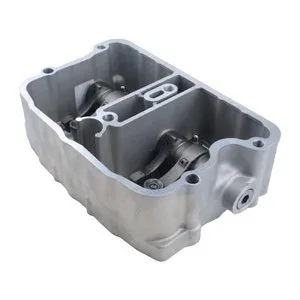
Engine Sequence Variants Verified — Rocker arm assemblies cross-checked against Cummins NT855, N14, and John Deere 8.1L build records before dispatch.
Technical Specifications
| Parameter |
Value |
| Part Number |
3052170 3047479 |
| Cross-Reference |
3052170, 3052170rx, 3047479 (reference only) |
| Product Type |
Rocker Arm |
| Machine Fitment |
NT855, N14, NH855, G855, NTA855A, CM558, 6810, 6910 |
| Brand Compatibility |
Cummins, John Deere |
| Material |
Forged 42CrMo alloy steel |
| Surface Treatment |
Phosphated finish |
| Assembly State |
Assembly |
| Condition |
New Aftermarket |
| Warranty |
6 months against manufacturing defects |
| MOQ |
1 piece |
| Standards |
ISO 9001, SAE J2412 |
Application Suitability
| Engine System |
Related Components |
| Valve Train — Cummins 855 / N14 |
Pushrods, valve bridges, pivot bushings, camshaft lobes |
| Valve Train — John Deere 8.1L (6810 / 6910) |
Pushrods, valve stem caps, rocker shaft assemblies |
| Top-End Overhaul |
Complete valve train kit, cylinder head gasket set, valve cover gaskets |
| Single-Cylinder Head Repair |
Matched rocker arm set per head, pushrod set, valve lash adjustment tools |
Why Rocker Arm Geometry Drives the Entire Engine Rebuild Outcome
A rocker arm assembly is not a standalone replacement — it is one link in a valve train chain where every adjacent surface must match.
When an NT855 comes in with bent valves or fractured pushrods, the failed rocker arm is often the symptom, not the cause. The fault usually traces back to lubrication starvation at the pivot bore, a worn camshaft lobe sending irregular lift profiles upstream, or a previous rebuild that mixed rocker arm variants across cylinders. I have opened N14 engines in Chilean mining camps where the prior shop installed rocker arms from a different engine serial sequence — the pivot bore diameter was close enough to mount, but the valve lash could never be brought into specification, and the engine tore itself apart within a few hundred hours. [NEED_CITE: Cummins 855 and N14 valve train serial variant differences]
These engines do not forgive geometry errors in the valve train. The rocker arm assembly must maintain consistent lift ratio and contact pattern against the valve stem across thousands of thermal cycles.

Valve Train System Context — What This Part Actually Controls
The rocker arm assembly transfers motion from the camshaft throug*ins 855-family and N14 engines, the rocker arm pivot point, the pushrod socket radius, and the valve stem contact pad all operate as a matched system. Replacing the rocker arm without inspecting the pushrods for straightness and the valve bridges for wear invites repeat failure within the first service interval. A rocker arm assembly installed onto a scored pushrod will develop uneven contact within hours, accelerating wear on the new component and drifting the valve lash out of tolerance.
Engine Serial Variants — Why the Same Base Model Needs Different Rocker Arms
Within the NT855, N14, and NTA855A families, engine serial numbers determine which rocker arm configuration left the factory. Differences appear in pivot bore diameter, rocker arm ratio, and pushrod socket geometry. An NTA855A used in mining haul trucks may carry a different rocker arm profile than an NT855 in a John Deere 6810 tractor, even though both share the 855 cubic inch displacement lineage. Ordering by machine model alone — without confirming the engine serial — is how wrong variants ship. [NEED_CITE: engine serial number identification methods for Cummins and John Deere heavy-duty platforms]
We verify the correct rocker arm assembly variant against the engine build record, not against copied cross-reference tables.
Forged 42CrMo Construction and Surface Hardness Control
The rocker arm is forged from 42CrMo alloy steel, a chromium-molybdenum grade selected for its fatigue strength under the repeated impact loading that valve train components endure. The phosphated surface finish provides a break-in compatible surface that retains oil film during the critical first hours of operation. Surface hardness is controlled within a range appropriate for valve train service, maintaining dimensional stability at the pivot bore and the valve stem contact pad. The pivot bore tolerance is held tightly so the rocker arm seats correctly on the shaft without side play that would alter valve timing under load.
The Hidden Cost of Skipping Root-Cause Diagnosis
Replacing the rocker arm without tracing why the previous set failed means the new assembly faces the same destructive condition. If a blocked oil gallery starved the pivot bore, the new rocker arm will score and seize on the same schedule. If a worn camshaft lobe is producing erratic lift, the new pushrod socket will pit and spall prematurely. Every valve train failure we investigate in the field follows this pattern: the failed component is replaced, the system fault remains, and the rebuild is repeated at double the cost. [NEED_CITE: valve train failure root cause analysis in heavy-duty diesel engines]
Why Source This Rocker Arm Assembly Through Our Engine Systems Channel
Our own production lines and qualified sourced supply operate under one warranty and one quality standard, so a rocker arm assembly carries the same terms whether produced in-house or sourced. Eight product categories mean the complete valve train kit — rockers, pushrods, valve bridges, gaskets — ships as one consignment under one commercial invoice. Orders start from one piece, which matters when a single cylinder head needs attention, not a full fleet overhaul. Part identification works from an engine serial number, a photograph of the nameplate, or an image of the old rocker arm. Our technical team confirms the correct serial variant before the order is packed, and a quality inspection record covering dimensional conformity accompanies each shipment.
Documentation & Verification
- Commercial invoice and packing list itemizing each rocker arm assembly and associated valve train parts
- Part compatibility and cross-reference sheet for 3052170, 3052170rx, 3047479 marked as reference only
- Dimensional and hardness inspection record included with every shipment
- Warranty terms covering manufacturing defects for six months from delivery
- Packing photographs taken before crate closure for condition verification
- HS code and customs documentation support for international engine parts shipments
Installation & Rebuild Sequence
- Clean the rocker shaft and all oil galleries before fitting the new rocker arm assembly to prevent pivot bore scoring
- Verify pushrod straightness and valve bridge condition — replace any component showing contact fatigue
- Torque rocker shaft mounting bolts to engine service manual specification in the correct sequence
- Set valve lash cold to the specified clearance, then recheck after the first thermal cycle
- Run the engine at idle for the initial break-in period while monitoring valve train noise
- Re-inspect valve lash after the first fifty hours of operation to confirm stability
Requesting a Quotation for Your Engine Rebuild
Provide the engine model, engine serial number, and any previous rebuild history so we can confirm the correct rocker arm assembly variant and matching valve train components. If the engine nameplate is unreadable, a photograph of the existing rocker arm and the cylinder head casting number is sufficient for identification. Tell us whether this is a single head repair or a complete overhaul so we can assemble the matched kit accordingly.
Frequently Asked Questions
Q: What other valve train components should be replaced alongside the rocker arms during an overhaul?
A: Pushrods should be checked for straightness and replaced if any bending or end-cap wear is found. Valve bridges, pivot bushings, and the rocker shaft itself should be inspected for scoring. Replacing the rocker arm assembly onto worn pushrods or a scored shaft will cause early failure of the new components and make valve lash adjustment impossible to hold.
Q: My engine is an NTA855A — does it use the same rocker arm as a standard NT855?
A: Not necessarily. The NTA855A may carry a different rocker arm configuration depending on the engine serial number and production run. Pivot bore diameter and rocker ratio can differ between these variants. Provide the engine serial number so we can confirm the correct rocker arm assembly against the build record before shipping.
Q: Does the overhaul gasket kit include the valve cover gaskets needed for this job?
A: Overhaul kits vary in contents depending on the specific kit configuration and engine build. Some kits include valve cover gaskets while others do not. When you provide the engine serial number, we verify which gaskets your build requires and include them in the consolidated parts list so nothing is missing when the engine is on the stand.
Q: How can I confirm the correct rocker arm when my engine nameplate is worn or painted over?
A: Send a photograph of the existing rocker arm alongside any readable casting numbers on the cylinder head or block. The engine serial number may also be stamped in a secondary location on the block. We cross-reference these details against the build record to identify the correct rocker arm assembly variant without relying solely on the nameplate.
Q: Can I order a complete valve train set — rockers, pushrods, and crossheads — under a single parts list?
A: Yes. Provide the engine model and serial number, and we compile the full matched valve train kit including the rocker arm assembly, pushrods, valve bridges, and any associated hardware. Everything ships as one consignment with a single compatibility sheet and quality inspection record, eliminating split deliveries and mismatched lead times.