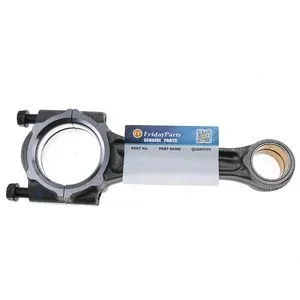
Matched Sets Shipped Together — Rods, bearings, and piston sets verified against your V2607's rebuild history before dispatch.
Technical Specifications
| Parameter |
Value |
| Part Number |
1J700-22012 |
| Product Type |
Connecting Rod |
| Cross-Reference |
1J70022012 (reference only) |
| Machine Fitment |
KX057-4, KX057-5, U55, U55-4, U55-5, SVL65-2, SVL65-2C, SSV65, SSV65C, SSV65P, SSV65PC, R530, R540, R630, R640 |
| Engine Compatibility |
Kubota V2607 / V2607T |
| Material |
Forged 40Cr steel |
| Surface Treatment |
Shot-peened |
| Surface Hardness |
HRC 28–32 |
| Dimensional Tolerance |
±0.01 mm |
| Certification |
ISO 9001 |
| Warranty |
3–12 months against manufacturing defects |
| MOQ |
1 piece |
Application Suitability
| Engine System |
Related Components |
| Block and rotating assembly |
Main bearings, con rod bearings, crankshaft |
| Piston and cylinder group |
Piston rings, cylinder liners, wrist pins |
| Lubrication circuit |
Oil pump, oil filter, gallery jets |
| Gasket and sealing system |
Full overhaul gasket set, crankcase seals |
Why Overhaul Kits Often Fail the Rebuild Bench
A connecting rod for Kubota V2607 engine rebuild projects is only as reliable as the clearance grades and matched components surrounding it. The failure usually isn't the rod — it's the mismatched bearing shell or unverified crankshaft journal condition.
I have seen Kubota V2607 engines come back to the bench within weeks because the rebuild kit contained standard-grade bearings while the crankshaft had already been ground to an undersize during a previous overhaul. The oil pressure dropped, the big-end knocked, and the entire lower end had to be torn down again. In African mining camps where a second teardown means weeks of lost production, this kind of mismatch is unacceptable [NEED_CITE: engine rebuild clearance verification procedures for industrial diesel]. Shops that skip the journal measurement step end up paying for it twice.

The Rod Inside the V2607 Lower Assembly
This connecting rod sits at the heart of the Kubota V2607 reciprocating assembly. It transfers combustion force from the piston to the crankshaft journal, and its big-end bore must match the installed bearing shell grade precisely. When sourcing a connecting rod for Kubota V2607 engine rebuild work, the rod cannot be treated as an isolated line item — it functions as part of a dimensionally matched set that includes the crankshaft, bearings, and piston assembly.
Rebuild History Dictates What You Actually Need
Every V2607 that has been through a prior overhaul may carry reground journals or oversize bores. If the crankshaft was machined to 0.25 mm undersize at the last rebuild, ordering standard bearings with a new rod will produce excessive clearance and rapid bearing failure. Before confirming any order, the crankshaft journal diameter must be measured and the correct bearing grade selected — STD, 0.25, or 0.50 undersize — so the connecting rod for Kubota V2607 engine rebuild work arrives with a matching set [NEED_CITE: crankshaft journal undersize grading standards for diesel engines]. Engine serial variants between V2607 and V2607T can also shift internal component specifications across production runs.
Reading the Specifications for Field Performance
The 40Cr forged steel construction provides a balanced combination of tensile strength and fatigue resistance required for the cyclic loading in a four-cylinder diesel. Shot-peening introduces compressive residual stress on the rod surface, which retards crack initiation at the highly stressed big-end transition radius. The HRC 28–32 surface hardness range keeps the rod durable without making it brittle enough to fracture under detonation loads. The ±0.01 mm dimensional tolerance on the big-end and small-end bores ensures that bearing crush and wrist pin fit remain within the engine builder's specification, avoiding the oil film breakdown that causes premature shell failure.
The Cost of Skipping Root-Cause Analysis
A rod that failed from lubrication starvation will fail again if the oil gallery blockage or pump wear is not corrected during reassembly. Shops that swap the broken connecting rod without tracing the failure back to its system origin — contaminated oil, blocked spray jet, or failed bearing shell — often see the replacement rod suffer the same fate. This pattern of repeat failure is common in heavy-duty cycle equipment like the SVL65 and SSV65 series, where thermal and load stresses are continuous [NEED_CITE: diesel engine connecting rod failure root cause analysis]. Mismatched bearing grades compound the problem, turning what should be a single-system repair into a full teardown.
Why Engine Rebuild Shops Source This Way
Our own production lines and qualified sourced supply carry the same QC and warranty terms, so a matched rod-and-bearing set arrives under one accountability. Eight categories of engine system components mean the overhaul kit — rods, pistons, bearings, gaskets — ships as one consignment rather than split across multiple vendors. Minimum order is one piece, which matters when a single rod has failed and the rest of the lower end is still serviceable. Cross-reference verification covers superseded and alternate numbers, catching the variant differences that copied tables miss. The technical team confirms bearing grade and piston oversize compatibility against your engine serial before anything ships, preventing the bench返工 that erodes shop margins.
Documentation & Verification
- Commercial invoice listing each rod, bearing grade, and piston set by engine serial variant
- Cross-reference sheet marking 1J70022012 as interchange reference only
- Bore roundness and dimensional inspection record included per piece
- Warranty terms covering material and manufacturing defects for 3–12 months
- Packing photographs showing matched sets grouped by cylinder number
Installation & Rebuild Sequence
- Measure crankshaft journal diameter before selecting bearing grade for the new connecting rod
- Verify big-end bore roundness against ±0.01 mm tolerance prior to assembly
- Assemble piston-to-rod with correct wrist pin orientation marked on the forged 40Cr body
- Torque rod bolts to specification and confirm bearing oil clearance with plastigauge
- Prime lubrication galleries before first crank to prevent dry-start bearing damage
- Run initial break-in under graduated load to seat bearing shells against the journal
Before You Request a Quote
Provide the engine model, serial number, and any known rebuild history — including whether the crankshaft has been reground and to what undersize grade. If the nameplate is worn, a photograph of the existing rod stamping or the block casting number allows our technical team to confirm variant compatibility. For shops planning a complete overhaul, share the full component list so matched piston sets, bearing grades, and gasket contents can be verified as one package.
Frequently Asked Questions
Q: What does a complete V2607 overhaul kit include, and does it cover my engine sequence variant?
A: A full kit typically covers gaskets, piston rings, main and con rod bearings, and seals. However, content varies by engine serial and production run. We verify your specific V2607 or V2607T variant before assembling the kit, confirming that bearing grades and piston sizes match your engine's current internal dimensions rather than shipping a generic set.
Q: My crankshaft was reground at the last rebuild — which bearing grade do I need with this rod?
A: The correct grade depends on the measured journal diameter after grinding. Common undersize grades are 0.25 mm and 0.50 mm. Provide the crankshaft measurement or the stamping from the old bearing shell, and we will match the connecting rod bearing set to the exact clearance grade your engine requires.
Q: Are V2607 and V2607T connecting rods interchangeable, or are there internal differences?
A: While the base part number may appear identical, turbocharged variants can carry differences in piston cooling, oil jet configuration, or bearing specification. We confirm compatibility against your engine serial number rather than assuming interchangeability, preventing the fitment errors that cause early failures.
Q: How do I identify my Kubota engine variant when the nameplate is unreadable?
A: Send a photograph of the existing connecting rod stamping, the block casting number, or any legible identification on the engine. Our technical team cross-references these against production records to confirm the exact variant and the correct internal component specifications for your rebuild.