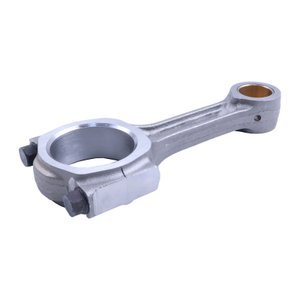
System-Matched Reciprocating Assembly — This STD connecting rod ships with verified dimensional records confirming crankshaft journal grade, ensuring the overhaul kit matches the actual engine build variant before teardown begins.
Technical Specifications
| Parameter |
Value |
| Product Type |
Connecting Rod |
| Machine Fitment |
Komatsu 3D82, 3D82AE, Yanmar 3TN82E, 3TNV82A, 3TNE82 |
| Oversize Grade |
STD |
| Material |
Forged SAE 4340 alloy steel |
| Small-End Bushing Material |
Sintered bronze |
| Surface Treatment |
Shot peening, phosphate coating with rust-inhibiting oil |
| Assembly State |
New aftermarket |
| Warranty |
6 months against manufacturing defects |
| Minimum Order Quantity |
1 piece |
Application Suitability
| Engine System |
Related Components |
| Reciprocating Assembly |
Piston, piston pin, piston rings, cylinder liner |
| Lubrication System |
Con rod bearing shells, main bearings, oil pump, oil filter |
| Cylinder Block & Head |
Head gasket, block heater, core plugs, valve stem seals |
| Engine Overhaul Kit |
Full gasket set, seal kit, thrust washers, freeze plugs |
When a Rebuild Fails Before the Engine Leaves the Bench
The wrong connecting rod grade invalidates an entire overhaul, regardless of how perfectly every other component was selected.
In desert workshop conditions, I have watched engines come back apart within weeks because the crankshaft had been reground to an undersize on a previous repair, yet standard-size bearing shells were installed on standard-size connecting rods. The oil film collapses under load, and the big end seizes [NEED_CITE: engine bearing failure modes related to clearance mismatch]. This STD connecting rod is engineered for engines where the crankshaft journals remain at factory standard diameter. If the crankshaft in your Komatsu 3D82 or Yanmar 3TN82E has been machined to 0.25 or 0.50 undersize, a standard rod will produce excessive bearing clearance from the first revolution. Confirming journal condition before ordering prevents the most expensive mistake in any reciprocating assembly rebuild.

The Reciprocating Assembly as a Matched System
A connecting rod does not function in isolation. It sits at the center of a reciprocating mass that includes the piston, piston pin, and bearing shells, all of which must share compatible dimensional grades. When sourcing a STD connecting rod engine rebuild replacement, the entire rotating and reciprocating assembly must be balanced against the crankshaft's actual measured condition. An engine rebuild shop quoting a full overhaul for a 3TNV82A must verify whether the block has seen prior sleeving, whether the crankshaft has been reground, and whether the piston pin bore in the small-end bushing matches the replacement piston. Any mismatch forces the technician to source a second set of components mid-rebuild, adding days of machine downtime.
Crankshaft History and the Grade Trap
Many compact excavators and portable compressors running the Yanmar 3TNE82 have been through at least one prior overhaul before arriving on the bench for the next rebuild. During that earlier repair, the crankshaft may have been ground to remove scoring, shifting the required bearing grade from STD to 0.25 or 0.50 undersize [NEED_CITE: crankshaft regrind practice in industrial diesel engine service]. Ordering a standard connecting rod without pulling the crankshaft and measuring the journals means building the engine on an assumption. The correct practice is to mic every journal before the parts order goes in. This STD grade rod is specified for journals that measure within the factory standard tolerance band. Our technical team reviews crankshaft condition reports and engine serial numbers to confirm the grade before dispatch, preventing the mismatch that sends a freshly assembled block back to the stand.
Reading the Specifications That Matter on the Bench
The forged SAE 4340 alloy steel body provides the tensile strength needed to handle the cyclic inertia loads of a three-cylinder diesel operating at governed speed. Shot peening introduces compressive residual stress across the rod beam surface, which retards fatigue crack initiation at the transition radii between the shank and the big-end cap. The phosphate coating with rust-inhibiting oil protects the machined surfaces during storage and shipping, but more importantly, it provides a controlled surface finish that aids initial lubrication during the critical first minutes of engine break-in. The sintered bronze small-end bushing is supplied with an interference fit to the rod bore, preventing rotation under the oscillating loads transmitted through the piston pin. This bushing must be line-bored or honed to match the specific piston pin diameter of the replacement piston set, a step that requires the correct tooling on the shop floor.
The Hidden Cost of Skipping Root-Cause Inspection
A connecting rod rarely fails on its own. The failure almost always traces back to a fault elsewhere in the engine system: a blocked oil gallery starving the big-end bearing, a failed oil pump reducing system pressure, or incorrect bearing clearance from a previous rebuild generating excess heat [NEED_CITE: lubrication system fault diagnosis in small diesel engines]. Installing a new STD connecting rod engine rebuild replacement without tracing and correcting the root cause means the new component enters service under the same conditions that destroyed its predecessor. I have seen rods returned with spun bearings after fewer than fifty hours because the oil pickup screen was still partially blocked from the original failure event. A full system inspection, including oil pump flow verification and gallery flushing, is the only way to protect the investment in new reciprocating components.
Why Source This Rod Through XUNPO
Our own production lines and qualified sourced supply operate under a single warranty and quality standard, so a connecting rod ordered alongside a full gasket set and bearing kit arrives with consistent documentation across all items. Eight product categories under one account mean the complete reciprocating assembly, lubrication components, and seal kits ship as a single consignment from our Guangzhou warehouse, eliminating the split deliveries that delay a rebuild. We accept orders from one piece, so a workshop pulling a single rod from a damaged 3D82AE can order just what the job requires without meeting a bulk threshold. Part identification is confirmed from the engine model, serial number, or a photograph of the existing component and its nameplate. Our cross-reference verification covers superseded part numbers and alternate references (for identification purposes), catching errors that copied tables carry forward between sellers. Before committing to a bulk fleet order, sample supply allows physical fitment confirmation on the bench.
Documentation & Verification
- Commercial invoice listing engine model, rod grade, and quantity per consignment
- Compatibility sheet confirming 3D82, 3TN82E, and related serial variants (reference only)
- Dimensional inspection record covering big-end bore roundness and small-end bushing fit
- Six-month warranty terms covering material and workmanship defects
- Packing photographs showing phosphate-coated rods secured against transit damage
- HS code and customs documentation prepared for international engine parts clearance
Installation & Rebuild Sequence
- Verify crankshaft journal diameter with a micrometer before unwrapping the new STD connecting rod
- Match the sintered bronze bushing bore to the replacement piston pin using a pin gauge
- Assemble rod and cap in the original orientation marked during teardown to preserve bore alignment
- Torque rod bolts to the engine manufacturer specification in the prescribed sequence
- Check big-end side clearance with a feeler gauge after fitting to the crankshaft
- Prime the lubrication system and verify oil pressure at idle before applying load during break-in
Getting the Right Grade for Your Engine Build
Provide the engine model, serial number, and any available crankshaft measurement data or prior overhaul records. Our technical team will cross-check the journal grade, confirm bushing compatibility with your piston set, and verify that this STD connecting rod engine rebuild replacement matches the specific build variant of your Komatsu or Yanmar power unit. Accurate information at the inquiry stage prevents the grade mismatch that forces a second teardown.
Frequently Asked Questions
Q: What grade connecting rod do I need if the crankshaft has been reground?
A: If the crankshaft journals have been machined to an undersize during a previous overhaul, you need a connecting rod matched to that undersize grade, typically 0.25 or 0.50. A STD rod is only correct if the journals remain at factory standard diameter. Always measure the crankshaft before ordering to confirm the actual grade required for your specific engine build.
Q: Does this connecting rod come with the small-end bushing installed?
A: Yes, this rod is supplied with the sintered bronze small-end bushing already fitted with an interference fit to the rod bore. The bushing will typically need to be honed or line-bored to match the exact diameter of your replacement piston pin during the assembly process, ensuring correct oil clearance at the small end.
Q: Are connecting rod bolts included with the rod assembly?
A: Connecting rod bolts are included with each rod assembly as a matched set. These bolts are torqued specifically to the rod they ship with and should not be interchanged between rods or reused from a previous service life. Always replace the bolts with the new rod to maintain the integrity of the big-end clamping force.
Q: How do I confirm which engine serial variant this rod fits?
A: Provide your engine model and serial number when inquiring. Internal differences between variants of the 3D82, 3TN82E, and related engines can include bushing bore diameter and bolt pattern. We cross-reference your serial number against the application data to confirm this STD connecting rod engine rebuild replacement is dimensionally correct for your specific build before shipping.
Q: What other components should be replaced alongside a connecting rod during a rebuild?
A: A connecting rod repair should be accompanied by replacement of the con rod bearing shells, piston, piston pin, piston rings, and the full engine gasket set. The oil pump, oil filter, and cylinder liner should also be inspected and replaced if wear limits are exceeded, ensuring the root cause of the original failure is addressed within the same overhaul.