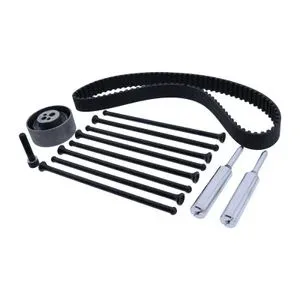
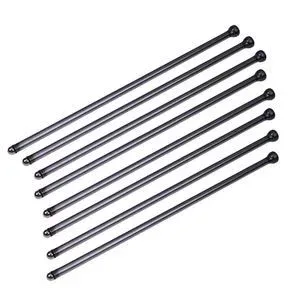
Matched Rebuild Sets — Timing belt, push rods, and pins shipped together so Deutz 1011 valve timing stays synchronized from the first crank.
Technical Specifications
| Parameter |
Value |
| Product Type |
Timing Kit |
| Cross-Reference |
02929933, 02109085, 100700, 02937741, 2937741, 04270987, 6670555, 6666715 (reference only) |
| Machine Fitment |
Deutz 1011, 1011F; Bobcat 863, 863G, 864, 864G, 873, 873G, 883, T200, S250, A220, A300 |
| Engine Model Coverage |
F2L1011, F3L1011, F4L1011, F2M1011, F3M1011, F4M1011, BF4L1011, F-suffix and M-suffix variants |
| Kit Contents |
Timing Belt, Push Rods, Timing Pin Set |
| Belt Material |
Aramid-reinforced HNBR rubber |
| Push Rod Material |
C45 steel |
| Timing Pin Material |
Case-hardened alloy steel |
| Condition |
New Aftermarket |
| Standard |
ISO 9001 |
| Warranty |
3–12 months against manufacturing defects |
Application Suitability
| Engine System |
Related Components |
| Valve Train Actuation |
Rocker arms, valve stems, cam followers |
| Crank-to-Cam Synchronization |
Tensioner pulley, idler gear, front crank seal |
| Cylinder Head Assembly |
Head gasket set, head bolts, valve cover gasket |
| Fuel Injection Timing |
Injection pump drive coupling, delivery valve seals |
| Cooling and Lubrication |
Water pump, oil pump drive gear |
The Hidden Cost of Mixing Suppliers on a 1011 Overhaul
A Deutz 1011 timing belt kit with push rods engine rebuild demands that every dimension match — belt tooth profile, push rod length, and pin diameter must all align to the same factory specification. When these three elements arrive from different sources, even minor tolerance stacking can throw valve timing off by a fraction of a degree.
In the field, I watched a skid steer go back down forty-eight hours after a supposedly complete top-end overhaul. The mechanic had sourced the belt locally and the push rods from another vendor. The Deutz 1011 timing belt kit with push rods engine rebuild looked fine on paper, but the push rods were slightly longer — just enough to alter valve lash across all cylinders. [NEED_CITE: tolerance stacking effects on overhead valve timing accuracy in air-cooled diesels]
The machine had to be torn down again, wasting gaskets, sealant, and two full days of shop time. That single mistake cost more than the entire kit would have.

Valve Train Geometry and the 1011 Family
The Deutz 1011 series uses an overhead valve arrangement driven by a timing belt rather than gears or chains. This design keeps the upper end quiet and lightweight, but it also means the belt, push rods, and alignment pins form one continuous kinematic chain. Any deviation in push rod length changes the effective rocker ratio, which shifts valve opening and closing events relative to piston position. Supplying all three elements as a single Deutz 1011 timing belt kit with push rods engine rebuild set ensures the geometry stays within design limits from the moment the cylinder head goes back on.
Serial Variants and Why One Number Is Not Enough
The 1011 family spans naturally aspirated F2L, F3L, F4L variants and turbocharged BF4L versions, each with distinct push rod lengths and belt routing. The F-suffix and M-suffix designations further differentiate industrial and mobile configurations. A push rod set cut for an F3L1011F will physically thread into an F4L1011, but the valve events will be wrong. Our cross-reference verification covers every variant in the 1011 lineup so the correct Deutz 1011 timing belt kit with push rods engine rebuild reaches your bench. [NEED_CITE: Deutz 1011 engine serial variant identification and push rod length differences]
Reading the Material Choices
The aramid-reinforced HNBR belt handles the high under-hood temperatures common in skid steer engine bays where airflow is restricted. C45 steel push rods resist the compressive buckling loads imposed by stiff valve springs at governed RPM. Case-hardened timing pins maintain diameter tolerance so the cam and crank lock precisely during belt installation. Each material is chosen for the specific stress it faces inside a 1011, not borrowed from a generic catalog.
When a Rebuild Fails the Second Time
Mismatched push rod lengths cause uneven valve seating, which leads to burnt exhaust valves within the first hundred hours. A belt with the wrong tooth profile can skip under load, bending push rods and potentially contacting pistons. These failures are rarely blamed on the kit — the shop assumes the mechanic made an error. In reality, the root cause was a set of components that never belonged together. [NEED_CITE: common causes of repeat valve train failure after diesel engine overhaul]
Why Rebuild Shops Source the Whole Set Here
We produce selected lines in our own facility and source the remainder from qualified ISO-certified partners, so every component in this kit carries the same quality control and warranty terms. The eight categories in our catalog mean tensioners, gasket sets, and front seals ship under one account. Minimum order starts at a single kit, so you can verify fitment on one machine before committing to a fleet order. Our technical team confirms engine serial variants and push rod lengths against your nameplate photograph before dispatch.
Documentation & Verification
- Commercial invoice listing kit contents with line-item part references
- Compatibility sheet mapping 02929933 cross-reference to your specific 1011 variant
- Dimensional inspection record for push rod length and pin diameter
- Warranty terms covering manufacturing defects for 3–12 months
- Packing photographs showing sealed belt packaging and foam protection
Installation & Rebuild Sequence
- Lock crankshaft and camshaft with included timing pins before removing old belt
- Verify new push rod length against removed originals cylinder by cylinder
- Install belt with marked side facing outward, then set tensioner to spec
- Rotate crankshaft two full revolutions by hand and re-check pin alignment
- Run engine at idle for initial break-in and re-torque rocker adjusters
Requesting the Right Kit for Your Engine
Provide your exact engine model and serial number from the nameplate — for example, BF4L1011F rather than just "1011." If the plate is worn, send a photograph of the block casting marks and any remaining stampings. Share the overhaul history if the engine has been rebuilt before, as previous machining may affect push rod grade selection. We will confirm variant coverage and kit contents before you commit.
Frequently Asked Questions
Q: What components does this kit include beyond a standard belt-only replacement?
A: This set contains the timing belt, a full set of push rods, and a timing pin set for crank and cam locking. A belt-only kit omits the push rods and pins, which are often the hidden cause of valve timing drift. Replacing all three together ensures the entire valve train returns to factory geometry.
Q: Does the same kit fit both naturally aspirated and turbocharged 1011 variants?
A: No. The F-series naturally aspirated engines and BF-series turbocharged engines use different push rod lengths. The M-series mobile variants also differ from the L-series industrial units. Provide your full engine designation so we supply the correct variant-specific set.
Q: Should I replace the belt tensioner at the same time?
A: Yes. A worn tensioner cannot maintain correct belt deflection, which accelerates tooth wear on the new belt. We carry matching tensioners in our catalog and can add one to your shipment so everything arrives together.
Q: How do I identify my exact Deutz engine model from the nameplate?
A: Look for a format such as F3L1011F or BF4M1011F stamped on the metal plate riveted to the valve cover or block. The letter prefix and any suffix indicate aspiration type, cylinder count, and application class. Send us a clear photograph if the stamping is faded.
Q: Can I order a single sample kit before placing a bulk purchase?
A: Yes. Single-kit orders are accepted so you can verify push rod length, belt tooth count, and pin fitment on one engine before ordering for a fleet. This eliminates the risk of stocking incorrect sets across multiple machine variants.