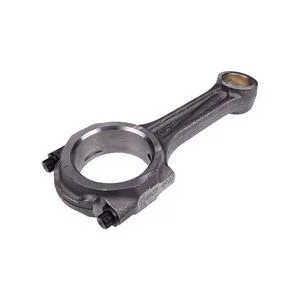
Matched Tolerances Shipped — every connecting rod leaves our Guangzhou facility with big-end and small-end bore data matched to the piston and bearing set for your specific Cummins B3.3 or QSB3.3 engine serial number.
Technical Specifications
| Parameter |
Value |
| Part Number |
4956017 |
| Product Type |
Connecting Rod |
| Cross-Reference |
4956017 (reference only) |
| Machine Fitment |
Cummins B3.3, QSB3.3 |
| Material |
Forged steel |
| Bore Tolerance |
±0.002 mm (big-end and small-end) |
| Surface Treatment |
Shot peening; heat-treated surfaces at piston pin and crankshaft interfaces |
| Condition |
New Aftermarket |
| Quality Certification |
ISO Certified |
| Warranty |
3-12 months against manufacturing defects |
Application Suitability
| Engine System |
Related Components |
| Complete overhaul |
Piston assembly, piston rings, piston pin, connecting rod bearings, main bearings, full gasket set |
| Single-cylinder repair |
Individual connecting rod, matched bearing shell grade, piston pin bushing |
| Rebuild kit stocking |
Overhaul kit with matched STD / 0.25 / 0.50 oversize components across all cylinders |
Why One Connecting Rod Can Sink an Entire Rebuild
A crankshaft ground to the first undersize and a standard-grade connecting rod bearing installed without checking the rebuild history — that mismatch is how a fresh overhaul fails before it reaches break-in. The connecting rod engine rebuild parts you order must match the exact size grade that the crankshaft journal currently demands.
I have seen repair shops in Indonesia pull apart a QSB3.3 only to discover the previous rebuild left the crankshaft at 0.25 undersize, while the new parts on the bench were all standard. The engine sat open for days waiting for the correct bearing shells. [NEED_CITE: Cummins B3.3 QSB3.3 crankshaft journal undersize grading conventions] When tolerance grades do not align across the piston, pin, rod bearing, and main bearing, you get oil clearance that is either too tight for proper film formation or too loose to hold pressure under load.

The System This Connecting Rod Belongs To
The connecting rod sits at the center of the reciprocating assembly, transferring combustion force to the crankshaft while the small-end bore and piston pin carry the lateral loads from piston motion. In a Cummins B3.3 or QSB3.3 engine, the connecting rod engine rebuild parts must be evaluated as a matched set — piston weight class, pin diameter, and bearing shell grade all converge at this single component. Supplying the rod without confirming the adjacent pieces is how tolerance stacks drift out of specification.
Size Grades, Rebuild History, and Serial Variants
Engines that have been through one or more prior overhauls often carry undersize crankshaft journals, meaning the connecting rod bearings must match whatever grade the machinist left behind — STD, 0.25, or 0.50. [NEED_CITE: engine rebuild undersize bearing selection practice for industrial diesel engines] Different production runs of the QSB3.3 also introduced internal part variations that are not visible from the outside. Providing the engine serial number allows us to confirm whether your block requires the standard variant or one of the serial-specific alternatives, preventing a situation where the part number is technically correct but the physical dimensions do not match the build on your bench.
Reading the Specifications That Matter in the Field
The ±0.002 mm bore tolerance on both big-end and small-end directly controls the oil film thickness between the bearing shell and the crankshaft journal. If the big-end bore runs wide, the bearing crush height drops and the shell can spin under load; if it runs tight, the assembled clearance chokes the oil supply during cold starts. Forged steel construction provides the fatigue strength needed to survive the tensile reversal that occurs every exhaust stroke, while shot peening introduces compressive residual stress on the surface to resist crack initiation at the bolt hole and I-beam transition radius. Heat treatment at the piston pin and crankshaft interfaces hardens the contact zones where fretting wear concentrates over thousands of hours.
What Happens When the Grade Is Wrong
Installing a standard-size connecting rod bearing on a crankshaft journal that has already been ground undersize produces excessive clearance from the first revolution. The result is low oil pressure at the rod journal, accelerated bearing wear, and eventual spin or seizure — often blamed on the bearing rather than the mismatch. [NEED_CITE: connecting rod bearing failure root cause analysis in medium-duty diesel engines] The engine comes apart again, the crankshaft may need another cut, and the cost of the second teardown dwarfs whatever was saved by not checking the rebuild history in the first place.
Why Buyers Source This Rod Through Our Account
Our own production lines and qualified partner facilities both operate under the same ISO-certified quality system, so the connecting rod engine rebuild parts you receive carry identical inspection standards regardless of origin. Eight product categories — from gasket sets to complete engine auxiliary components — ship under one account with one warranty, meaning an entire overhaul list consolidates into a single dispatch from our Guangzhou warehouse. Minimum order starts at one piece, so a single emergency rod does not force you into buying a full set. Part identification works from the part number, the machine model, a photograph of the nameplate, or an image of the old component. Cross-reference verification covers superseded numbers and serial-specific variants, and sample supply is available for fitment confirmation before you commit to bulk quantities.
Documentation & Verification
- Commercial invoice and packing list itemizing each connecting rod with bore measurement data
- Compatibility and cross-reference sheet marking 4956017 as reference only alongside verified serial variants
- Dimensional inspection record showing big-end and small-end bore readings for every rod shipped
- Warranty terms covering manufacturing defects for 3-12 months under stated operating conditions
- Packing photographs documenting rod protection and crate condition before the container closes
- HS code and customs documentation support for destination-country import clearance
Installation & Rebuild Sequence
- Clean all oil passages in the connecting rod before assembly to prevent debris from scoring the new bearing shell
- Verify crankshaft journal size grade with a micrometer and select bearing shells that match the measured dimension
- Check cap-to-rod alignment marks and torque the big-end fasteners in the specified sequence to achieve correct crush height
- Confirm piston pin fit in the small-end bushing by hand — forced assembly indicates a tolerance mismatch that must be resolved before the engine runs
- After assembly, rotate the crankshaft by hand to detect binding before installing the cylinder head
Sending the Right Information With Your Inquiry
To confirm the correct connecting rod and matched components for your Cummins B3.3 or QSB3.3, share the engine serial number and any known rebuild history — particularly whether the crankshaft has been ground to an undersize grade. If the nameplate is worn, a photograph of the block casting number or the old rod stamping lets us cross-reference the variant. This information ensures the parts on your bench form a matched set from piston to bearing.
Frequently Asked Questions
Q: Does the overhaul kit include the connecting rod or is it sold separately?
A: The standard overhaul kit covers pistons, rings, pins, bearings, and gaskets. The connecting rod is typically supplied as a separate line item so you can specify the exact quantity and grade needed. We can bundle the rod with the full kit under one part list when you confirm the engine serial number and rebuild status.
Q: The crankshaft has been ground to 0.25 undersize — which bearing grade do I need with this rod?
A: You need 0.25 undersize connecting rod bearings to match the ground journal diameter. The rod itself remains the same part number; only the bearing shell thickness changes. Share the measured journal dimension so we can confirm whether 0.25 is the correct grade or if the shaft has been cut further.
Q: Do different QSB3.3 serial numbers use different connecting rod part numbers?
A: Some production runs introduced internal variations that affect the small-end bushing diameter and bolt specification. The external part number may appear identical while the internal dimensions differ. Providing your engine serial number allows us to verify the exact variant required for your block.
Q: One connecting rod is cracked — what other components should I inspect?
A: Check the crankshaft journal for scoring or heat discoloration, the adjacent main bearings for debris damage, and the piston pin for galling. A cracked rod often points to a lubrication failure or bearing spin that may have sent metal through the oil gallery, affecting other cylinders in the same engine.
Q: How do I confirm the engine model and serial number when the nameplate is gone?
A: Look for the casting number on the block near the oil filter housing or the stamping on the bell-housing flange. A photograph of either marking allows us to cross-reference the production range and identify the correct connecting rod variant for your specific engine build.