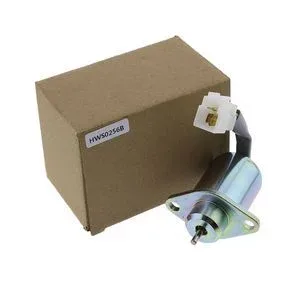
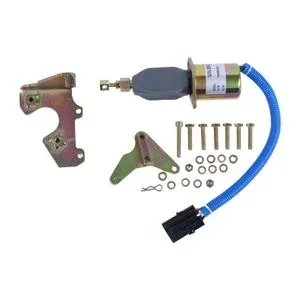
Engine serial variants verified — Each 17454-60010 stop solenoid is cross-checked against the specific Kubota 05 Series build revision before dispatch, preventing mismatched connector or plunger travel issues during recommissioning.
Technical Specifications
| Parameter |
Value |
| Part Number |
17454-60010 |
| Product Type |
Stop Solenoid |
| Cross-Reference |
16616-60010, 16616-60013, 16616-60015, 17594-60014, SA-4569-T, SA-4569T, SA4569T, 1503ES-12A5UC5S (reference only) |
| Machine Fitment |
Kubota D905, D1005, D1105, D1105-B-GENSET-2-S1, V1205, V1305, V1505, V1505T, B1700D, B1700E, B1700HSD, B1700HSE, B21, B2100D, B2100E, B2100HSD, B2100HSE, B2400D, B2400E, B2400HSD, B2400HSE, BX2200D, BX22D, F2260, F2560, F2560E, F3060 |
| Voltage |
12V |
| Condition |
New Aftermarket |
| Warranty |
3–12 months against manufacturing defects |
| Manufacturing Standard |
ISO-certified production partners |
Application Suitability
| Engine System |
Related Components |
| Fuel shutoff and safety shutdown |
Fuel pump linkage, wiring harness, ignition switch circuit |
| Electrical-to-fuel interface |
Glow plugs, engine sensors, charging system output |
| Engine overhaul recommissioning |
Overhaul gasket set, fuel filter, belt drive components |
| Generator set continuous duty |
Voltage regulator, control panel wiring, alternator connections |
Why a Physically Fitting Fuel Shutoff Solenoid Can Still Fail After Rebuild
Correct mounting pattern does not guarantee correct electrical behaviour under load.
I have seen rebuilt Kubota 05 Series engines pass bench tests only to exhibit intermittent shutdown failures once they are back under real working conditions. The solenoid bolts on, the plunger moves, but the pull-in voltage threshold or stroke length does not align with what the engine harness actually delivers. The result is a machine that runs fine at idle but refuses to cut fuel cleanly when the operator turns the key off — or worse, fails to shut down at all during an emergency. [NEED_CITE: diesel engine runaway prevention standards for industrial equipment]
This is not a solenoid defect in isolation. It is a system-level mismatch between the fuel shutoff solenoid engine rebuild component and the electrical architecture that commands it. During my years in the Yangtze Delta warehouse operation, I watched repair centres blame the new part, tear the fuel system apart again, and only then discover that the wiring harness had a voltage drop the old solenoid happened to tolerate but the new one would not. Separately sourcing pistons, liners, and rings in mismatched oversize grades causes the same category of avoidable rework — the individual parts are fine, but the system does not function as a matched set.
The Fuel Control System as an Integrated Circuit
A fuel shutoff solenoid engine rebuild replacement sits at the boundary between the electrical system and the fuel delivery system. Its job is binary: energise to allow fuel flow, de-energise to cut it. But the transition between those two states depends on coil resistance, plunger return spring force, and the voltage actually arriving at the connector — not the voltage printed on the alternator label. When a Kubota D905 or V1505T comes in for overhaul, the charging system output and wiring harness condition must be verified alongside the solenoid itself. Replacing the solenoid without checking the circuit that drives it is like fitting new piston rings into a bore you never measured.
Superseded Numbers and Connector Variants Across the 05 Series
The Kubota 05 Series shares a common solenoid mounting footprint across models from the D905 through the V1505T, which creates the false impression that any stop solenoid with the right bolt pattern will work. The superseded reference chain — from 16616-60010 through 17454-60010 to 17594-60014 — reflects design revisions in coil specification, connector type, and plunger geometry over successive production runs. A generator set variant like the D1105-B-GENSET-2-S1 may use a different wire gauge or connector housing than a tractor-mounted D1105 of the same era. Ordering without verifying the engine serial and harness configuration risks receiving a unit that bolts on but cannot communicate correctly with the existing loom. [NEED_CITE: Kubota 05 Series engine serial variant identification practices]
Voltage, Stroke, and Coil Resistance in Practice
The 12V rating of this stop solenoid defines its nominal operating voltage, but real-world behaviour depends on what the charging system delivers at the connector under load. A solenoid designed for a stable 12V supply may hesitate or chatter if the actual voltage at the terminal dips during cranking or spikes during load dump. Plunger stroke length determines whether the fuel rack moves fully between the run and stop positions — too short and the engine may not shut down cleanly, too long and the plunger can bind against the fuel pump linkage. Coil resistance must fall within a range that allows the ignition switch circuit to energise the solenoid reliably without drawing excessive current that accelerates contact wear in the switch itself. These parameters interact: a marginal voltage supply can be tolerated by a low-resistance coil but will expose a high-resistance one. That is why bench-testing coil resistance and stroke before dispatch matters more than visual inspection alone.

The Cost of Installing a Mismatched Solenoid After Overhaul
A stop solenoid that partially works — energising on the bench but failing to pull in consistently once the rebuilt engine is under vibration and thermal load — creates a diagnostic trap. The repair centre assumes the fuel pump is at fault, strips the injection system, replaces seals and delivery valves, and reassembles, only to find the shutdown problem persists. Each cycle of teardown and reassembly adds labour hours and risks disturbing correctly fitted components from the original overhaul. The root cause was never inside the fuel pump; it was a solenoid whose electrical characteristics did not match the harness it was connected to. [NEED_CITE: diesel engine diagnostic misattribution patterns in aftermarket rebuilds]
In my experience watching parts move through the warehouse and into repair bays, the most expensive failures are not the ones where the part is obviously wrong. They are the ones where the part is close enough to fit but wrong enough to cause intermittent faults that resist diagnosis. A matched fuel shutoff solenoid engine rebuild approach — where the solenoid, its connector, and the circuit it operates within are all verified against the same engine serial — eliminates this entire category of rework.
What We Verify Before This Solenoid Ships
Every unit is checked against the engine model and serial number you provide, not just the part number you searched for. Cross-reference verification covers the full superseded chain — 16616-60010, 16616-60013, 16616-60015, 17454-60010, 17594-60014, and the SA-4569-T family — so you receive the revision your harness expects. Coil resistance and plunger stroke are measured and recorded before dispatch, not assumed from batch sampling. Our own production lines and qualified sourced supply carry identical quality control and warranty terms under a single account, whether the solenoid is self-produced or sourced. The technical team confirms connector configuration and voltage compatibility against your specific engine build, and samples are available for fitment confirmation before you commit to a bulk order. We stock a broad range of engine electrical components so that matched sets — solenoids, sensors, glow plugs — can ship as one consignment with one warranty. [NEED_CITE: aftermarket engine electrical component testing protocols]
Documentation & Verification
- Commercial invoice listing each solenoid by engine serial and cross-reference number
- Compatibility sheet marking all OEM references as interchange reference only
- Coil resistance and plunger stroke measurement record included per unit
- Warranty terms covering electrical and mechanical failure modes explicitly
- Packing photographs showing connector protection and anti-corrosion wrapping
- HS code and customs classification support for cross-border shipment
Installation & Rebuild Sequence
- Verify wiring harness continuity and connector pin condition before fitting the new solenoid
- Clean the fuel pump mounting surface to prevent debris from interfering with plunger travel
- Confirm plunger stroke alignment with the fuel rack linkage before tightening mounting fasteners
- Torque electrical connections to specification to prevent resistance buildup under vibration
- Bench-test the complete shutoff circuit with the engine stationary before first cranking
- Run the engine through several start-stop cycles under no load before returning to service
Before You Request a Quote
Provide your engine model, serial number, and any known overhaul history so we can confirm the correct solenoid revision and connector type. If the nameplate is worn or painted over, a photograph of the existing solenoid and its connector is usually enough for our team to identify the right unit. For rebuild shops ordering for multiple engines, share the full engine list so we can verify each unit individually and consolidate the matched fuel shutoff solenoid engine rebuild components into one shipment.
Frequently Asked Questions
Q: What else in the fuel system should I inspect when replacing the stop solenoid?
A: Check the fuel pump mounting surface for wear, inspect the linkage for binding or excessive play, and verify the wiring harness connector for corrosion or loose pins. The charging system output at the solenoid terminal should be measured under cranking conditions, not just at idle, to confirm adequate voltage delivery during the most demanding electrical state.
Q: How do I know which superseded part number applies to my engine serial?
A: The superseded chain from 16616-60010 through 17454-60010 to 17594-60014 reflects design revisions across production runs. Provide your engine model and serial number, and our technical team will confirm which revision your harness expects. Guessing from a cross-reference table alone risks receiving a unit with the wrong connector or coil specification.
Q: Are the connector and wiring harness included with the solenoid?
A: This supply covers the solenoid unit itself. If your existing connector is damaged or incompatible with the confirmed solenoid revision, let us know when ordering so we can source a matching connector or pigtail. Consolidating electrical components in one order avoids the delay of waiting for a second shipment.
Q: Can I order a matched set of engine electrical components together?
A: Yes. Solenoids, glow plugs, sensors, and related electrical parts for Kubota 05 Series engines can be grouped under one account with one warranty. Provide the full engine list and we will verify each component against the same serial data, ensuring system-level compatibility across the entire electrical set.
Q: What testing is done before dispatch to verify coil and plunger performance?
A: Each solenoid undergoes coil resistance measurement and plunger stroke verification before packing. These values are recorded on the quality inspection record that ships with your order. We do not rely on batch-level sampling; every unit is individually checked to confirm it meets the electrical and mechanical parameters required for your specific engine build.