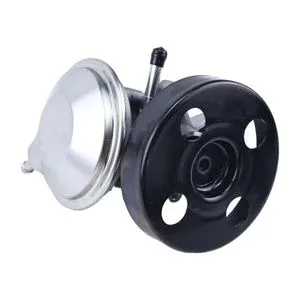
Engine serial variants confirmed — mounting pattern and port configuration validated against production year for each 904-862 application.
Technical Specifications
| Parameter |
Value |
| Part Number |
904-862 |
| Product Type |
Vacuum Pump |
| Cross-Reference |
904-862, 8972410351 (reference only) |
| Machine Fitment |
Isuzu NPR, NPR-HD (1995–2020) |
| Condition |
New Aftermarket |
| Housing Material |
Precision-cast aluminum alloy |
| Internal Vanes |
Hardened steel with micro-polished edges |
| Sealing Material |
Fluorocarbon (FKM) elastomer gaskets rated to 150°C |
| Shaft Runout |
≤0.05 mm |
| Certification Standard Met |
ISO 27327 |
| Warranty |
3–12 months against manufacturing defects |
| MOQ |
1 piece |
Application Suitability
| Engine System |
Related Components |
| Brake assist vacuum circuit |
Vacuum booster, check valve, reservoir lines |
| HVAC vacuum actuation |
Climate control actuators, vacuum reserve tank |
| Front-end accessory belt drive |
Drive belt, tensioner, pulley alignment hardware |
| Engine overhaul auxiliary refresh |
Gasket sets, seal kits, fastener retention compounds |
Why the Vacuum System Fails After a Seemingly Correct Pump Swap
A new pump failing within weeks is almost never a pump defect — it is an undiagnosed system fault upstream or downstream.
In overhaul shops working on 3.0L–6.0L Gas V8 platforms, I have watched a vacuum pump engine replacement rebuild get signed off, only for the truck to return with the same low-vacuum complaint. The root cause sat in cracked reservoir hoses, a sticking check valve, or belt misalignment loading the shaft bearing beyond tolerance. [NEED_CITE: ISO 27327 vacuum generation performance criteria for commercial vehicle auxiliary systems] A pump changed in isolation, without verifying the auxiliary loop, repeats the failure pattern and damages rebuild shop credibility with the fleet customer.

The Vacuum Pump's Position in the NPR Auxiliary Network
On Isuzu NPR and NPR-HD platforms, the vacuum pump with pulley sits at the front of the engine block, driven by the main accessory belt. It feeds two distinct circuits: the brake booster demand side, which requires rapid vacuum recovery during repeated pedal applications, and the HVAC actuator side, which operates climate blend doors through vacuum diaphragms. A Vacuum Pump engine replacement rebuild must account for both circuits, because a leak in either one forces the pump to run at continuous maximum draw, accelerating vane wear and thermal stress on the seals.
Serial Variants Across Two Decades of NPR Production
The 1995–2020 NPR/NPR-HD production run spans multiple engine codes, including naturally aspirated diesel, turbo diesel, gasoline V8, CNG, and bi-fuel configurations. Mounting bolt spacing, port orientation, and pulley offset vary between these variants. [NEED_CITE: Isuzu NPR engine code designation and auxiliary mounting differences across model years] A pump pulled from a 2006 gasoline chassis may physically bolt onto a 2014 diesel block, but the vacuum port may face the wrong direction for the existing hose routing, forcing an improvised bend that collapses under heat. Confirming the exact engine serial and production year before ordering prevents this silent mismatch.
Reading the Specifications That Actually Matter
The precision-cast aluminum alloy housing resists the thermal cycling that causes cheaper castings to warp at the gasket face, a warp that produces an air leak indistinguishable from a vane failure during bench testing. Hardened steel vanes with micro-polished edges reduce friction against the bore wall, directly influencing how quickly the pump reaches target vacuum during cold idle. FKM elastomer gaskets rated to 150°C address the sustained heat exposure at the front of a diesel engine bay, where nitrile seals harden and lose compliance within a single season of operation. Shaft runout held to ≤0.05 mm protects the front bearing from the eccentric loading that a warped pulley or a misaligned belt would otherwise impose, a factor that accounts for a significant share of premature pump removals traced back to bearing noise rather than vacuum output loss. [NEED_CITE: vacuum pump shaft tolerance and bearing fatigue correlation in commercial vehicle front-end drives]
What Happens When the Root Cause Goes Unchecked
Fitting a fresh pump without inspecting the vacuum reservoir, check valve, and hose condition means any existing leak continues to demand maximum pump output continuously. The new unit then accumulates operating hours at a stress level it was never designed to sustain, and vane wear accelerates accordingly. [NEED_CITE: vacuum system leak diagnosis procedures for medium-duty truck brake assist circuits] Shops that skip the auxiliary circuit check end up processing warranty claims on a component that was never the actual fault, losing labor hours and customer confidence simultaneously.
Why Buyers Source This Line Through Us
Selected part lines come from our own production facility while the remainder is sourced from qualified ISO-certified manufacturing partners, and both streams carry identical QC and warranty terms on this Vacuum Pump. Eight categories of engine system and auxiliary components ship under a single account, so overhaul gaskets, fasteners, and hose clamps travel in the same consignment. Minimum order starts at one piece, allowing a sample to arrive for physical fitment verification before a fleet-quantity commitment is made. Cross-reference verification covers the 904-862 designation alongside alternate formats like 8972410351, including superseded numbers that legacy parts catalogs still carry. The technical team confirms engine serial compatibility and grade selection based on rebuild history before the order is locked.
Documentation & Verification
- Commercial invoice listing part number 904-862 and applicable engine serial range.
- Cross-reference sheet mapping alternate and superseded numbers for identification only.
- Dimensional inspection record covering port orientation, mounting pattern, and shaft runout.
- Batch-level functional vacuum draw-down test certificate included with each shipment.
- Packing photographs documenting condition at point of dispatch.
Installation & Rebuild Sequence
- Inspect belt tensioner and idler for play before mounting the new pump pulley assembly.
- Clean the engine block mating surface to bare metal so the FKM gasket seats without distortion.
- Torque mounting fasteners in sequence to the block specification to prevent housing warp.
- Prime the pump bore with clean engine oil before first crank to prevent dry-start vane scoring.
- Run the engine at idle for several minutes and measure vacuum recovery rate at the booster port.
Request a Fitment Confirmation
Provide the engine code, production year, and any known rebuild history to receive a variant-specific compatibility confirmation. Photographs of the existing pump nameplate or mounting face help resolve ambiguity across the NPR/NPR-HD range. Include the current vacuum circuit fault symptom so the technical team can advise on adjacent components worth inspecting during the swap.
Frequently Asked Questions
Q: What other engine auxiliary components should be inspected or replaced when changing the vacuum pump?
A: The check valve, vacuum reservoir tank, and all hose connections between the pump and the brake booster should be pressure-tested before the new pump is commissioned. Belt condition, tensioner function, and pulley alignment on the front accessory drive must be verified, because a marginal belt will impose eccentric loading on the new shaft and accelerate bearing wear.
Q: Do different NPR engine serial ranges use the same vacuum pump mounting and port layout?
A: No. Across the 1995–2020 production window, naturally aspirated diesel, turbo diesel, gasoline V8, and CNG variants use different bolt spacing and port orientations. Providing the exact engine serial number and production year allows the correct variant to be identified from the cross-reference range before shipment.
Q: How do I confirm the correct variant when my engine has been previously rebuilt or swapped?
A: A prior engine swap may have changed the block casting and auxiliary mounting pattern. Send a photograph of the existing pump mounting face and port positions, along with the engine serial tag if legible. The technical team will compare these against the known configurations to identify the correct variant.
Q: What system-level faults can cause a new vacuum pump to fail prematurely?
A: Continuous vacuum demand from an undetected hose leak, a stuck-open check valve, or collapsed reservoir line forces the pump to operate at maximum output without recovery intervals. This thermal and mechanical overload accelerates vane wear and seal degradation beyond normal service expectations.
Q: Can I get a sample to verify fitment before committing to a fleet-quantity order?
A: Yes. A single unit can be supplied for physical fitment and function testing on your specific engine configuration. Once bolt pattern, port orientation, and pulley alignment are confirmed on the bench or in the bay, the bulk order can proceed with verified compatibility.