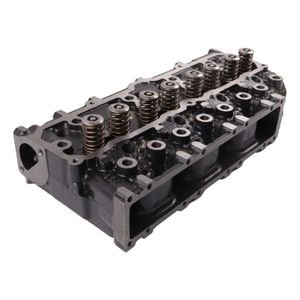
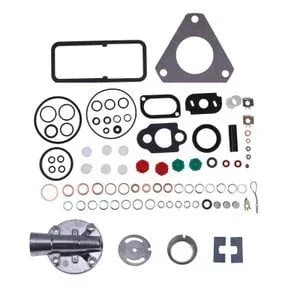
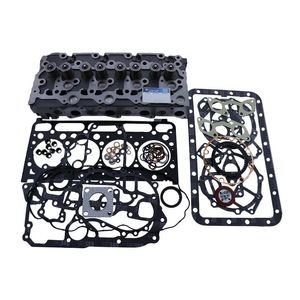
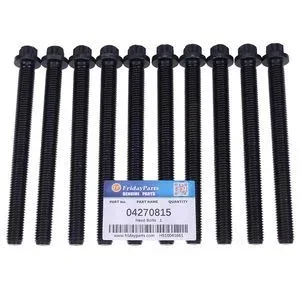
Matched Sets for Rebuild — complete cylinder head 179-1854 arrives with valves and springs assembled, verified against C3.4 serial variants to prevent mismatched valve train geometry during top-end overhaul.
Technical Specifications
| Parameter |
Value |
| Part Number |
179-1854 |
| Cross-Reference |
233-5500 (for identification purposes) |
| Product Type |
Cylinder Head |
| Machine Fitment |
236B, 236B3, 242B3, 246B, 246C, 248B, 252B, 252B3, 256C, 257B3, 259B3, 262B, 262C, 262C2, 267B, 268B, 272C, 277B, 277C, 277C2, 279C2, 287B, 287C, 287C2, 289C2, 297C, 906, 906H, 907H, 908, 908H |
| Assembly State |
Complete with valves, valve springs, assembled ready to install |
| Material |
High-strength pearlitic gray iron (ASTM A48 Class 30B) |
| Deck Flatness |
±0.05 mm |
| Valve Guide Bore Concentricity |
<0.03 mm |
| Mating Face Surface Finish |
Ra 1.6 μm |
| Pressure Test |
6 bar for 5 minutes |
| Standards |
ISO 9001, ASTM A48 Class 30B |
| Warranty |
3–12 months against manufacturing defects |
| MOQ |
1 piece |
Application Suitability
| Engine System |
Related Components |
| Combustion chamber upper boundary |
Head gasket set, head bolts, valve cover gasket |
| Coolant jacket flow path |
Thermostat, water pump, coolant passage seals |
| Valve train actuation |
Camshaft, rocker arms, pushrods, valve lifters |
| Intake and exhaust sealing |
Intake manifold gasket, exhaust manifold gasket, turbo mounting hardware |
Why Cylinder Head Failures Trace Back to Systems You Haven't Checked Yet
A warped or cracked cylinder head for CAT 3044C C3.4 engine rebuild is rarely the root cause — it is the casualty.
In the Pearl River Delta warehouse district, I have watched rebuild shops swap a damaged head onto an engine without tracing why the original failed. Weeks later, the replacement shows the same recession patterns, the same hot spots near the injector cups. The fault usually lives in the cooling circuit: a thermostat stuck partially closed, a water pump impeller eroded beyond effective flow, or blocked coolant passages in the block itself. Replacing the head without verifying these adjacent systems sets up a repeat failure cycle that no component warranty will cover. [NEED_CITE: diesel engine cooling system root cause analysis for cylinder head failures]
Engine serial designations add another layer. The 3044C, C3.4, and C3.4 IND variants share external dimensions but can carry different valve train specifications across production batches. Ordering without serial number confirmation risks receiving a head with valve sizes or spring rates that do not match the camshaft profile already in the block.

Where This Head Sits in the Combustion System Architecture
The cylinder head forms the upper seal boundary of the combustion chamber. Its mating face must maintain flatness against the head gasket under repeated thermal cycling, while the coolant jacket passages cast into the head manage heat extraction from the valve bridge areas. A cylinder head for CAT 3044C C3.4 engine rebuild that arrives pre-assembled with valves and springs eliminates the need for seat cutting and spring load verification — steps that require specialized equipment and introduce variables when performed in general workshops.
Serial Variant Confirmation and Rebuild History Matching
The C3.4 family has undergone internal revisions across production years. Valve guide bore diameters, spring installed heights, and valve seat angles may shift between early 3044C and later C3.4 IND designations. Before dispatch, the engine serial number prefix determines which variant specification applies. [NEED_CITE: engine serial number identification for cylinder head variant matching]
Equally important is the rebuild history of the engine in question. If the block has been line-bored or decked during a previous overhaul, the compression height changes, and standard-thickness head gaskets may not achieve correct sealing load. Confirming whether the block remains at factory dimension or has been machined affects both gasket selection and head bolt torque sequence.
Reading the Specifications That Matter at the Bench
The ASTM A48 Class 30B material designation specifies pearlitic gray iron with tensile properties suited to the thermal cycling demands of a four-cylinder diesel combustion chamber. This material provides the damping characteristics needed to absorb combustion shock without crack propagation across the valve bridge.
Deck flatness held to ±0.05 mm ensures the head gasket achieves uniform sealing load across all four cylinder bores. When flatness drifts beyond this tolerance, localized gasket blowout occurs — typically between adjacent cylinders where clamping force is lowest.
Valve guide bore concentricity below 0.03 mm keeps the valve stem traveling true through its full stroke. Excessive concentricity error causes the valve to contact the seat off-center, producing uneven wear and eventual compression leakage. [NEED_CITE: valve guide concentricity tolerance effects on seat sealing in diesel engines]
The Ra 1.6 μm mating face surface finish provides the texture profile that allows the head gasket to bite and seal without relying on excessive clamping force alone.

The Hidden Cost of Skipping the System Check
A rebuild shop installs a replacement head without verifying that the water pump is delivering rated flow. The engine runs adequately for several hundred hours, then the new head develops micro-cracks near the exhaust valve seats — the same location, the same failure mode as the original. The customer blames the part. The real fault was a cooling system delivering inadequate flow, allowing localized boiling in the head passages. [NEED_CITE: diesel engine cylinder head thermal fatigue failure mechanisms]
This pattern repeats when thermostat function is not verified, when coolant concentration is wrong for the operating climate, or when radiator cap pressure rating has degraded below specification. The cylinder head absorbs the consequence of failures it did not cause.
Why Rebuild Shops Source This Component Here
Own production lines and qualified sourced supply operate under a single warranty structure, meaning a cylinder head for CAT 3044C C3.4 engine rebuild carries the same coverage terms whether it rolled off our internal machining center or a partner facility.
Eight product categories — engine, hydraulic, electrical, undercarriage, cabin, seal kits, tools, and general spares — ship under one account, so the head gasket set, head bolts, and valve cover gasket arrive in the same consignment as the head itself.
Part identification works from number, machine model, photograph, or nameplate image. A faded serial plate on a skid steer does not block order confirmation.
Cross-reference verification covers superseded and alternate numbers, preventing shipment of a discontinued variant when a current specification exists.
Minimum order from one piece supports emergency rebuilds without forced overstocking.
Technical team confirmation of engine serial variant and rebuild history ensures the correct specification ships rather than a generic fitment guess.
Documentation & Verification
- Commercial invoice listing cylinder head part number with cross-reference 233-5500 noted as reference only
- Dimensional inspection record covering deck flatness, valve guide concentricity, and mating face finish
- Pressure test certificate at 6 bar confirming coolant jacket integrity before dispatch
- Warranty terms specifying coverage scope for casting and valve train components
- Packing photographs showing protective packaging on mating surfaces and valve stems
- HS code and customs documentation support for international engine parts shipments
Installation & Rebuild Sequence
- Clean block mating surface and verify flatness before positioning the head to prevent gasket sealing failures
- Install new head bolts — do not reuse torque-to-yield fasteners from the previous assembly
- Follow manufacturer torque sequence in staged increments, confirming final angle specifications
- Verify valve clearance after head installation and before valve cover fitting
- Prime the cooling system and check for leaks at head gasket joints during initial run-in
- Monitor coolant temperature during the first operating hours to confirm thermostat and water pump function
Before You Request a Quote
Provide the engine serial number plate photograph or stamped serial number from the block. Include any known rebuild history — whether the block has been decked, line-bored, or fitted with oversize components. If the failure mode of the original head is known (cracking, warpage, valve seat recession), describe it so the technical team can recommend adjacent system checks before the replacement head ships.
Frequently Asked Questions
Q: Does this cylinder head arrive fully assembled or do I need to transfer valves and springs from the old head?
A: This complete cylinder head ships with valves and valve springs pre-installed and assembled ready to install. No valve seat cutting, spring load verification, or component transfer from the old head is required. This eliminates machining steps that general workshops may lack equipment to perform accurately.
Q: What other gaskets and fasteners should be replaced at the same time as the cylinder head?
A: The head gasket set, head bolts (especially if torque-to-yield type), valve cover gasket, and intake and exhaust manifold gaskets should be replaced during the same service event. Sourcing these together prevents split shipments and ensures sealing surfaces are matched to the new head dimensions.
Q: How do I confirm whether my engine is a 3044C, C3.4, or C3.4 IND variant?
A: The engine serial number plate on the block provides the definitive identification. Different production batches may carry variations in valve train specifications despite sharing the same external casting. Providing the serial number or a photograph of the nameplate allows verification of which variant specification applies to your engine.
Q: What caused the original head to fail, and what adjacent systems should I inspect to prevent recurrence?
A: Cylinder head failures commonly trace back to cooling system deficiencies — thermostat malfunction, water pump erosion, or blocked coolant passages. Before installing the replacement head, verify coolant flow rate, thermostat opening temperature, and radiator cap pressure rating to address the root cause rather than replacing only the damaged component.
Q: Is the head gasket included, or is it sourced separately as part of an overhaul kit?
A: The head gasket is sourced separately and is not included with this cylinder head assembly. Specify your engine serial number when ordering so the correct gasket thickness is matched to your block configuration, accounting for any previous machining that may have altered deck height.