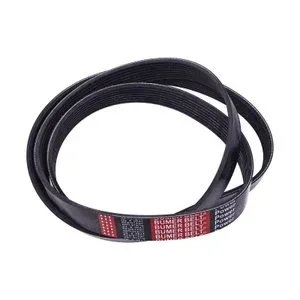
Complete Set Matching — MD145156 16692 belt routing verified against L3E engine serial range before dispatch
Technical Specifications
| Parameter |
Value |
| Part Number |
MD145156 16692 |
| Cross-Reference |
MD145156 (reference only), 16692 (reference only) |
| Product Type |
Belt |
| Compatible Engine |
Mitsubishi L3E |
| Machine Fitment |
T120SS, MLT3060MV |
| Material |
High-tensile polyester cords and heat-resistant rubber compounds |
| Condition |
New Aftermarket |
| Warranty |
3–12 month warranty against manufacturing defects |
| Manufacturing Standard |
ISO 9001 |
Application Suitability
| Engine System |
Related Components |
| Belt Drive — Primary Power Transmission |
Tensioner assembly, idler pulleys, crankshaft pulley |
| Alternator Drive Circuit |
Alternator mounting bracket, alternator bearing, wiring harness connections |
| Cooling Fan Drive |
Fan hub bearing, fan shroud alignment, radiator hose routing |
| Water Pump Drive |
Water pump seal, thermostat housing, coolant bypass passage |
Why a Snapped V Belt MD145156 Engine Replacement Part Is Rarely the Whole Story
The belt broke because something else failed first.
A snapped V belt on a Mitsubishi L3E engine is almost never just a belt problem. On mine sites in Nigeria, I have seen L3E engines shut down with a broken belt, only to find the tensioner pulley bearing had seized weeks earlier. The V Belt MD145156 engine replacement part took the overload and failed. Replace the belt alone and the new one lasts days. Address the tensioner, check the idler, and the belt runs for its full service interval [NEED_CITE: belt drive system failure root cause analysis for industrial diesel engines].
The same pattern repeats with Generac MLT3060MV light towers. The engine sits in an enclosure where heat buildup accelerates rubber degradation. A belt that shows cracking on the ribs is telling you the cooling airflow path is restricted. Ignore that and the replacement V Belt MD145156 engine replacement part inherits the same thermal abuse.

The Belt Drive System and Its Adjacent Components
This V belt is one element in a power transmission chain that drives the alternator, water pump, and cooling fan on the Mitsubishi L3E platform. When an engine rebuild shop quotes a belt replacement, the tensioner spring rate and pulley face wear must be checked in the same service event. A worn pulley groove changes the belt seating depth, altering the effective pitch diameter and causing slip under load. The V Belt MD145156 engine replacement part must engage at the correct depth to transmit rated torque without rib wear.
Engine Serial Variants and Belt Routing Differences
The Mitsubishi L3E engine family has production runs spanning different accessory configurations. Early-build engines may use a single-belt drive for all auxiliaries, while later variants split the load across two belts with independent tensioners. The T120SS tractor application and the Generac MLT3060MV light tower application use different accessory mounting brackets, which can alter belt length requirements even when the base engine block is identical. Confirming the engine serial number against the belt routing diagram prevents receiving a belt that is two ribs too narrow or a few millimeters short on effective length. [NEED_CITE: Mitsubishi L3E engine serial number identification and accessory variant differences]
How Heat-Resistant Compound and Cord Construction Affect Service Life
The heat-resistant rubber compound in this belt maintains dimensional stability when engine bay temperatures climb during continuous duty in mining or remote construction applications. Standard-grade belts harden and develop surface cracks under sustained high-temperature exposure, losing grip on the pulley faces. The high-tensile polyester cord core provides the load-bearing structure. When cords stretch beyond specification, the belt rides higher in the pulley groove, reducing the contact area and accelerating wear on both the belt ribs and the pulley surfaces.
The Cost of Skipping the System Check
Replacing only the belt without inspecting the tensioner, idler pulleys, and driven accessories leads to a predictable cycle: new belt installed, rapid wear appears within the first operating hours, belt fails again, machine goes back down. The second downtime event carries the same cost as the first plus the credibility loss with the equipment owner. In mining operations where a generator-fed light tower supports night-shift work, a second belt failure can mean an entire shift stands idle. [NEED_CITE: cumulative downtime cost of repeat belt drive failures in remote power generation]
Sourcing With Verified Cross-Reference and System Matching
This V Belt MD145156 engine replacement part ships under verified cross-reference numbers MD145156 and 16692, checked against the applicable L3E engine serial ranges. Our technical team reviews the engine variant to confirm belt routing and length before release. We supply matched belt sets for fleets running multiple L3E-platform machines, so every unit in the maintenance schedule gets the correct specification. Quality inspection records accompany each shipment confirming dimensional accuracy and material certification. Sample supply is available for fitment confirmation before bulk commitment.
Documentation & Verification
- Commercial invoice listing MD145156 16692 with cross-reference notation for customs clearance
- Part compatibility sheet showing applicable L3E engine serial ranges and routing diagrams
- Dimensional inspection record confirming belt profile, cord count, and effective length
- Warranty terms document covering manufacturing defects under normal operating conditions
- Packing photographs showing belt condition and packaging integrity before dispatch
- HS code classification support for belt import documentation
Installation & Rebuild Sequence
- Inspect tensioner spring tension and pulley face wear before installing the new V belt
- Verify pulley alignment with a straightedge across the crankshaft and driven accessory pulleys
- Set belt tension to the engine manufacturer specification and recheck after initial run-in
- Run the engine at idle for the first cycle and observe belt tracking on each pulley
- Re-torque accessory mounting bolts after the first heat cycle to prevent bracket shift
Request a Belt Drive System Quote
Provide your engine serial number, the machine model (T120SS or MLT3060MV), and any previous rebuild history so we can confirm the correct belt specification and identify which adjacent components need inspection. For fleet accounts, share the full engine list and we will build a matched set quote covering every variant in your inventory.
Frequently Asked Questions
Q: What other belt drive components should be inspected when replacing this V belt?
A: Check the tensioner assembly for spring fatigue and pulley bearing play, inspect all idler pulleys for face wear and wobble, and verify that driven accessories such as the alternator and water pump spin freely without drag. Any seized or stiff component will overload the new belt and cause premature failure within the first operating cycle.
Q: How do I confirm this belt fits my specific Mitsubishi L3E engine serial number?
A: Provide the engine serial number from the block nameplate along with the machine application. We cross-reference the serial against known accessory bracket configurations and belt routing diagrams for the L3E platform to confirm the correct profile and effective length before shipping.
Q: What causes premature V belt failure and how do I prevent repeat failures?
A: Common causes include seized tensioner bearings, misaligned pulleys from a shifted accessory bracket, restricted airflow causing excessive heat buildup, and driven accessories with failing internal bearings. Addressing the root cause during the same service event prevents the replacement belt from inheriting the same destructive condition.
Q: Can I order matched belt sets for multiple engines in my fleet?
A: Yes. Share the engine serial numbers and machine models for every L3E-platform unit in your fleet. We verify each engine variant, confirm belt routing and length requirements, and ship a matched set with individual labeling so each belt goes to the correct machine during scheduled maintenance.