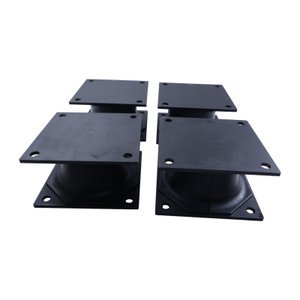
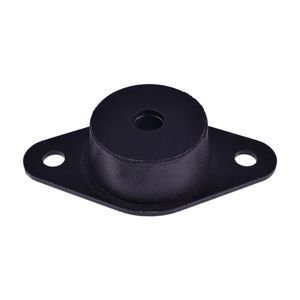
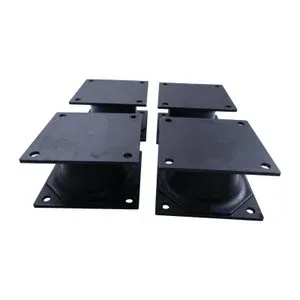
Matched Sets Shipped — Every cushion damper order leaves our Guangzhou facility as a verified 4-piece set, hardness-matched within a single production batch to eliminate uneven load paths across the compactor engine mounting plane.
Technical Specifications
| Parameter |
Value |
| Part Number |
TRSA000008038, SW-180100, SW180100 |
| Product Type |
Cushion Damper |
| Cross-Reference |
TRSA000008038, SW-180100, SW180100 (reference only) |
| Machine Fitment |
Stanley HS6000, HS6019, HS6100, HSX6, HS8000, HS11000, HSX11; Bobcat PCF64; Doosan vibratory plate compactors |
| Material |
Natural rubber compound with high damping coefficient |
| Hardness |
65±3 Shore A |
| Peak Shock Load Capacity |
up to 4.2 kN |
| Dimensional Tolerance (Inner/Outer Diameter) |
±0.3 mm |
| Dimensional Tolerance (Height) |
±0.5 mm |
| Quantity per Set |
4 pieces |
| Condition |
New aftermarket |
| Warranty |
6-month warranty against manufacturing defects |
| Standards |
ISO 9001, ASTM D698 |
Application Suitability
| Engine System |
Related Components |
| Engine-to-chassis vibration isolation |
Engine mount brackets, mounting bolts and lock washers |
| Compactor power unit auxiliary |
Drive belt tensioners, pulley bearings, hydraulic motor mounts |
| Periodic overhaul refresh |
Complete isolator sets, engine gasket kits, fastener replacement kits |
| High-cycle vibratory service |
Anti-vibration fasteners, chassis reinforcement plates, motor coupling inserts |
When One Cracked Mount Signals a System-Wide Rebuild Need
A single degraded isolator almost always means the remaining three have absorbed unequal dynamic loading and are approaching failure.
On Indonesian mining sites and municipal road projects, I have watched technicians pull a Stanley plate compactor apart only to find the engine base cracked from resonance that a fresh matched set would have prevented. The rubber compound in these cushion dampers endures thousands of high-amplitude cycles per hour. When one unit hardens, cracks, or compresses past its recovery point, the adjacent mounts inherit load spikes they were never designed to carry. This cascade turns a scheduled refresh into an engine-out chassis repair. A systematic Rubber Isolator Shock Mount engine vibration damper rebuild addresses the isolation system as a complete assembly, preventing secondary damage to bearing housings and hydraulic line connections [NEED_CITE: vibration-induced fatigue cracking in compactor chassis structures].

The Isolation System's Role in the Engine Auxiliary Group
The cushion damper belongs to the engine auxiliary subsystem, sitting at the critical interface between the compactor's vibrating base plate and the engine cradle. Its function is to decouple the high-frequency oscillation generated during compaction from the rotating assembly above. When this isolation boundary degrades, vibratory energy migrates upward into the crankcase, accelerating wear on main bearings and compromising oil pump pickup alignment. Replacing the Rubber Isolator Shock Mount engine vibration damper rebuild components as a matched 4-piece set restores uniform damping geometry, ensuring each mounting point shares dynamic load equally.
Why Hardness Matching Across the Set Matters More Than Individual Specs
A cushion damper stamped 65 Shore A means little if the four pieces in your set span a 10-point hardness spread. Softer units compress further under static engine weight, tilting the crankshaft axis and introducing a bending moment into the output shaft. Over hundreds of operating hours, this misalignment wears the coupling splines and accelerates seal leakage at the hydraulic motor interface. Our matched sets are drawn from a single vulcanization batch, verified within the ±3 Shore A tolerance band, so static deflection remains uniform across all four mounting points [NEED_CITE: elastomer batch consistency standards for vibration isolation components].
How Material Formulation Addresses Real Degradation Pathways
The natural rubber compound in these isolators incorporates anti-ozone and UV stabilizers because plate compactors operate in direct sunlight and near exhaust heat. Ozone attack initiates micro-cracks on the rubber surface that propagate inward under cyclic compression, eventually reaching the metal-to-rubber bond line. Once the bond fails, the isolator loses its ability to transfer shear loads, and the engine shifts on its mounts during direction changes. The high damping coefficient formulation absorbs vibratory energy across the frequency range typical of eccentric shaft rotation, converting mechanical oscillation into manageable heat rather than transmitting it to the chassis frame.
The Hidden Cost of Partial Set Replacement
Swapping a single failed isolator while leaving three aged units in place creates a stiffness imbalance that the engine was never designed to tolerate. The fresh unit absorbs a disproportionate share of static load, compressing further and tilting the engine. This tilt loads the fan belt unevenly, wears the alternator bearing prematurely, and can crack the exhaust manifold flange. Shops that adopt full-set replacement during every compactor overhaul eliminate these secondary failures and keep machines in productive service rather than cycling through repeat teardowns [NEED_CITE: engine mount stiffness imbalance effects on auxiliary drive components].
What This Supply Channel Brings to Your Rebuild Program
Our selected production lines manufacture these cushion dampper sets under the same QC protocol applied to sourced supply, so warranty terms remain identical regardless of origin. The 10,000+ SKU catalog across eight categories means the mounting bolts, gasket sets, and drive belt components your overhaul requires ship under one account with consolidated documentation. Single-piece minimums allow you to order a trial set for fitment verification before committing to fleet-scale quantities. Our technical team cross-references engine serial variants against mounting pattern records, confirming the isolator set matches your specific Stanley or Bobcat compactor generation. Guangzhou warehouse stock on common configurations enables rapid dispatch when a machine-down situation demands immediate isolation system replacement.
Documentation & Verification
- Commercial invoice and packing list referencing each cushion damper set by batch number
- Compatibility sheet confirming cross-reference part numbers TRSA000008038 and SW-180100 marked as reference only
- Quality inspection record showing Shore A hardness readings for all four pieces in the set
- Six-month warranty terms covering manufacturing defects in rubber compound and metal bond integrity
- Packing photographs documenting set completeness and protective separation before crate closure
- HS code classification support for customs clearance at destination port
Installation & Rebuild Sequence
- Clean engine cradle mounting surfaces to bare metal, removing old rubber residue and corrosion before positioning new cushion dampers
- Verify ±0.3 mm inner and outer diameter tolerance against mounting stud dimensions to confirm interference fit integrity
- Torque mounting hardware in a diagonal cross pattern to achieve uniform compression across all four isolator positions
- Check engine alignment with a straightedge across the valve cover after the set is loaded, correcting any tilt before proceeding
- Run the compactor at low eccentric speed for the first ten minutes, monitoring for abnormal harmonic resonance indicating a seating issue
Preparing Your Inquiry
Provide the engine model, compactor serial number, and any previous overhaul history so we can verify the correct cushion damper variant and confirm dimensional compatibility with your existing mounting hardware. If the original nameplate is worn or painted over, a photograph of the mounting pattern and existing isolator dimensions allows our team to cross-reference the appropriate matched set for your machine.
Frequently Asked Questions
Q: Why must isolators be replaced as a matched set rather than individually?
A: A single new isolator among three aged units creates uneven stiffness distribution. The fresh piece absorbs disproportionate static load, tilting the engine and accelerating wear on belts, bearings, and exhaust connections. Matched replacement from a single production batch ensures uniform hardness and compression, maintaining proper crankshaft alignment across all four mounting points.
Q: What other engine auxiliary components should be inspected when replacing cushion dampers?
A: Examine mounting bracket bolt holes for elongation, check the engine-to-hydraulic-motor coupling for spline wear, and inspect drive belt condition and tensioner operation. Exhaust manifold flange cracks often trace back to prolonged vibration isolation failure. Addressing these adjacent items during the isolator refresh prevents early return visits.
Q: How does vibration isolation failure lead to secondary engine mount damage?
A: Degraded rubber transmits high-cycle oscillation directly into the engine cradle and chassis frame. This energy accelerates fatigue cracking in mounting brackets, loosens fasteners, and can fracture weld joints at the engine base. Replacing the full isolator set restores the intended vibration boundary, protecting structural components from progressive damage.
Q: Can I verify the correct hardness grade for my specific compactor model?
A: Yes. Provide your compactor model and engine serial number so we can reference the specified Shore A hardness range. Each matched set ships with a quality inspection record documenting individual hardness readings, allowing you to confirm the batch falls within the 65±3 Shore A tolerance before installation.
Q: What documentation confirms the isolators meet dynamic load specifications?
A: Every set includes a quality inspection record with dimensional measurements and hardness values, a compatibility sheet with cross-reference numbers marked as reference only, and warranty documentation covering the rubber compound and bond integrity for six months against manufacturing defects.