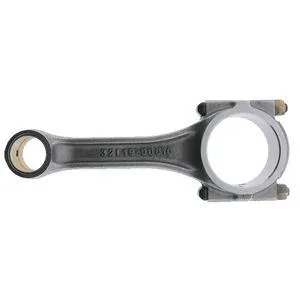
Matched Grade Sets — Every connecting rod ships with verified bearing clearance data matched to the crankshaft regrind history on file.
Technical Specifications
| Parameter |
Value |
| Part Number |
4956017 |
| Product Type |
Connecting Rod |
| Cross-Reference |
4956017 (reference only) |
| Machine Fitment |
Cummins B3.3, QSB3.3 |
| Material |
4340 alloy steel (forged) |
| Surface Treatment |
Heat-treated to HRC 38–42, shot-peened, anti-corrosion oil coating |
| Pin Bore Tolerance |
±0.005 mm |
| Big-end Width Tolerance |
±0.01 mm |
| Surface Roughness |
Ra ≤ 0.8 μm |
| Assembly State |
New Aftermarket |
| Certification |
ISO 9001 |
| Warranty |
6 months against manufacturing defects |
| MOQ |
1 piece |
Application Suitability
| Engine System |
Related Components |
| Block & Internal Parts |
Main bearings, rod bearings, piston assemblies, crankshaft |
| Lubrication System |
Oil pump, oil filter, oil cooler, galleries and jets |
| Cylinder Components |
Cylinder liners, piston rings, wrist pins, circlips |
| Emission & Exhaust |
Turbocharger, EGR valve, exhaust manifold gaskets |
Why Rebuilds Fail Before the First Oil Change
Mismatched tolerances between the connecting rod, bearings, and crankshaft journal cause more repeat failures than the rod itself.
A Cummins B3.3 or QSB3.3 goes onto the stand for an overhaul. The teardown reveals a spun bearing or a fractured rod. The easy conclusion is that the connecting rod engine rebuild requires a new rod. But in my years working through Guangzhou repair bays and later supplying parts to those same shops, I have seen the real culprit far more often: the crankshaft had been reground on a previous visit, and the replacement bearings were ordered in standard grade. The clearance was wrong from the moment the engine turned over. [NEED_CITE: engine bearing clearance specifications for rebuilt diesel engines]
The same pattern repeats when a single failed rod gets swapped without tracing why it failed. Oil starvation from a blocked gallery, a worn oil pump, or incorrect bearing crush can fracture even a properly spec'd rod within hours. A Connecting Rod 4956017 replacement without root-cause diagnosis is a repair that has not actually been completed.

Where the Rod Sits in the Rebuild Sequence
The connecting rod is not an isolated purchase. It connects the piston assembly to the crankshaft, transferring combustion force through the big-end bearing and the pin bore bushing. During a Cummins B3.3 or QSB3.3 overhaul, the rod must be evaluated alongside its piston, wrist pin, rod bearing shell, and the crankshaft journal it rides on. Replacing one without inspecting the others introduces mismatched wear surfaces that accelerate failure across the entire rotating assembly. Every connecting rod engine overhaul demands this system-level view before any parts are ordered.
Regrind History and Bearing Grade Matching
Cummins QSB3.3 variants span several output ratings and serial ranges, and crankshafts in these engines often survive multiple overhauls. Each regrind moves the journal to a smaller diameter — typically in 0.25 mm increments — which demands undersize bearings to maintain the specified oil film thickness. When I first started in parts supply, I shipped standard-grade bearing shells alongside a replacement rod for a QSB3.3 that had already been ground undersize. The clearance was too large, the oil film collapsed under load, and the engine was back on the stand within a week. Now every rod order triggers a conversation about crankshaft condition and bearing grade before anything leaves the warehouse. [NEED_CITE: crankshaft journal regrind undersize standards for diesel engines]
Forged Steel, Heat Treatment, and Bore Tolerance
The 4340 alloy steel forging provides the tensile strength to handle repeated combustion loading without stretching. Heat treatment to HRC 38–42 balances hardness with enough ductility to resist brittle fracture under shock loads — a common failure mode in construction-site engines that see sudden load spikes. Shot peening introduces compressive residual stress on the surface, which retards crack initiation at the bolt fillet and I-beam transition. The pin bore tolerance of ±0.005 mm and big-end width tolerance of ±0.01 mm ensure that the rod accepts standard bushings and bearing shells without selective fitting, and the Ra ≤ 0.8 μm surface roughness at the bearing interface supports stable oil film formation from the first revolution.
The Cost of Skipping the Clearance Check
When a rebuild shop installs a new connecting rod without verifying bearing crush and journal clearance, the consequences are not immediate. The engine starts, runs, and may even pass a break-in dyno pull. But as hours accumulate, excessive clearance allows the bearing shell to hammer against the journal, generating debris that migrates through the oil system. Main bearings, turbo bearings, and piston cooling jets all suffer. The second teardown is always more expensive than the first. [NEED_CITE: diesel engine bearing failure analysis and root cause diagnosis] Shops that skip this step find themselves absorbing warranty comebacks that trace directly back to a clearance check that took fifteen minutes.
Why Rebuild Shops Source Rods and Matched Sets Here
XUNPO manufactures selected part lines in-house and sources the remainder from ISO 9001-certified partners, so self-produced and sourced connecting rods carry identical QC and warranty terms. Eight product categories mean a full B3.3/QSB3.3 overhaul kit — rods, bearings, pistons, gaskets, seal kits — ships under one account with one set of freight documents. Orders start at one piece for emergency single-cylinder repairs. The Guangzhou warehouse holds stock on high-turnover items for fast dispatch. Part identification works from a part number, machine model, photograph, or nameplate image. Cross-reference verification covers superseded and alternate numbers. Samples are available for bench fitment confirmation before bulk commitment.
Documentation & Verification
- Commercial invoice and packing list referencing each rod by serial and engine application
- Bearing cross-reference sheet marked reference only for Cummins B3.3 and QSB3.3 variants
- Dimensional inspection record covering pin bore, big-end width, and surface roughness
- Warranty terms document stating coverage period and manufacturing defect scope
- Packing photographs showing anti-corrosion oil coating and VCI wrapping per rod
- HS code and customs classification support for international engine parts shipments
Installation & Rebuild Sequence
- Verify crankshaft journal diameter with a micrometer before selecting bearing grade for the connecting rod
- Clean oil galleries and piston cooling jets to prevent debris from scoring the new rod bearing surface
- Check connecting rod bolt stretch to specification rather than relying on torque alone
- Confirm bearing crush height with Plastigauge after cap installation on each rod journal
- Prime the lubrication system before initial start to establish oil film at the big-end bearing immediately
- Record break-in oil pressure readings to confirm correct clearance across all rod and main bearings
Requesting a Fitment-Confirmed Quote
Provide the engine model, serial number, and any known crankshaft regrind history so the correct bearing grade can be paired with the connecting rod. If the nameplate is missing or illegible, a photograph of the existing rod stamping or the engine block casting number allows verification. Shops planning a full overhaul should share the complete component list to confirm that pistons, bearings, and gasket sets match the same engine build specification.
Frequently Asked Questions
Q: What other components should be replaced together with the connecting rod during an overhaul?
A: A proper Cummins B3.3 or QSB3.3 overhaul pairs each connecting rod with matched rod bearings, piston assemblies, wrist pins, and main bearings. Cylinder liners, gasket sets, and seal kits should also be evaluated. Shipping these as one matched set ensures consistent tolerances and eliminates the risk of receiving parts spec'd for different engine serial ranges.
Q: How do I determine the correct bearing grade if the crankshaft has been previously reground?
A: Measure the crankshaft journal diameter with a micrometer and compare it against the Cummins service manual specification for standard, 0.25 mm, 0.50 mm, or 0.75 mm undersize. Share these measurements when ordering the connecting rod so the correct bearing shells can be included in the same shipment.
Q: Do different serial number ranges within the B3.3/QSB3.3 family use different connecting rod variants?
A: Yes. The B3.3 and QSB3.3 platforms span multiple power ratings and emission configurations, and some variants use rods with different big-end widths or bolt patterns. Provide the engine serial number so the exact variant can be confirmed against cross-reference data before dispatch.
Q: What caused the original rod to fail and how do I prevent recurrence after replacement?
A: Common root causes include oil starvation from blocked galleries, incorrect bearing clearance after a previous regrind, and over-torqued or stretched rod bolts. Inspect the oil pump, clean all lubrication passages, verify journal dimensions, and replace fasteners to prevent the same failure mode from recurring on the rebuilt engine.
Q: Can I get a sample for bench fitment verification before committing to a bulk rebuild order?
A: Yes. A single connecting rod can be supplied as a sample so your rebuild shop can verify pin bore fit, big-end alignment, and bearing shell crush height on the actual crankshaft before releasing a full engine set order.