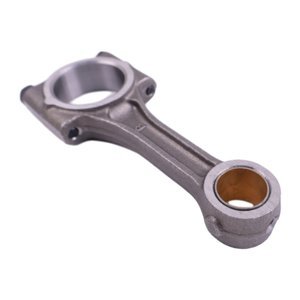
Matched Bottom-End Group — Rod bore and bearing grade verified against crankshaft journal condition before dispatch.
Technical Specifications
| Parameter |
Value |
| Product Type |
Connecting Rod |
| Engine Fitment |
Kubota D905, D1005, D1105, D1305, V1205, V1305, V1405, V1505 |
| Material |
High-strength alloy steel (source value — verify against manufacturer catalog) |
| Manufacturing Process |
Forged (source value — verify against manufacturer catalog) |
| Condition |
New Aftermarket |
| Quality Certification |
ISO-certified |
| Warranty |
3-12 months against manufacturing defects |
| Application Scope |
Construction machinery, agricultural equipment, industrial generators |
Application Suitability
| Engine System |
Related Components |
| Bottom-end rotating assembly |
Con rod bearings (STD / undersize grades) |
| Piston and cylinder group |
Pistons, piston rings, wrist pins |
| Lubrication circuit |
Oil pump, main bearings, crankshaft |
| Complete engine overhaul |
Gasket kit, seal kit, engine filters |
Why Rebuilds Fail Before the First Oil Change
The connecting rod is only as good as the bearing shell and crankshaft journal it mates with.
A rebuild shop tears down a Kubota D1105 and finds a scored journal on one throw. The decision to order a single connecting rod without measuring the journal diameter or checking the previous rebuild's bearing grade is how engines come back with knocking at low hours. I have seen shops swap the rod, torque the cap, and fire the engine — only to hear the distinct metallic rattle of a big-end bore that does not match the installed bearing shell [NEED_CITE: engine rebuild tolerance stacking and bearing clearance failure modes]. The failure is not the rod itself; it is the system mismatch that went unchecked.

The Rotating Assembly as a Measured System
This connecting rod operates inside the bottom-end assembly of Kubota D-series and V-series compact diesels, where tolerances are unforgiving. The big-end bore must be measured before selecting con rod bearings, because the bore can stretch beyond standard after hard service. A connecting rod ordered without this measurement risks running with either excessive clearance, causing oil pressure loss, or insufficient clearance, leading to bearing seizure within hours of startup.
Previous Rebuild History Dictates the Next Order
Engines in rental fleets and agricultural service often have undocumented rebuild histories. A crankshaft may have been reground to 0.25mm or 0.50mm undersize on a prior overhaul, meaning standard bearings will not achieve the correct oil film thickness. The connecting rod must be paired with bearings that match the actual journal diameter, not the factory nominal dimension [NEED_CITE: crankshaft reground standards and undersize bearing selection for diesel engines]. This is where engine serial number verification and teardown measurement become non-negotiable steps before parts are ordered.
Forging, Material, and What They Mean in Service
The high-strength alloy steel forging process gives the connecting rod its fatigue resistance under the repetitive compressive and tensile loads of diesel combustion. In compact engines like the D905 through V1505, the rod must withstand peak cylinder pressures while maintaining precise alignment between the piston pin bore and the big-end bore. Any deviation in straightness or bore geometry translates directly into uneven bearing loading and accelerated wear on the crankshaft journal surface it rides on.
The Cost of Skipping the Measurement Step
Ordering a connecting rod based on engine model alone, without confirming journal grade and rod bore condition, leads to one of two outcomes. The rod arrives, the bearings are installed, and the clearance is wrong — either the engine knocks immediately, or it passes initial testing and fails under load weeks later. The machine goes back on the teardown bench, labor hours double, and the customer's confidence in the rebuild evaporates. A few minutes with a bore gauge and micrometer during the quoting stage prevents this entirely [NEED_CITE: diesel engine overhaul quality control measurement protocols].
What We Verify Before It Ships
Production lines and sourced supply carry the same warranty terms under one account. This connecting rod is supplied as part of a matched bottom-end group — pistons, rings, bearings, and wrist pins can ship as a verified assembly set so clearances are confirmed before anything reaches the bench. Our technical team checks engine serial variants and cross-reference data (for identification purposes) to confirm the correct rod for your specific engine build. Guangzhou warehouse stock on common Kubota platform parts means fast dispatch on standard configurations. Quality inspection records covering rod bore diameter and big-end geometry are available. A sample unit for fitment confirmation can be supplied before you commit to a full overhaul order.
Documentation & Verification
- Commercial invoice listing engine model and serial number for traceability
- Compatibility and cross-reference sheet (reference only) confirming engine variant match
- Dimensional inspection record covering big-end bore and weight grading
- Warranty terms covering manufacturing defects for the stated period
- Packing photographs showing protective separation of rod and cap
- HS code and customs documentation for cross-border engine parts shipments
Installation & Rebuild Sequence
- Measure crankshaft journal diameter before unboxing to confirm bearing grade selection
- Verify rod bore is within specification and cap has not been swapped from another rod
- Install matched con rod bearings with correct tab alignment and check oil clearance with plastigauge
- Torque rod bolts to specification in sequence, then confirm free rotation without binding
- Prime lubrication system before first start to prevent dry bearing contact on initial cranking
Tell Us What the Engine Has Been Through
Provide the engine model, serial number, and any known rebuild history so we can confirm whether standard or undersize bearings are required. If the crankshaft has been reground or the engine has had prior overhauls, share that detail so the connecting rod and matched components are sized to the actual journals, not the factory drawings.
Frequently Asked Questions
Q: What other components should be replaced together with the connecting rod during an overhaul?
A: The connecting rod should be evaluated alongside con rod bearings, piston, piston rings, wrist pin, and main bearings as a matched bottom-end group. Replacing the rod without inspecting the crankshaft journal condition or selecting correctly graded bearings risks immediate clearance failure. We supply these as a verified assembly set so dimensional compatibility is confirmed before the rebuild begins.
Q: How do I determine whether my crankshaft needs STD or undersize bearings?
A: The crankshaft journal must be measured with a micrometer after teardown. If the engine has been previously rebuilt, the journals may have been reground to an undersize dimension. Ordering standard bearings for a reground crankshaft produces excessive clearance and oil pressure loss. Share the measured diameter or engine serial number so we can confirm the correct bearing grade to pair with your connecting rod.
Q: Are connecting rods identical across all Kubota D-series and V-series variants?
A: No. While the D905 through V1505 share platform architecture, rod dimensions, bolt specifications, and weight grading can differ between engine variants and production runs. Engine serial number verification is required to confirm the correct part. We cross-reference your serial against variant-specific data before confirming the order.
Q: What caused the original connecting rod to fail?
A: Common root causes include lubrication starvation from oil pump failure or blocked galleries, bearing shell fatigue from extended service intervals, and crankshaft scoring from contamination. Replacing the connecting rod without addressing the underlying cause invites repeat failure. Our technical team can help identify likely failure modes based on the damage pattern you describe.
Q: Can I get a matched set for a complete bottom-end rebuild?
A: Yes. Rods, pistons, rings, bearings, and wrist pins can be supplied as a matched assembly group with clearances verified for your specific engine build. This eliminates the risk of sourcing individual components from multiple suppliers with mismatched tolerances. Provide your engine model and serial number to receive a consolidated quote for the complete bottom-end group.