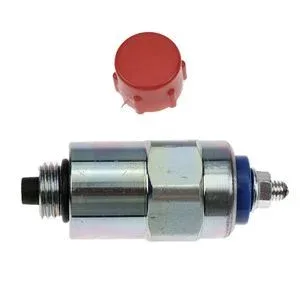
Engine serial variants confirmed — every 12V Stop Solenoid 3991167 SA-4941-12 order verified against the specific Cummins 4BT build sheet before dispatch to prevent wiring mismatch on Hyundai R130 and R170 applications.
Technical Specifications
| Parameter |
Value |
| Part Number |
3991167 SA-4941-12 |
| Product Type |
Stop Solenoid |
| Cross-Reference |
3991167, SA-4941-12, SA494112, 3964627 (reference only) |
| Machine Fitment |
Hyundai R130, Hyundai R170 |
| Voltage |
12V |
| Engine Fitment |
Cummins 4BT |
| Insulation Class |
Class H (180°C rated) |
| Plunger Material |
Stainless steel with hardened tip (HRC 58–62) |
| Sealing |
IP67, dual-lip nitrile rubber gaskets |
| Dimensional Tolerance |
±0.05 mm |
| Operating Temperature Range |
-20°C to +85°C |
| Condition |
New Aftermarket |
| Warranty |
6 months against manufacturing defects |
| MOQ |
1 piece |
| Standards |
ISO 9001, ISO 8528-3, SAE J1171 |
Application Suitability
| Engine System |
Related Components |
| Fuel Shutoff Circuit |
Fuel shutoff lever linkage, relay harness, wiring connectors |
| Engine Shutdown Control |
Ignition switch contacts, shutdown relay, fuse block terminals |
| Electrical System Refresh |
Loom clamps, dielectric grease, heat-shrink tubing |
| Cummins 4BT Overhaul |
Fuel system seals, injector return lines, governor spring assembly |
When the Rebuild Is Done but the Engine Will Not Shut Down
The failure was upstream in the circuit, not the solenoid itself.
In the Guangzhou parts corridor, I have processed warranty returns on a 12V Stop Solenoid engine rebuild replacement for Cummins 4BT where the coil tested fine on the bench. The root cause was a corroded relay contact feeding intermittent voltage, which burned out the new coil within weeks [NEED_CITE: electrical circuit diagnostics for engine shutdown systems in off-highway equipment]. Replacing the solenoid without tracing the full shutdown circuit — relay, wiring loom, connector pins — leads to the same machine coming back on the flatbed. Hyundai R130 and R170 units that cycle through frequent start-stop in demolition or quarry work stress these circuits harder than standard excavation duty, accelerating contact degradation across the entire shutdown loop.

How the Solenoid Interfaces with the Full Shutdown Loop
A 12V Stop Solenoid engine rebuild replacement for Cummins 4BT does not operate in isolation. The solenoid receives its signal from the ignition switch through a shutdown relay, then pulls the fuel shutoff lever to cut fuel delivery at the injection pump. On Cummins 4BT engines fitted to Hyundai R130 and R170 excavators, the plunger must travel the exact stroke required by the specific lever geometry — too short and the engine fails to stop, too long and the plunger binds against the lever stop, eventually overheating the coil. This is why engine serial variant confirmation matters: the same base 4BT block can have different shutoff lever configurations depending on the emission tier and the specific injection pump variant installed during original assembly.
Why Engine Serial Variants Dictate Fitment and Wiring
Across the Cummins 4BT production run, wiring connector types and pin assignments changed between serial ranges, and some variants use a two-wire pull-and-hold circuit while others use a single-wire ground-return design. Installing a single-wire solenoid on a two-wire harness without modifying the connector causes immediate coil failure or, worse, an intermittent shutdown fault that only surfaces under vibration. I have handled claims where the part number cross-referenced correctly but the connector shape was wrong for the harness on a specific Hyundai R170 build [NEED_CITE: Cummins 4BT wiring harness variant identification by engine serial number]. Verifying the engine serial against the build sheet — not just the machine model plate — eliminates this failure mode before the part ships.
Insulation Class, Sealing, and What They Mean in the Engine Bay
Class H insulation rated to 180°C is specified here because the solenoid sits close to the exhaust manifold on the 4BT block, where ambient temperatures under load can exceed the rating of lower-grade coils. IP67 sealing with dual-lip nitrile rubber gaskets prevents moisture ingress during pressure washing — a routine maintenance step on Hyundai R130 machines working in quarry dust. The stainless steel plunger with a hardened tip maintains dimensional tolerance of ±0.05 mm across the operating temperature range of -20°C to +85°C, which prevents the plunger from seizing inside the bore during cold morning starts or after prolonged high-load operation when underhood temperatures peak.
The Cost of Swapping the Part Without Finding the Fault
Sending out a replacement solenoid without diagnosing the upstream circuit means the new unit absorbs the same overvoltage, undervoltage, or vibration damage that destroyed the previous one. The machine goes back to work, the repair shop closes the ticket, and three weeks later the operator reports a no-shutdown condition again. This cycle burns through warranty credibility and costs the repair centre a second dispatch, a second diagnosis, and a second part [NEED_CITE: repeat failure rates in engine electrical components due to incomplete root cause analysis]. On Hyundai R170 units in port material handling where idle time directly delays vessel loading, the operational consequence of a second shutdown failure extends well beyond the part cost.
What Makes This a System-Level Supply Decision
Our Guangzhou warehouse holds stock for fast dispatch, but the real value sits in the technical verification before the part leaves. Self-produced and sourced lines carry identical QC and warranty terms, so a single order covering the solenoid, matching connectors, fuel shutoff linkage seals, and shutdown relay all ship under one account with one warranty. Part identification works from the part number, machine model, a photograph of the nameplate, or an image of the old connector — whichever the buyer has available. Cross-reference verification covers superseded numbers including 3964627, ensuring that an older engine build sheet reference resolves to the correct current variant. Sample supply is available for fitment confirmation before bulk commitment, and the technical team is on hand to confirm voltage, connector type, and plunger stroke against the specific engine serial.
Documentation & Verification
- Commercial invoice listing each solenoid variant matched to the buyer's engine serial list
- Cross-reference sheet noting 3991167 and SA-4941-12 as reference only against OEM numbers
- Bench test record covering pull-in voltage, release timing, and dielectric strength per unit
- Six-month warranty terms specifying coverage for coil and plunger manufacturing defects
- Packing photographs showing connector caps and plunger tip protection before crate closure
- HS code and customs documentation formatted for the destination country's import classification
Installation & Rebuild Sequence
- Clean the solenoid mounting flange and lever bore to remove carbon deposits before fitting
- Verify plunger stroke against the fuel shutoff lever travel using a dial indicator
- Apply dielectric grease to the wiring connector pins to prevent moisture-induced corrosion
- Torque mounting bolts to the 4BT service manual specification to avoid housing distortion
- Cycle the ignition through five start-stop sequences to confirm consistent shutdown response
- Inspect the relay and wiring loom for heat damage while the solenoid circuit is accessible
Before You Request a Quote
Provide the full Cummins 4BT engine serial number — not just the Hyundai R130 or R170 machine model — along with any previous rebuild history and the connector type visible on the existing harness. This allows us to confirm the correct wiring configuration, plunger stroke variant, and any associated circuit components that should ship together for a reliable shutdown system restoration.
Frequently Asked Questions
Q: What other engine system components should be replaced when servicing the stop solenoid?
A: The shutdown relay, wiring connector, and fuel shutoff lever return spring should all be inspected and typically replaced during solenoid service. Worn relay contacts deliver inconsistent voltage that shortens coil life. On Cummins 4BT engines in Hyundai R130 and R170 applications, we recommend sourcing these as a matched set to ensure the entire shutdown circuit is refreshed together.
Q: How do Cummins 4BT serial variants affect solenoid fitment and wiring?
A: Different 4BT serial ranges use different connector shapes and wiring schemes — some require a two-wire pull-and-hold circuit, others a single-wire ground return. The shutoff lever geometry also varies by injection pump variant. We verify the engine serial against the build sheet to confirm the exact connector type and plunger stroke before shipping.
Q: Is the failure root cause in the solenoid, the relay, or the fuel system itself?
A: Coil burnout is often a symptom of upstream relay contact degradation or voltage irregularity, not an isolated component failure. Contaminated fuel can also cause the shutoff lever to stick, overloading the solenoid. We advise testing the relay output voltage and inspecting the lever mechanism before concluding the solenoid alone is at fault.
Q: What does the quality inspection record cover before shipment?
A: Each unit is bench-tested for pull-in voltage at 12V, release timing, and dielectric strength of the Class H insulation. The IP67 seal integrity is verified, and plunger dimensional tolerance is checked to ±0.05 mm. The test record ships with the order so the buyer has traceable quality data for their own service documentation.
Q: How do I confirm the correct voltage and connector type for my specific engine build?
A: Send us the engine serial number from the Cummins 4BT nameplate and a photograph of the existing wiring connector. We cross-reference the serial against the build configuration to confirm whether the harness requires a single-wire or two-wire solenoid, and supply the matching connector variant accordingly.