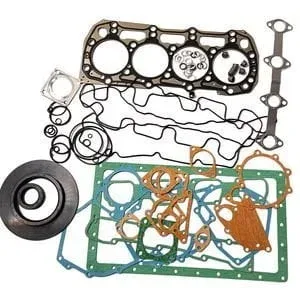
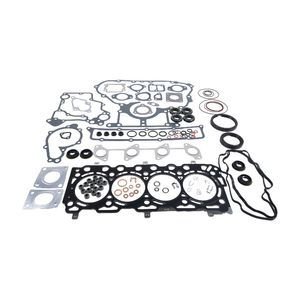
Complete Overhaul Gasket Set — Matched seals verified against Shibaura N844L and N844LT engine serial variants before dispatch
Technical Specifications
| Parameter |
Value |
| Product Type |
Overhaul Gasket Kit |
| Compatible Engine |
Shibaura N844L, N844LT |
| Engine Displacement |
2.2L |
| Condition |
New Aftermarket |
| Standard Compliance |
ISO 9001 |
| Warranty |
3–12 months against manufacturing defects |
| Machine Fitment |
New Holland L170, LS170, C175, L175, LS175, L215, L218, L220, LX665; CASE SR160, SR175, SV185; JCB TLT30, TLT30D |
Application Suitability
| Engine System |
Related Components |
| Cylinder head sealing |
Head gasket, valve cover gasket, head bolt set |
| Crankcase and oil management |
Oil pan gasket, rear main seal, front crankshaft seal |
| Cooling system interfaces |
Thermostat housing gasket, water pump seal |
| Fuel and injection system |
Injector sleeve seals, fuel pump mounting gasket |
Why an Overhaul Gasket Kit for Shibaura N844L Engine Rebuild Often Arrives Incomplete
Verify kit contents against your exact engine serial before the block is torn down.
I spent years around mine sites in Latin America pulling engines apart, and the pattern is always the same: the teardown is done, the block is on the stand, and that is when you discover the overhaul gasket kit for your Shibaura N844L engine rebuild is missing the thermostat housing seal or the wrong injector sleeve O-rings. The N844L and N844LT share a base architecture, but emission system configurations and auxiliary gasket requirements diverge across production runs. [NEED_CITE: engine variant identification practices for compact diesel platforms] A generic parts list cannot account for these differences, and waiting two weeks for a single missing seal while the cylinder block sits exposed is a cost no workshop needs.

System-Level Sealing Coverage Across the 2.2L Diesel Platform
This overhaul gasket kit for Shibaura N844L engine rebuild addresses the full sealing envelope of the 2.2L diesel, from the cylinder head down to the oil pan. The head gasket, valve cover gasket, oil pan gasket, and associated seals ship as a verified set so the rebuild progresses without pausing for individual component orders. Every sealing surface in the top-end and bottom-end assembly is covered, which matters when a single mismatched gasket can cause cross-contamination between oil and coolant circuits.
Engine Serial Variants and the N844LT Difference
The N844LT introduces turbocharged induction and altered emission routing compared to the naturally aspirated N844L, which changes several gasket profiles in the kit. Valve cover bolt patterns, exhaust manifold sealing geometry, and turbo oil return flange gaskets differ between variants. [NEED_CITE: Shibaura N844 series engine variant documentation for aftermarket parts identification] Confirming the engine serial number before kit assembly ensures every gasket matches the specific build configuration, including units that have undergone previous rebuilds where machining may have altered mating surface dimensions.
Material Ratings and Compression Behavior Under Load
The head gasket in this kit uses high-temperature resistant materials rated for the 2.2L diesel operating envelope. Sustained load cycles on skid steers and compact track loaders generate significant thermal cycling, and gasket materials that shrink or lose resilience under repeated heat exposure cause compression loss within the first few hundred hours. Reinforced edges on the head, valve cover, and oil pan gaskets resist deformation in high-vibration duty cycles typical of construction and mining environments. Material compliance and dimensional accuracy are verified through pre-shipment inspection records so the installed set maintains consistent clamping pressure across all sealing surfaces.
The Hidden Cost of Mismatched Gasket Thickness
An engine that has been rebuilt before may have had the cylinder head or block deck machined, reducing the distance between mating surfaces. Standard-thickness gaskets in an overhaul gasket kit for Shibaura N844L engine rebuild will compress beyond their design envelope in that scenario, leading to early failure at the head-to-block interface or oil gallery leaks that contaminate the cooling system. [NEED_CITE: cylinder head machining effects on gasket compression in rebuilt diesel engines] The cost of pulling the head again far exceeds checking rebuild history before ordering. Non-standard gasket thickness may be required, and confirming this during the procurement stage prevents a second teardown within the first season back in service.
Why Rebuild Shops Source This Kit Through XUNPO
Own production lines and qualified sourced supply operate under one account with unified warranty terms, so the overhaul gasket kit ships with the same quality assurance regardless of which facility produced each seal. Eight product categories mean adjacent rebuild components — piston ring sets, bearing shells, valve train parts — consolidate into a single shipment. Engine serial verification is performed before dispatch rather than after delivery, and technical support is available to confirm whether your specific N844L or N844LT variant requires emission-system-specific gaskets. Sample supply is offered for fitment confirmation before bulk commitment on fleet-level rebuild programs.
Documentation & Verification
- Commercial invoice listing each gasket by position and engine serial match
- Cross-reference sheet for OEM part identification (reference only) with variant notes
- Dimensional inspection record covering gasket thickness and bore alignment
- Warranty terms covering manufacturing defects for 3–12 months
- Packing photographs showing kit contents before crate closure
- HS code classification support for customs clearance in destination markets
Installation & Rebuild Sequence
- Clean all mating surfaces to bare metal before positioning head gasket; verify dowel alignment
- Confirm head bolt stretch specifications match your N844L or N844LT service manual
- Install valve cover gasket with sealant at cam tower intersections per engine variant
- Torque oil pan fasteners in sequence to prevent gasket extrusion at corners
- Pressure-test cooling and oil systems before first loaded operation to confirm seal integrity
Requesting a Verified Kit for Your Engine
Provide the engine serial number, any known rebuild history including head or block machining, and the machine model where the engine is installed. This information allows confirmation of variant-specific gaskets and thickness requirements before the kit ships.
Frequently Asked Questions
Q: What exactly is included in this overhaul gasket kit for my specific engine serial?
A: The kit covers head gasket, valve cover gasket, oil pan gasket, and associated seals matched to your N844L or N844LT variant. Exact contents depend on the engine serial number, which determines emission configuration and auxiliary seal requirements. Submit your serial number and we return a complete itemized checklist before shipment.
Q: My engine was rebuilt before — how do I know if standard-thickness gaskets still apply?
A: Previous machining of the cylinder head or block deck reduces the distance between mating surfaces. Standard gaskets may over-compress and fail early. Share the rebuild history or measure the deck height, and we confirm whether oversize or non-standard thickness gaskets are needed for your specific engine.
Q: Are N844L and N844LT gasket kits interchangeable, or do they differ by emission system?
A: They share a base architecture but diverge in turbo oil return, exhaust manifold, and emission-related sealing profiles. The N844LT requires variant-specific gaskets that the naturally aspirated N844L does not. Confirming the engine serial number is the only reliable way to ensure the correct kit.
Q: What other engine components should be inspected or replaced during the same overhaul?
A: Piston rings, bearing shells, valve stem seals, and head bolts should all be evaluated during the same teardown. Running new gaskets against worn rings or stretched head bolts undermines the entire rebuild. We consolidate matched components across all engine sub-systems into one verified shipment.
Q: How do I confirm the engine model when the nameplate is worn or painted over?
A: Submit a photograph of the engine block, particularly the casting numbers near the oil filter housing or bell housing flange. Our technical team cross-references casting marks against known N844L and N844LT production configurations to identify the correct variant even without a legible nameplate.