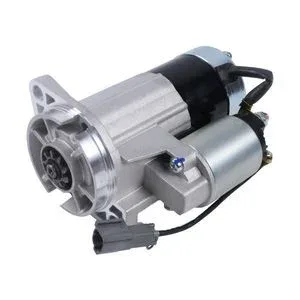
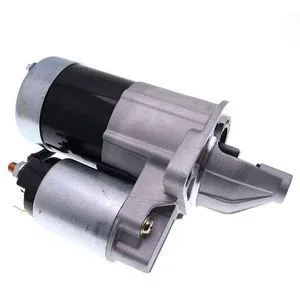
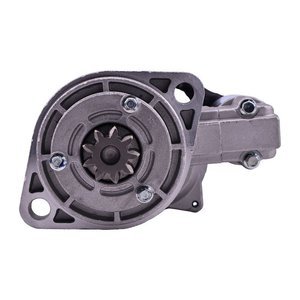
Matched System Sets — Each 23300-FU410 ships only after engine serial and flywheel ring gear tooth count are confirmed against the K-series build variant.
Technical Specifications
| Parameter |
Value |
| Part Number |
23300-FU410 |
| Product Type |
Starter Motor |
| Cross-Reference |
23300-FU410, 23300FU410, 23300-GS20A, 23300GS20A, M000T65381, M0T65381, M0T65581, 114479, 91H2003330, 91H20-03330, 18973N (reference only) |
| Machine Fitment |
Nissan K15, K21, K25 engine applications (excavators, loaders, industrial generators) |
| Voltage |
12V |
| Power Output |
1 kW |
| Rotation |
CW (Clockwise) |
| Number of Teeth |
9T |
| Condition |
New Aftermarket |
| Warranty |
3–12 months |
| Manufacturing Standard |
ISO 9001 (manufacturing partners) |
Application Suitability
| Engine System |
Related Components |
| Starting & Ignition Circuit |
Solenoid relay, battery cables, terminal lugs, ignition switch |
| Flywheel Assembly |
Ring gear (tooth count and wear state), flywheel bolts |
| Engine Rebuild Auxiliary |
Starter drive gear, bushings, mounting fasteners, heat shield |
| Charging System |
Alternator output verification, voltage regulator, belt tension |
Why a Fresh Starter Fails Weeks After Installation
The starter is rarely the root cause — the circuit and mating surfaces are.
In mining and heavy construction environments running Nissan K-series powerplants, a replaced 23300-FU410 starter motor often burns out within weeks because the underlying fault was never addressed. Corroded battery cable terminals, undersized wiring, or a worn flywheel ring gear create voltage drop and mechanical misalignment that destroy the new unit just as they destroyed the old one. [NEED_CITE: electrical circuit voltage drop diagnostic procedures for heavy-duty diesel starting systems] Field experience across West African sites shows that condemning the starter without checking the solenoid trigger voltage and ring gear tooth condition leads to repeat failures that get blamed on part quality. The 23300-FU410 starter motor engine rebuild replacement cycle becomes a costly loop until the system is diagnosed as a whole.

The Starter's Place Inside the K-Series Engine System
The 23300-FU410 belongs to the engine auxiliary system on Nissan K15, K21, and K25 platforms. It is not an isolated component — its pinion gear meshes directly with the flywheel ring gear, and its solenoid draws current through the same circuit that feeds the ignition switch and safety interlocks. During an engine overhaul, this starter motor should be inspected as part of a matched set that includes the drive gear, pinion bushings, and mounting hardware. Replacing the 23300-FU410 starter motor engine rebuild replacement unit without verifying the condition of these adjacent parts invites premature wear on the new assembly.
Engine Serial Variants and Mounting Pattern Differences
Nissan K-series engines span multiple build generations, and the starter mounting pattern, port orientation, and electrical connector type can differ between early and late serial ranges. A 23300-FU410 cross-reference number may cover variants with different flange configurations or solenoid terminal positions. Before committing to a bulk order, confirm the engine serial number and compare the old unit's mounting face, bolt hole spacing, and connector pin layout against the replacement. [NEED_CITE: Nissan K-series engine serial range variant identification for auxiliary components] Sending a photograph of the existing starter nameplate and the engine block casting number allows the technical team to verify the correct variant before dispatch.
Reading the Specifications That Matter at Rebuild Time
The 12V / 1 kW rating defines the cranking torque available for cold starts on K25 engines operating in high-ambient-temperature environments. A 9-tooth pinion must match the flywheel ring gear tooth count precisely — even a single tooth difference in the ring gear specification causes partial engagement and rapid gear wear. Clockwise rotation is standard for Nissan K-series crank orientation, and installing a counter-rotation unit (from a different engine family sharing the same OEM reference number) will spin the engine backwards, causing valve train damage within seconds. The 1 kW output is adequate for K15 and K21 applications but sits at the lower boundary for K25 engines with high-compression rebuilds, so verifying the compression ratio after a bore-out is essential before finalizing the starter selection.
The Cost of Skipping Root-Cause Diagnosis
Installing a new starter without tracing the failure back through the electrical circuit creates a pattern of repeat purchases that masks the real problem. Undersized battery cables generate voltage drop under cranking load, starving the solenoid and causing the pinion to engage partially — this grinds the 9T gear against the ring gear until both are destroyed. A workshop that replaces only the starter will see the same machine return within weeks, and the cumulative downtime across a fleet of Nissan K25-powered excavators becomes a significant operational loss. [NEED_CITE: starting system root cause analysis checklist for industrial diesel engines] Matching the 23300-FU410 starter motor engine rebuild replacement to a verified circuit condition prevents this cycle.
Why Source This Component Through XUNPO
Both self-produced and qualified sourced supply lines carry identical QC and warranty terms, so the 23300-FU410 ships under the same coverage regardless of production origin. Eight product categories mean the starter, solenoid relay, ring gear, and overhaul gaskets consolidate under one account and one consignment. Minimum order starts from one piece — critical when a single machine is down and a sample is needed before fleet-wide commitment. Part identification works from a part number, machine model, photograph, or nameplate image, which matters when the original label is painted over or corroded. Cross-reference verification covers superseded and alternate numbers across K-series build generations. A technical team is available to confirm compatibility, grade, and engine serial matching before the order is placed.
Documentation & Verification
- Commercial invoice and packing list referencing the specific 23300-FU410 variant shipped
- Part compatibility and cross-reference sheet mapping OEM numbers (reference only) to engine serial ranges
- Quality inspection record covering voltage output, rotation direction, and 9T pinion engagement depth
- Warranty terms document stating coverage scope for manufacturing defects
- Packing photographs showing unit condition and protective wrapping before crate closure
- HS code and customs documentation support for international engine parts shipment
Installation & Rebuild Sequence
- Clean the starter mounting face and engine block mating surface to prevent misalignment of the 9T pinion with the ring gear
- Verify solenoid trigger wire voltage at the terminal before connecting the new 23300-FU410 unit
- Torque mounting bolts to engine manual specification in sequence to avoid flange distortion
- Inspect flywheel ring gear teeth for hooking or spalling before mating the starter drive gear
- Perform a no-load bench test confirming clockwise rotation before installing on the K-series engine
- Run initial cranking cycles and measure voltage drop across battery cables under load
Request the Right Match for Your Rebuild
Provide the engine model (K15, K21, or K25), engine serial number, and any previous rebuild history including bore size and compression changes. If the nameplate is unreadable, send a photograph of the old starter mounting face, electrical connector, and the engine block casting number. This information allows the technical team to confirm the correct 23300-FU410 variant and identify any adjacent components that should be replaced as a matched set during the overhaul.
Frequently Asked Questions
Q: What other engine-system parts should I inspect or replace when changing the starter?
A: Inspect the flywheel ring gear for tooth wear, check battery cable gauge and terminal condition, test the solenoid relay for proper trigger voltage, and examine the starter mounting bushings. On K-series engines already opened for rebuild, replace the starter drive gear and associated fasteners as a matched set to prevent misalignment with the new 23300-FU410 unit.
Q: How do I confirm the correct starter variant for my specific Nissan K-series engine serial?
A: Provide the engine serial number and, if possible, a photograph of the old unit's mounting face and electrical connector. Nissan K-series engines have variant differences in flange configuration and solenoid terminal position across build generations. The technical team cross-references the serial against known configurations before confirming the 23300-FU410 match.
Q: What is the root-cause checklist before condemning the starter motor?
A: Measure voltage drop across battery cables under cranking load, verify solenoid trigger voltage at the terminal, inspect the flywheel ring gear for damaged teeth, and check all ground connections for corrosion. A starter that appears faulty is often the victim of circuit resistance or mechanical misalignment rather than an internal defect.
Q: Are matched overhaul kits available that include starter-adjacent components?
A: Yes. Overhaul kits for Nissan K15, K21, and K25 platforms can include the starter drive gear, pinion bushings, mounting hardware, and electrical connectors alongside the core engine rebuild components. Consolidating these into one consignment ensures compatibility and avoids the delays of sourcing adjacent parts separately.
Q: How do I verify engine model when the nameplate is worn or missing?
A: Send photographs of the engine block casting number, the cylinder head casting, and any visible serial stamps on the block. The technical team uses these markings along with machine model and application context to identify the exact K-series variant and confirm the correct 23300-FU410 starter motor engine rebuild replacement specification.