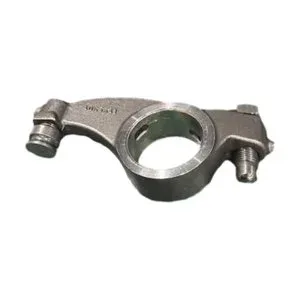
Verified Engine Variant Match — Rocker Arm Assembly 3052170/3047479 checked against your Cummins or John Deere engine serial to confirm internal tolerance and sequence variant before shipment.
Technical Specifications
| Parameter |
Value |
| Part Number |
3052170/3047479 |
| Product Type |
Rocker Arm |
| Cross-Reference |
3052170, 3052170RX, 3047479 (reference only) |
| Machine Fitment |
Cummins NT855, N14, NH855, G855, CM558, NTA855A / John Deere 6810, 6910 |
| Material |
Forged alloy steel (source value — verify against manufacturer catalog) |
| Surface Treatment |
Heat-treated contact pads (source value — verify against manufacturer catalog) |
| Assembly State |
Assembly |
| Standard |
SAE J431 G10500 |
| Certification |
ISO 9001 |
| Warranty |
3–12 months against manufacturing defects |
| MOQ |
1 piece |
Application Suitability
| Engine System |
Related Components |
| Valve Train (NT855 / N14 rebuild) |
Pushrods, valve stems, rocker shaft bushings |
| Cylinder Head Assembly (6810 / 6910) |
Valve springs, injector linkage, crossheads |
| Emission & Exhaust Timing |
Cam followers, timing gear wear surfaces |
| Single-Cylinder Repair Scope |
Gasket set, valve guide seals, retaining hardware |
Rocker Arm Assembly Engine Rebuild: Why System Context Decides the Outcome
A replacement rocker arm that fits the shaft but ignores the underlying valve train wear pattern will fail again within a predictable window.
When an engine comes in for rebuild, the focus often lands on the visibly failed component. The rocker arm shows wear, so it gets swapped. But if the pushrod that drove it was already bent slightly, or if the cam lobe feeding that cylinder has lost profile, the new part inhe*ns NT855 in a Nigerian quarry return to the bench after a few hundred hours because the previous shop replaced the rocker but never measured the adjacent pushrod runout [NEED_CITE: diesel engine valve train alignment tolerances during overhaul]. The failure was not in the new part. It was in the decision to treat it as an isolated repair.

Matching the Rocker Arm to the Rest of the Valve Train
The Rocker Arm Assembly 3052170/3047479 operates within a chain of components that translate cam rotation into valve movement. Every interface in that chain carries tolerance accumulation. If the valve stem tip has developed a concave wear pattern, the rocker contact pad will concentrate load on a smaller area regardless of how well the pad itself was heat-treated. This is why engine rebuild shops that quote a rocker arm without also inspecting or replacing the mating pushrod and checking valve stem condition regularly see premature repeat failures [NEED_CITE: valve train wear cascade in heavy-duty diesel rebuilds].
Engine Serial Variants That Change the Part You Actually Need
Cummins NT855 and N14 engines share a lineage but differ in internal geometry across production runs. The NTA855A variant, common in certain John Deere 6810 and 6910 applications, carries specific rocker ratio requirements that do not interchange freely with the base NT855 specification. An engine that has been through a prior rebuild may also have modified clearances if oversized components were installed previously. Confirming the engine serial number and reviewing any known rebuild history prevents shipping a rocker arm that physically mounts but produces incorrect valve lift and timing events.
Reading the Specifications That Matter at the Bench
The forged alloy steel body of this rocker arm provides the bulk strength to handle repeated impact loading from the pushrod. The heat-treated contact pads address the specific wear mechanism at the valve stem interface, where sliding friction combines with high contact pressure. SAE J431 G10500 material classification governs the base metallurgy, which matters when the engine operates under sustained high-load conditions such as quarry crushing or continuous agricultural duty. What the specifications do not tell you is whether the shaft bore in your existing rocker shaft is still within tolerance — a worn shaft will allow oil pressure loss and rocker instability regardless of the arm's own quality [NEED_CITE: rocker shaft bore wear limits in inline six diesel engines].
The Cost Hidden Inside a Mismatched Rebuild
A rocker arm installed without checking the root cause of the previous failure creates a specific pattern of repeat downtime. The new part fails at the contact pad within a shortened interval. The engine comes back to the bench. The shop absorbs labor for a second teardown. The customer loses confidence. None of this registers as a warranty claim on the part itself because the part was not defective — the system around it was not addressed. This is the most common pattern I have seen across mining fleet rebuilds where procurement focuses on individual line items rather than system-level matching.
Supply That Accounts for the Full Rebuild Scope
Production on selected part lines combined with qualified sourced supply under one account means the rocker arm ships alongside the pushrods, gaskets, and seals the job actually requires. Eight core categories allow a complete valve train overhaul to dispatch as a single consignment rather than arriving in staggered shipments from multiple vendors. One-piece minimum order supports the single-cylinder repair that cannot wait for a full engine rebuild. Part identification from engine model, serial number, or nameplate photograph resolves situations where the old part number is no longer legible. Cross-reference verification covers superseded numbers across NT855 and N14 generations. Sample supply allows fitment confirmation before bulk commitment on fleet-level orders. Technical support confirms whether your specific engine variant requires the 3052170 or 3047479 configuration.
Documentation & Verification
- Commercial invoice listing each rocker arm by confirmed engine serial variant
- Cross-reference sheet mapping 3052170 and 3047479 to applicable engine ranges (reference only)
- Dimensional inspection record covering bore diameter and contact pad hardness
- Warranty terms specifying coverage for manufacturing defects over 3–12 months
- Packing photographs showing shaft bore protection during transit
- HS code documentation for customs clearance at destination port
Installation & Rebuild Sequence
- Clean rocker shaft thoroughly before installation to prevent bore scoring on the new assembly
- Verify pushrod straightness and replace any showing measurable runout before fitting the rocker arm
- Confirm valve lash adjustment per engine manual specification after the rocker arm is torqued to shaft
- Check oil flow through the rocker shaft bore during initial priming before engine start
- Monitor valve train noise during the first operating hours to confirm correct seating and lubrication
Requesting a Matched Quote for Your Rebuild Scope
To receive an accurate quotation, provide the engine model, serial number, and any known rebuild history so the correct variant can be confirmed. If the existing part number is unreadable, a photograph of the nameplate or the old rocker arm beside a ruler allows identification. Include any adjacent components you need for the same job so everything dispatches together.
Frequently Asked Questions
Q: Does the standard overhaul kit include rocker arms and related valve train hardware?
A: Most standard overhaul kits cover pistons, rings, bearings, and gaskets but exclude rocker arms unless specifically listed. Valve train components are often quoted separately because wear varies significantly between engines. We can supply the rocker arm assembly alongside pushrods, valve springs, and seals as a consolidated package matched to your engine serial number.
Q: Are rocker arms interchangeable across different serial numbers of the same Cummins engine model?
A: Not always. The NT855 and N14 families have production variations that affect rocker ratio, shaft diameter, and mounting geometry. The NTA855A variant used in certain John Deere applications has specific requirements. Providing your engine serial number allows us to confirm which configuration applies before shipment.
Q: What other components should be inspected when replacing a rocker arm?
A: The pushrod for straightness, the valve stem tip for wear pattern, the rocker shaft bore for scoring or oversize condition, and the cam lobe profile for that cylinder. Addressing only the rocker without checking these adjacent interfaces risks repeating the same failure within a shortened service interval.
Q: Can I order a sample to confirm fitment before placing a bulk order?
A: Yes. Sample supply is available for fitment confirmation on your specific engine before committing to a larger quantity. This is particularly useful when dealing with engines that have been through prior rebuilds with modified clearances or when the exact variant is uncertain.
Q: How do I identify the correct part number if my existing rocker arm marking is worn off?
A: Send a photograph of the old part alongside a ruler or caliper for scale, along with the engine nameplate or serial number if available. Our technical team can cross-reference the physical dimensions and engine variant to confirm whether the 3052170 or 3047479 configuration is correct for your application.