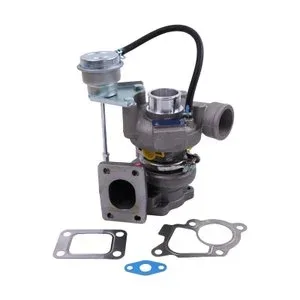
Matched Overhaul Supply — Each RHF3H turbocharger ships verified against engine serial variants and rebuild history to prevent mis-match on the bench.
Technical Specifications
| Parameter |
Value |
| Part Number |
7000677 7020831 |
| Product Type |
Turbocharger |
| Cross-Reference (reference only) |
7000677, 7020831 |
| Machine Fitment |
Bobcat S160, S185, S205, S550, S570, S590, T180, T190, T550, T590 |
| Engine Compatibility |
Kubota V2607-DI, V2607T |
| Turbine Wheel Material |
Precision-forged nickel-chromium alloy |
| Bearing Type |
Dual ceramic ball bearing assembly |
| Compressor Housing Tolerance |
±0.02 mm |
| Sealing Surface Treatment |
Electroless nickel plating (25–30 μm thickness) |
| Boost Pressure Validation |
1.2 bar |
| Max Exhaust Gas Temperature |
720°C |
| Leakage Rate |
<0.15 L/min at 1.5 bar |
| Vibration Amplitude |
<2.1 mm/s RMS |
| Condition |
New Aftermarket |
| Warranty |
6 months against manufacturing defects |
| Quality Standard |
ISO 9001 |
Application Suitability
| Engine System |
Related Components |
| Emission & Exhaust |
Turbo mounting gaskets, exhaust manifold studs, heat shields |
| Lubrication (oil feed to turbo) |
Oil feed line, restrictor orifice, oil drain tube, crankcase breather |
| Air Intake |
Intake duct seals, air filter element, charge air hose clamps |
| Engine Block Overhaul |
Piston rings, main and rod bearings, cylinder head gasket set |
| Fuel System (root-cause checks) |
Injection pump timing, injector spray pattern, fuel return line |
Why Replacing the Turbo Alone Rarely Solves the Problem
A burned-out RHF3H turbocharger engine rebuild part is almost always a symptom, not the cause.
Walk into any rebuild bay and you will find shelves stacked with turbos that failed within weeks of installation. The pattern is familiar: the old unit came off, the new one went on, and the same oil starvation or exhaust leak destroyed it again. A blocked oil return line, a cracked exhaust manifold gasket, or excessive crankcase pressure will kill a replacement unit just as fast as the original [NEED_CITE: common root causes of repeat turbocharger failure in diesel engines]. Mechanics learn this the hard way — I have seen a Kubota V2607-DI burn through a fresh unit in two weeks because nobody checked the drain tube. That machine went back on the lift, the owner lost days of revenue, and the shop absorbed a warranty claim that was never really a turbo defect.

The Exhaust and Intake System This Turbo Lives Inside
Every RHF3H turbocharger engine rebuild part sits at the intersection of three fluid circuits — exhaust gas, pressurized intake air, and engine oil. When planning an overhaul on a V2607-DI or V2607T, treating the turbo as an isolated swap ignores the system it operates within. The exhaust manifold gasket surface must be flat within specification, the intake duct seals must hold boost without leaking, and the oil feed restrictor must deliver the correct volume. Miss any one of these and the new turbo absorbs the consequence.
Matching Oil Feed Geometry to Rebuild History
Previous overhauls introduce variables that affect turbo survival. If the block was bored and fitted with oversize bearings, oil clearance and pressure change. A turbo that expects a specific feed pressure may receive less, causing the dual ceramic ball bearing assembly to run starved during cold starts. Shops that rebuild Kubota engines regularly know to verify oil pressure at the turbo feed port before signing off [NEED_CITE: oil pressure verification at turbocharger feed port during diesel engine rebuild]. When the RHF3H turbocharger engine rebuild part arrives, the electroless nickel-plated sealing surfaces should mate cleanly with feed and drain fittings that have been inspected — not reused blindly from the previous engine build.
Reading the Specification Sheet Like a Rebuilder
The nickel-chromium alloy turbine wheel handles the thermal cycle of a compact diesel exhaust stream, where peak temperatures during heavy loading reach toward the rated 720°C limit. What matters at the bench is the ±0.02 mm compressor housing tolerance — this controls the air-gap balance between compressor and turbine sides, and any deviation shifts boost pressure off the validated 1.2 bar target. The vibration amplitude figure (<2.1 mm/s RMS) tells you the rotating assembly was balanced as a unit; if the turbo is dropped or the compressor wheel is nicked during handling, that balance is gone. Leakage validation at <0.15 L/min confirms the shaft seals will hold under normal crankcase pressures without weeping oil into the intake tract.
The Cost of Skipping Root-Cause Diagnosis
When a shop bolts on a new turbo without tracing the original failure, the machine returns with the same complaint — low power, smoke, or oil consumption — and the customer loses confidence. The second teardown costs labor hours, gasket sets, and reputation [NEED_CITE: financial impact of repeat engine repairs on contractor equipment utilization]. An RHF3H turbocharger engine rebuild part installed over a blocked drain or leaking exhaust manifold is not a warranty case; it is a diagnostic failure. Rebuilders who skip this step end up absorbing the cost themselves.
Why Source This Turbocharger Here
Selected turbocharger lines are produced in our own facility while the remainder is sourced from ISO-certified manufacturing partners, so both carry the same quality control and six-month warranty. The eight product categories mean an entire V2607 overhaul kit — turbo, gaskets, piston rings, bearings — ships under one account and one consignment. Orders start at one piece, so a single emergency turbo for a downed Bobcat S550 does not require padding a minimum. Guangzhou warehouse stock enables fast dispatch on common configurations. Part identification works from a part number, machine model, or a photograph of a worn nameplate — and cross-reference verification covers superseded numbers that other sellers carry forward without checking. A sample unit can be supplied for fitment confirmation before any bulk commitment.
Documentation & Verification
- Commercial invoice and packing list itemizing turbocharger and matched gasket set
- Compatibility and cross-reference sheet marking 7000677 and 7020831 as reference only
- Quality inspection record with boost pressure, leakage, and vibration test results
- Six-month warranty terms covering manufacturing defects from dispatch date
- Packing photographs showing anti-static foam and sealed carton before crate closure
- HS code and customs documentation prepared for engine parts classification
Installation & Rebuild Sequence
- Clean the turbo oil feed port and drain passage on the block before fitting the RHF3H unit.
- Verify oil restrictor orifice diameter matches the Kubota V2607 service specification.
- Torque exhaust manifold and turbo mounting nuts in staged sequence to seat gaskets evenly.
- Prime the oil feed line before first crank to prevent dry-start bearing damage.
- Run the engine at idle for initial break-in and check for exhaust and oil leaks at all flanges.
Requesting a Matched Rebuild Quote
Provide the engine serial number and any prior rebuild history — including whether oversize bearings or modified components were installed. If the machine model is known but the engine plate is unreadable, send a photograph of the block casting number. This allows us to confirm the correct turbocharger variant, the compatible gasket set, and whether the oil feed geometry aligns with the current engine build.
Frequently Asked Questions
Q: What other components should be replaced alongside the turbocharger during an engine overhaul?
A: The turbocharger oil feed line, drain tube, exhaust manifold gasket, intake duct seals, and crankcase breather should all be inspected and typically replaced as a matched set. Reusing any of these introduces unknown wear into a system that depends on clean oil delivery and sealed exhaust and intake paths to protect the new turbo.
Q: Does the V2607-DI have internal variants that affect turbo fitment across different production years?
A: Yes. Engine serial ranges within the V2607 family can differ in oil feed port position, drain flange bolt pattern, and compressor housing orientation. Providing the full engine serial number allows verification of the correct variant rather than relying on model number alone, which may cover several production configurations.
Q: How do I diagnose whether the turbo failed on its own or due to an upstream engine system issue?
A: Inspect the oil feed and drain lines for blockage, measure oil pressure at the turbo feed port, check exhaust manifold gasket integrity, and test crankcase pressure. If any of these fall outside specification, the root cause lies in the engine system rather than the turbocharger itself.
Q: Can I source a matched overhaul kit that includes this turbocharger with the correct gaskets and seals?
A: Yes. A complete overhaul supply — turbocharger, engine gasket set, piston ring set, bearing shells, and all associated seals — can be consolidated under a single order. Specify the engine serial number and rebuild scope so every component is matched to the same engine build.
Q: What engine serial information do you need to confirm the right turbo variant for my rebuild?
A: The full engine serial number from the Kubota nameplate, or a photograph if the plate is worn. This identifies the production variant, oil feed configuration, and any superseded part numbers. If the plate is missing, the machine model and approximate year narrow the range for cross-reference verification.