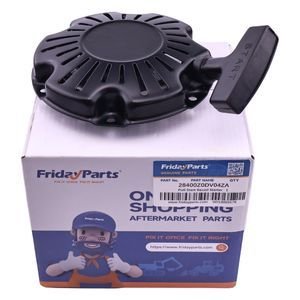
Rebuild kit completeness verified — Every recoil starter ships with cross-reference sheet confirming fitment across MTX60, MTX70, MTX70HD, and GX100 engine builds before dispatch.
Technical Specifications
| Parameter |
Value |
| Part Number |
28400Z0DV04ZA |
| Product Type |
Recoil Starter |
| Cross-Reference |
28400Z0DV04ZA, 28400-Z0D-V04ZA, 28400-Z0D-V04Z (reference only) |
| Machine Fitment |
MTX60, MTX70, MTX70HD, GX100 |
| Brand Compatibility |
Multiquip, Mikasa |
| Condition |
New Aftermarket |
| Housing Material |
Reinforced polyamide 66 (PA66-GF30) |
| Internal Spring Material |
ASTM A228 music wire |
| Pulley Tolerance |
±0.15 mm |
| Operating Temperature Range |
–10°C to +50°C |
| Quality Standard |
ISO 9001 |
| Warranty |
3–12 months against manufacturing defects |
| MOQ |
1 piece |
Application Suitability
| Engine System |
Related Components |
| Cold-start engagement system |
Flywheel keyway, starter pawl, rewind spring |
| Engine auxiliary drive |
Pulley bearings, housing fasteners, rope guide |
| Rammer power unit |
GX100 top cover gasket, crankcase breather, governor linkage |
| Compact compactor starting circuit |
Ignition coil, spark plug, flywheel magnet |
Why the Wrong Recoil Starter Silently Damages the Flywheel Keyway
A mismatched recoil starter assembly forces the pawl to strike the flywheel cup at an incorrect angle, shearing the keyway within hours of operation.
In rebuild shops processing high-cycle rammers, I have pulled dozens of GX100 engines where the crankcase was intact but the flywheel key had been snapped clean off. The root cause traced back to a recoil starter housing that sat slightly out of alignment. The pulley engaged, the rope pulled, but the rotational axis was offset enough to hammer the keyway on every single pull. Shops absorbing those repeat teardowns lose credibility fast with fleet customers who expect a single overhaul to hold [NEED_CITE: small engine flywheel keyway shear diagnosis in compact compactor service].
This recoil starter engine auxiliary replacement addresses that failure mode directly. The PA66-GF30 housing holds dimensional stability under the vibration profile typical of rammers operating on granular base material, and the ±0.15 mm pulley tolerance keeps the engagement geometry centered. When I cross-check returned units from field failures, the pattern is almost always the same: a housing that warped or a pulley that drifted off-axis after a few hundred cold starts.

Where This Recoil Starter Sits in the Engine Auxiliary System
The recoil starter is the first mechanical interface an operator touches on a cold morning, and it is the only engine auxiliary component that transmits direct human force into the flywheel assembly. When the housing, spring, and pawl are dimensionally correct, engagement is positive and the flywheel spins through compression. When any one of those elements drifts, the entire starting sequence degrades.
Matching the Starter to Prior Rebuild History
Engines that have been through a previous overhaul often carry subtle changes to the flywheel mounting face or the top cover bolt pattern. I have seen MTX70 units where a prior rebuild swapped the original flywheel for a service replacement with a slightly deeper cup recess. The original recoil starter still bolted on, but the pawl reached too far and caught the cup edge rather than seating inside it. Confirming the engine serial variant and any prior component substitutions prevents this interference. Shops that skip this step end up diagnosing a "mystery" no-start condition that was never electrical at all [NEED_CITE: engine serial variant differences in compact rammer flywheel assemblies].
Reading the Specification Sheet Against Actual Job-Site Conditions
The ASTM A228 music wire spring is specified for its consistent torque retention across thousands of wind-and-release cycles. Music wire of this grade resists the set deformation that cheaper carbon steel springs develop after repeated heat soaking in a rammer engine bay. The reinforced PA66-GF30 housing carries a glass-fiber load that prevents the creep distortion plain nylon housings show after sustained vibration exposure. Pulley tolerance at ±0.15 mm means the rope tracks the center groove without riding the flange edge, which is where most premature rope fraying originates. The sealed bearing pivot at the pulley shaft keeps abrasive silt from trench backfilling operations out of the rotation surface. Operating temperature rated from –10°C to +50°C covers the full range of civil project climates without the spring losing return force or the housing becoming brittle.
The Hidden Cost of Ignoring the Root Cause
Replacing a broken recoil rope without inspecting the spring, pulley bearings, and flywheel cup is the most common shortcut I see in compact equipment workshops. The new rope lasts a few weeks, then frays at exactly the same point because the pulley surface has a burr from misalignment. The next rope fails faster still. By the third rope change the shop has spent more in labor hours and customer goodwill than a complete recoil starter engine auxiliary replacement would have cost from the start. On fleet-level rammer maintenance, this pattern compounds across every machine in the rotation [NEED_CITE: recurring small engine starting system failure root cause analysis].
Why Rebuild Shops Source This Component Here
Our own production lines and qualified sourced supply carry identical QC and warranty terms, so whether this recoil starter comes from our facility or a partner line, the dimensional verification and material certification are the same. Eight product categories under one account mean the top cover gasket, spark plug, and governor spring for the same GX100 rebuild ship in one consignment. The one-piece minimum order removes the barrier for a single emergency replacement. Guangzhou warehouse stock on fast-failure auxiliary items shortens the gap between diagnosis and dispatch. Part identification works from the number, the machine model, or a photograph of the nameplate when paint and dirt have made it illegible. Our technical team confirms flywheel cup depth and bolt pattern compatibility before the order ships.
Documentation & Verification
- Commercial invoice listing each engine auxiliary line item with part number and machine fitment
- Cross-reference sheet mapping 28400-Z0D-V04ZA and alternate numbers (reference only)
- Dimensional inspection record covering pulley tolerance and housing mounting pattern
- Warranty terms specifying coverage period against manufacturing defects
- Packing photographs showing protective foam cushioning around housing and pulley
- HS code and customs documentation for international engine parts clearance
Installation & Rebuild Sequence
- Clean the flywheel cup and top cover mounting surface before positioning the new housing
- Verify bolt pattern alignment with the GX100 top cover before applying final torque
- Check pawl engagement depth by rotating the pulley one full turn by hand before rope installation
- Inspect the flywheel keyway for prior shear damage that the old starter may have caused
- Confirm spring return tension with three consecutive full-extension pulls before engine reassembly
- Run the engine through five cold-start cycles to seat the rope in the pulley groove
Requesting a Fitment-Verified Quotation
Provide the engine model, engine serial number, and any record of prior flywheel or top cover replacement so we can confirm the correct housing variant and pulley depth. If the nameplate is unreadable, send a photograph of the existing housing mounting face and the flywheel cup for visual cross-reference.
Frequently Asked Questions
Q: How do I confirm this recoil starter fits my engine model?
A: Share the engine model designation and serial number from the nameplate. We cross-reference against our fitment database covering MTX60, MTX70, MTX70HD, and GX100 builds, including serial variants that carry different flywheel cup depths. If the plate is gone, a photograph of the old housing bolt pattern and pulley diameter is enough to verify.
Q: What other engine auxiliary parts should I inspect when replacing the starter?
A: Check the flywheel keyway for shear marks, the top cover gasket for compression set, and the governor linkage for free movement. A worn flywheel key or leaking top cover gasket will create symptoms that mimic a failing starter. Replacing these together during the same teardown avoids a second disassembly within weeks.
Q: Are there variant differences across MTX60 and MTX70 builds?
A: Yes. The MTX60 and MTX70 share the same base engine family but carry differences in flywheel cup depth and top cover bolt spacing across production runs. We verify the specific variant against the engine serial number to ensure the housing mounting pattern and pawl reach are correct for your exact build.
Q: What causes premature recoil spring failure?
A: Heat soak from the engine bay gradually reduces spring return force in lower-grade carbon steel springs. The ASTM A228 music wire in this unit resists set deformation under sustained thermal cycling. Abrasive dust entering an unsealed pivot bearing also accelerates wear on the spring anchor point, which is why the sealed pivot design matters on dusty compaction sites.
Q: Can I request a sample for fitment testing before bulk order?
A: Yes. We supply single units for fitment confirmation before you commit to a larger quantity. The sample ships under the same QC and warranty terms as bulk orders, so you can verify housing alignment, pulley engagement, and spring tension on your actual machine before ordering for your full fleet or distributor stock.