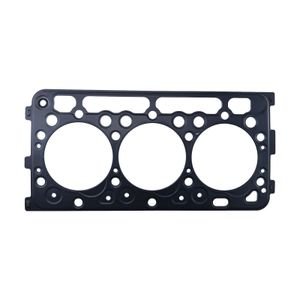
Matched Sets Shipped Together — cylinder head bolts verified against engine serial and rebuild history before dispatch, ensuring torque specs align with your block's actual condition.
Technical Specifications
| Parameter |
Value |
| Part Number |
04151904 |
| Product Type |
Cylinder Head Bolt |
| Cross-Reference |
04151904, 4151904, 2101681 (reference only) |
| Machine Fitment |
BF4L913, BF6L913, F3L912, F3L912W, F4L912, F5L912, F6L912 |
| Brand Compatibility |
DEUTZ |
| Condition |
New Aftermarket |
| Quality Standard |
ISO 9001 Certified |
| Warranty |
3–12 months against manufacturing defects |
| MOQ |
1 piece |
Application Suitability
| Engine System |
Related Components |
| Cylinder Head Fastening |
Head Gasket, Valve Stem Seals, Intake/Exhaust Manifold Gaskets |
| Top-End Overhaul |
Valve Guides, Valve Springs, Rocker Arm Bushings |
| Complete Engine Rebuild |
Piston Rings, Main Bearings, Con-Rod Bearings, Crankshaft Seals |
| Decarbonization Service |
Combustion Chamber Cleaning Kit, Injector Sleeve Seals |
When the Head Comes Off but the Bolts Haven't Arrived
A teardown reveals stretched head fasteners only after the cylinder head is already on the bench. The gasket set arrived on time, but the replacement Cylinder Head Bolt 04151904 for Deutz engine rebuild kits is still in transit, leaving a partially disassembled engine occupying your bay.
Yield-type fasteners on air-cooled Deutz 912 and 913 series engines cannot be reused once they exceed their elastic limit, and that limit is often reached during the initial factory torque sequence. Reusing them risks uneven clamping load across the head face. [NEED_CITE: torque-to-yield fastener reuse standards in diesel engine rebuilding] This is why the bolts must be treated as a mandatory replacement item every time the head is removed, not an inspection-and-reuse component.
The Fastening System Behind Every Successful Head Rebuild
Every Cylinder Head Bolt 04151904 compatible with Deutz BF4L913 functions as part of a calibrated clamping system. The bolt's yield point, the head gasket's compression recovery, and the block's thread condition all interact to maintain sealing pressure across combustion cycles. If any one element is out of specification, the others compensate briefly before the leak path opens.
This means the bolt is never just a bolt — it is the controlling element in a system that includes the head gasket, valve stem seals, and manifold gaskets. Sourcing them as a matched group from one supplier ensures dimensional consistency across the entire sealing interface.
Block Thread Condition and Rebuild History
Engines that have seen previous overhauls often present thread damage in the block's bolt holes. Helicoil inserts or thread chasing alter the effective engagement depth, which changes how the bolt stretches under torque. A standard Cylinder Head Bolt 04151904 designed to replace the original specification assumes virgin or correctly restored threads. [NEED_CITE: thread repair impact on fastener clamp load in cast iron blocks]
The 912 and 913 families share a common architecture but differ in head casting details. Bolt length and torque-angle sequences vary between early F-series and later BF-series heads. Confirming the exact engine variant prevents installing a fastener that bottoms out before achieving proper clamp load or one that lacks sufficient thread engagement.
Yield Point, Clamping Force, and Thermal Cycling
The head bolts on Deutz 912/913 engines operate in a high-thermal-gradient environment. Air cooling produces wider temperature swings across the head and block compared to liquid-cooled designs, meaning the fastener experiences significant cyclic expansion and contraction. The material grade and heat treatment must sustain clamp force through thousands of these cycles without relaxation.
Torque-to-yield installation stretches the bolt past its elastic limit into the plastic zone, where it acts like a calibrated spring. This provides more consistent clamping than torque-only methods, but it also means the bolt has been permanently elongated. Attempting to reuse a yielded bolt on a subsequent rebuild produces unpredictable clamp force — some bolts will be near their fracture point while others still have reserve capacity. [NEED_CITE: thermal cycling effects on fastener preload retention in air-cooled diesel engines]
The ISO 9001 production standard ensures batch-to-batch consistency in material properties, which matters when you are torquing a full set and expecting uniform stretch behavior across all positions.

The Cost of Reusing What Should Be Replaced
A reused head bolt that fails to maintain clamp load does not announce itself immediately. The first sign is usually a weeping head gasket at the pushrod side, often mistaken for a gasket defect rather than a fastener problem. The head then comes off again, the gasket is replaced again, and the same bolts go back in — repeating the failure cycle.
Each teardown and reassembly adds labor cost and machine downtime. In a rebuild shop environment, this pattern erodes customer confidence faster than any single component failure. The root cause traces back to treating a yield-type fastener as a reusable one. [NEED_CITE: repeat head gasket failure root cause analysis in workshop environments]
What Makes This Supply Channel Different
Selected fastener lines are produced in our own facility, with the remainder sourced from ISO-certified manufacturing partners — both carry identical quality control and warranty terms. This means the bolt you receive has been checked against the same standards regardless of which production line it came from.
Eight product categories under one account allow you to add head gaskets, valve stem seals, and manifold gaskets to the same order as the Cylinder Head Bolt 04151904 replacement for Deutz 912/913 series. One consignment, one quality inspection record, one warranty reference.
Identification is possible from a part number, machine model, photograph, or nameplate image. When a painted-over nameplate leaves you with only "BF4L913" to work from, our technical team cross-checks the engine serial range against known bolt specification variants before confirming the order.
Sample supply is available for fitment confirmation before you commit to bulk quantities. This is practical for rebuild shops standardizing their Deutz overhaul inventory and wanting to verify thread engagement and head clearance on a bench engine first.
Cross-reference verification covers superseded and alternate numbers. If your documentation shows 4151904 or 2101681 instead of 04151904, we confirm interchangeability against your specific engine variant rather than relying on copied tables that may carry forward errors.
Documentation & Verification
- Commercial invoice listing bolt quantity matched to engine cylinder count
- Cross-reference sheet mapping 04151904, 4151904, and 2101681 as interchange reference
- Dimensional inspection record covering thread pitch, shank diameter, and overall length
- Warranty terms covering manufacturing defects for 3–12 months
- Packing photographs showing bolt sets grouped by engine position
- HS code and export documentation support for customs clearance
Installation & Rebuild Sequence
- Clean all block thread holes with compressed air and thread chaser before installing new Cylinder Head Bolt 04151904 units
- Verify thread engagement depth accounts for any previous Helicoil or insert repairs in the block
- Follow Deutz torque-angle sequence in stages, allowing head settling between passes
- Apply specified lubricant to bolt threads and under-head contact surface for accurate torque readings
- Check for uniform stretch across all positions after final torque-angle pass
- Document torque values and bolt positions for future rebuild reference
Request a Rebuild Quote
Provide the complete engine model designation, serial number, and any known rebuild history so we can verify bolt length and torque specification variants. If the engine has undergone previous overhauls, note whether thread inserts were installed. Include adjacent components — head gasket, valve stem seals, manifold gaskets — if you need them in the same shipment for a coordinated rebuild schedule.
Frequently Asked Questions
Q: Why must cylinder head bolts be replaced every time the head is removed?
A: These are torque-to-yield fasteners that stretch into their plastic deformation zone during installation. Once stretched, they cannot reliably produce the same clamp force on reuse. Installing a previously yielded bolt risks uneven head loading and gasket failure. Always replace the full set when the head comes off, regardless of visual condition.
Q: What other components should be replaced alongside the head bolts?
A: The head gasket, valve stem seals, and intake and exhaust manifold gaskets form the core sealing set. Depending on engine condition, valve guides, injector sleeve seals, and rocker cover gaskets may also be required. Sourcing these together ensures batch consistency and eliminates split shipments that delay reassembly.
Q: Are 912 and 913 series head bolts interchangeable?
A: Both families share a common block architecture, but head casting revisions between early F-series and later BF-series engines can affect bolt length and torque specifications. Always confirm against the specific engine model and serial number rather than assuming cross-compatibility across the entire platform.
Q: How do I verify thread condition in a previously rebuilt engine?
A: Run a thread chaser through each bolt hole and inspect for insert repairs or damaged threads. Measure effective thread depth with a depth gauge. If Helicoils or other inserts are present, confirm the bolt length still provides adequate engagement below the insert. Document findings before ordering replacement fasteners.
Q: Can the engine serial number confirm the correct bolt specification?
A: Yes. The serial number identifies the production run and head casting variant, which determines bolt length and torque sequence. Provide the full serial number along with the engine model so we can cross-check against known specification breakpoints and confirm the correct fastener set for your engine.