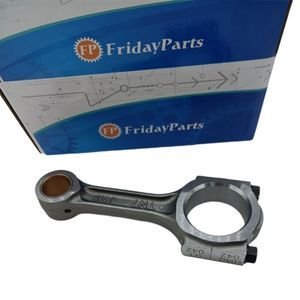
Matched Bottom-End Components — Every connecting rod leaves our Guangzhou facility with its bearing shells and rod bolts verified as a matched set for the stated engine serial range.
Technical Specifications
| Parameter |
Value |
| Part Number |
719810-23100 |
| Product Type |
Connecting Rod |
| Cross-Reference (reference only) |
71981023100, YM719810-23100, YM71981023100 |
| Machine Fitment |
Yanmar 3TNE78, 3TNE78A; Komatsu 3D75N-1YC, 3D78AE-3A/B/C/D, 3D78N-1A/C/E, 3D80-1, 3D82AE-3C/D/E/F/G/H/HB/HC/5M-BA/5P-CB/6/6BM-DA, 3D82E-3A/B, PC20R-8, PC27MR-2, PC27R-8 DELUXE |
| Material |
Forged SAE 1045 steel |
| Hardness |
260–280 HB |
| Dimensional Tolerance |
±0.01 mm |
| Big-end / Small-end Bearing Clearance |
0.025–0.045 mm |
| Rod Bolt Grade |
12.9 (torque-to-yield) |
| Surface Treatment |
Shot-peened |
| Condition |
New Aftermarket |
| Warranty |
3–12 months against manufacturing defects |
| MOQ |
1 piece |
Application Suitability
| Engine System |
Related Components |
| Bottom-end reciprocating assembly |
Main bearings, con rod bearings, crankshaft journals, piston assemblies |
| Complete engine overhaul |
Gasket kit, seal kit, piston rings, cylinder liners, thrust washers |
| Bottom-end targeted rebuild |
Crankshaft regrind assessment, oil pump inspection, lubrication pathway flush |
| Distributor overhaul kit stock |
Matched rod sets, bearing shells (STD / 0.25 / 0.50 undersize), piston pins |
Why a Connecting Rod Replaced in Isolation Fails Again
A connecting rod failure is almost never the rod alone — it is a symptom of what happened inside the bottom end.
I have opened too many Yanmar 3TNE78 engines on Indonesian job sites where a workshop swapped a single rod without checking whether the crankshaft journal had been reground to an undersize in a previous overhaul. The new rod arrives at STD tolerance, the bearing shells do not match the reground journal, and within weeks the engine knocks again. The connecting rod engine rebuild only holds when every mating surface is measured and every adjacent component is graded to the same history. [NEED_CITE: engine bearing clearance standards for reground crankshaft journals]

Bottom-End Assembly: Where This Rod Lives
The connecting rod sits at the center of the bottom-end reciprocating assembly, linking piston motion to crankshaft rotation. Every force cycle passes through the big-end bearing, the rod body, and the small-end bushing in sequence. When any one of these interfaces is out of tolerance, the connecting rod engine rebuild absorbs the mismatch as accelerated wear rather than immediate failure, making the problem invisible until the next teardown.
Crankshaft Reground History and Bearing Grade Selection
Before ordering a replacement rod, the crankshaft must be measured. Many Komatsu 3D82AE engines in the field have already been through one or two regrinds, meaning the journal diameter is no longer STD. The correct bearing undersize — typically available in STD, 0.25 and 0.50 — must be selected to match the reground journal, and the new rod must be verified to accept that shell thickness. A connecting rod ordered without this check forces the rebuild to stall mid-assembly. [NEED_CITE: crankshaft regrind undersize grade identification for industrial diesel engines]
Material and Clearance: What the Specifications Actually Mean
Forged SAE 1045 steel provides the fatigue strength needed for continuous duty cycles at 2,200–2,800 rpm, which is where these Yanmar and Komatsu engines typically operate under hydraulic pump load. The shot-peened surface introduces compressive residual stress that slows crack initiation at the rod's I-beam transition radius — the most common fatigue failure location. The ±0.01 mm dimensional tolerance governs big-end bore roundness, which directly controls oil film thickness in the bearing shell. If the bore is even slightly out of round, the oil wedge collapses at peak combustion pressure, and metal-to-metal contact begins. The 0.025–0.045 mm bearing clearance range is the operating window where hydrodynamic lubrication holds across the full rpm band. Grade 12.9 torque-to-yield rod bolts stretch to a controlled preload that maintains cap alignment under combustion shock loading — these bolts must never be reused, because the yield stretch is permanent.
The Hidden Cost of Skipping System-Level Checks
A workshop that installs a new rod without verifying oil pump output and lubrication pathway cleanliness is leaving the root cause of the original failure in place. Low oil pressure at the big-end bearing starves the oil film, and the replacement rod fails in the same way the original did. I have seen this pattern repeat on Komatsu PC27R-8 machines where the oil pickup screen was half-blocked with carbon deposit. The connecting rod engine rebuild then carries the blame for what was actually a lubrication system failure. [NEED_CITE: diesel engine lubrication starvation root cause analysis for connecting rod bearing failure]
Why Procurement Through This Channel Works for Engine Rebuilds
Our production lines cover selected part ranges while the remainder comes from ISO-certified manufacturing partners — both carry the same QC and warranty terms, so a connecting rod and its matching bearing shells ship under one accountability. Eight categories of engine and machine parts mean the complete overhaul list — rods, bearings, pistons, gaskets, seals — moves under one account and one consignment. Minimum order from one piece allows a workshop to replace a single failed rod without carrying surplus inventory. Our Guangzhou warehouse holds stock on fast-failure items for these Yanmar and Komatsu platforms. Part identification works from a number, a machine model, a photograph of a worn nameplate, or a serial plate image. Cross-reference verification covers superseded and alternate numbers, catching the mismatches that copied tables carry forward. Sample supply is available for fitment confirmation before a fleet-level bulk commitment.
Documentation & Verification
- Commercial invoice and packing list itemizing rod quantities and bearing grades per engine serial
- Part compatibility and cross-reference sheet marked reference only for 719810-23100 interchange numbers
- Dimensional CMM scanning record showing big-end bore roundness and small-end bushing diameter per batch
- Warranty terms covering manufacturing defects for 3 to 12 months from dispatch
- Packing photographs showing anti-rust oil application and foam cushioning before carton closure
- HS code and customs documentation support for engine component export clearance
Installation & Rebuild Sequence
- Clean block oil galleries and verify oil pump pressure before installing any new rod assembly
- Measure crankshaft journal diameter to confirm STD or undersize grade before selecting bearing shells
- Install Grade 12.9 rod bolts new and torque to the manufacturer's yield-angle specification
- Check big-end and small-end bearing clearance with plastigauge after cap installation
- Rotate crankshaft by hand to verify free movement before fitting piston assemblies
- Run initial break-in at reduced load for the manufacturer's stated period to seat bearing shells
Request a Matched Rebuild Quote
Provide the exact engine model, serial number range, and any known crankshaft regrind history so we can confirm the correct connecting rod variant and matching bearing grade. If the nameplate is worn or painted over, send a photograph of the engine block casting number and we will verify fitment against the Komatsu or Yanmar serial database. For complete overhaul kits, share the full component list so we can cross-check for missing items before dispatch.
Frequently Asked Questions
Q: What components are included in a typical bottom-end overhaul kit for this engine series?
A: A standard bottom-end kit for Yanmar 3TNE78 and Komatsu 3D78-series engines covers connecting rods, main and con rod bearings, piston assemblies, piston pins, thrust washers, and the lower gasket set. The exact contents vary by engine serial range and whether the crankshaft has been reground. We verify the kit list against your specific engine serial before dispatch to prevent missing items.
Q: How to determine correct bearing undersize grade after crankshaft regrind?
A: Measure each crankshaft journal with a micrometer and compare against the OEM STD diameter specification. The difference indicates the regrind depth — typically 0.25 mm or 0.50 mm undersize. The bearing shells must match this undersize, and the connecting rod big-end bore must accept the corresponding shell thickness without altering the target clearance range.
Q: Do different serial ranges within the same engine model share identical connecting rods?
A: Not always. The Komatsu 3D82AE series spans sub-variants from 3C through 6BM-DA, and internal component revisions were introduced across production runs. Two engines stamped with the same base model may carry different rod bolt specifications or bearing widths. Provide the full engine serial number so we can verify the correct variant before shipping.
Q: What system-level checks should accompany connecting rod replacement?
A: Beyond measuring the crankshaft journals, verify oil pump output pressure, inspect the oil pickup screen for blockage, and flush all block oil galleries. Lubrication starvation is a leading root cause of rod bearing failure. Installing a new rod without confirming clean oil delivery to the big-end bearing leaves the original failure mechanism in place.
Q: How to identify the exact engine variant when the nameplate is worn or missing?
A: Locate the engine block casting number, typically stamped on the upper block surface near the cylinder head mating face. Photograph this number along with any visible markings on the bell housing or flywheel housing. These identifiers allow cross-referencing against production records to determine the exact engine variant and the correct internal component set.