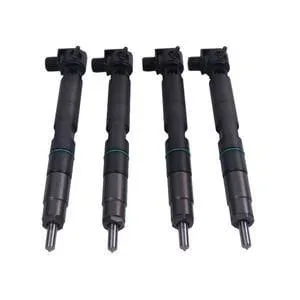
Engine Sequence Variants Verified — Injector calibration codes matched to D24/D18 build records before dispatch, preventing flow mismatch across cylinder banks.
Technical Specifications
| Parameter |
Value |
| Part Number |
400903-00074D |
| Product Type |
Fuel Injector |
| Cross-Reference (reference only) |
40090300074D, 400903-00074C, 40090300074C, 7275454, 28337917, 7516848 |
| Machine Fitment |
Doosan D24, Doosan D18, Doosan D24NAP, Bobcat T450, Bobcat T550, Bobcat T590, Bobcat T595, Bobcat T630, Bobcat T650 |
| Condition |
New Aftermarket |
| Flow Test Pressure |
1,800 bar |
| Nozzle Tip Material |
Hardened stainless steel |
| Solenoid Response Time |
Under 0.3 ms |
| Needle Valve Clearance Tolerance |
±2 μm |
| Sealing Surface Coating |
PTFE-impregnated elastomer |
| Sealing Temperature Range |
-40°C to 135°C |
| Warranty |
6 months against manufacturing defects |
| Standards |
ISO 9001, ISO 8573-1 Class 2, SAE J1850 |
| MOQ |
1 piece |
Application Suitability
| Engine System |
Related Components |
| High-pressure fuel delivery |
Fuel return lines, high-pressure rail seals, copper crush washers |
| Combustion chamber sealing |
Injector sleeve O-rings, cylinder head gasket set |
| Fuel filtration and supply |
Primary and secondary fuel filters, water separator element |
| Engine overhaul |
Complete injector set, fuel pump, timing gear alignment tools |
Why Injectors Fail Again Weeks After Replacement
Replacing the injector without tracing the root cause inside the fuel circuit almost guarantees a repeat failure.
In mining and demolition environments, a single failed injector is rarely an isolated event. Contamination from degraded return hoses, a collapsing fuel filter element, or restricted return-line flow pushes debris or excess pressure into the new unit. I have seen rebuilt D24 engines come back with injector nozzle scoring within a few hundred hours because the upstream fuel filtration had been bypassed during a previous field repair [NEED_CITE: fuel contamination particle size thresholds for high-pressure common rail systems]. The fuel injector 400903-00074D performs correctly when the surrounding system is sound — but it cannot survive dirty fuel or abnormal return pressures on its own.

System-Level Diagnosis Before Injector Removal
The fuel injector 400903-00074D sits inside a closed-loop delivery system on the Doosan D24 and D18 engine platforms. Before pulling the old unit, measure fuel return volume at the rail and check for pressure drop across both primary and secondary filters. A restricted return line forces fuel backward past the needle seat, eroding the sealing surface over time. Addressing the upstream fault protects the replacement injector and the adjacent fuel lines that share the same contamination exposure.
Engine Serial Variants and Calibration Codes
The D24 platform includes the base D24, the D18 variant, and the D24NAP — each with differences in ECU mapping and injector flow calibration. An injector programmed for a D24NAP may deliver slightly different pulse volumes than one calibrated for a standard D24, even though the physical part number 400903-00074D fits the cylinder head bore. Confirming the engine serial number against build records ensures the correct calibration code is supplied. This verification step matters during rebuilds where matched sets must maintain cylinder-to-cylinder balance across all firing events [NEED_CITE: cylinder balance tolerance standards for multi-cylinder diesel injection systems].
Reading the Spec Sheet Against Actual Operating Conditions
The hardened stainless steel nozzle tip resists abrasive wear from fuel-borne particles, which is critical in quarry and demolition applications where ambient dust infiltrates fuel storage. The ±2 μm needle valve clearance tolerance governs how precisely the injector meters fuel during each pulse — any deviation from this tolerance causes lean or rich combustion in the affected cylinder. The solenoid response time under 0.3 ms supports the rapid injection events required by the common rail system at high engine speeds. Meanwhile, the PTFE-impregnated elastomer seal maintains integrity across the -40°C to 135°C range, preventing fuel weeping at the injector body-to-sleeve interface during cold starts and sustained high-load operation.
The Cost of Skipping the Fuel System Audit
When a rebuild shop installs a fresh injector without inspecting return hoses, crush washers, and rail seals, the new component inherits whatever fault destroyed its predecessor. In the field, this means a machine returns to the workshop within weeks, requiring another teardown of the valve cover and fuel rail. The labor cost of that second removal often exceeds the price of the ancillary components that should have been swapped during the first service [NEED_CITE: diesel injector replacement labor and secondary failure correlation]. Sourcing matched fuel system components alongside the injector prevents this cycle.
Why Source This Injector Through XUNPO
Our own production lines and qualified sourcing partners operate under the same QC protocol and warranty terms, so the fuel injector 400903-00074D carries a consistent 6-month manufacturing defect warranty regardless of origin. Eight product categories mean fuel injectors, return hoses, seal kits, and filtration elements ship under one account and one consignment, eliminating split deliveries. Minimum order is one piece — a single emergency replacement dispatches without forced bulk. Our technical team cross-checks superseded numbers such as 400903-00074C against your engine serial to confirm variant compatibility. Samples are available for fitment confirmation before you commit to a full matched set.
Documentation & Verification
- Commercial invoice listing injector part number, calibration code, and engine serial reference
- Cross-reference sheet mapping 400903-00074D to superseded 400903-00074C for identification purposes
- Bench flow test record at operating pressure included with each unit
- Warranty terms covering manufacturing defects for six months from dispatch
- Packing photographs showing anti-static foam and sealed carton condition before crating
- HS code and customs documentation support for cross-border shipment
Installation & Rebuild Sequence
- Clean injector bore and sleeve with lint-free cloth before seating the new injector
- Verify copper crush washer thickness matches specification for proper combustion seal
- Torque injector clamp bolt to engine manual specification to avoid sleeve distortion
- Prime fuel system and check return volume at each injector before first start
- Run engine at idle for initial warm-up cycle and monitor for cylinder misfire codes
- Record flow balance readings after break-in to establish baseline for future service
Requesting a Matched Set Quotation
Provide your engine model, serial number, and any previous rebuild history so we can confirm the correct injector variant and calibration code. If the existing injector label is worn or painted over, send a photograph of the cylinder head casting number and machine nameplate. For overhaul planning, share the full fuel system component list from your service manual so we can quote matched injectors alongside return lines, seals, and filtration elements in a single consignment.
Frequently Asked Questions
Q: What other fuel system components should be replaced when changing an injector?
A: Copper crush washers, injector sleeve O-rings, and high-pressure rail seals should be replaced every time an injector is removed. Inspect fuel return hoses for internal collapse and swap primary and secondary filters if contamination is suspected. Replacing these adjacent components during the same service prevents repeat failures caused by debris or pressure anomalies already present in the fuel circuit.
Q: Do different engine serial numbers within the D24 platform require different injector variants?
A: Yes. The D24, D18, and D24NAP share the same physical injector bore, but ECU calibration and flow mapping differ between variants. Supplying the engine serial number allows verification of the correct calibration code, ensuring cylinder-to-cylinder balance during operation. Installing a mismatched calibration variant causes uneven combustion and accelerated wear.
Q: How do I determine whether the failure was caused by the injector or by upstream fuel contamination?
A: Examine the removed injector nozzle tip under magnification. Abrasive scoring patterns indicate fuel-borne particle contamination from degraded filters or tank sediment. Clean tip surfaces with carbon deposits suggest incomplete combustion from a different root cause. Checking fuel return volume and filter differential pressure across the system confirms whether contamination is ongoing.
Q: Should I replace one injector or the full set during an engine rebuild?
A: During a full engine rebuild, replacing all injectors as a matched set maintains uniform flow characteristics across every cylinder. Installing a single new injector alongside worn units creates an imbalance where the new unit compensates for degraded neighbors, shortening its service life. For a targeted diagnostic repair, a single replacement is acceptable if the remaining units test within specification.
Q: How do I confirm the correct part number when the existing injector label is unreadable?
A: Send a photograph of the machine nameplate and engine serial number plate. Our technical team cross-references the superseded number sequence — including transitions from 400903-00074C to 400903-00074D — against engine build records to identify the correct variant. This avoids trial fitment on site and ensures the calibration code matches your specific engine build.