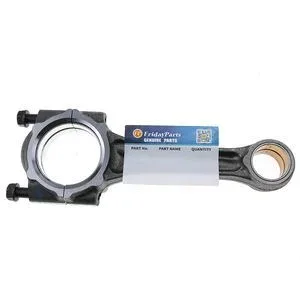
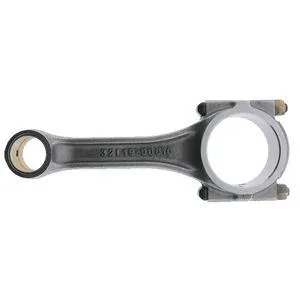
Matched Overhaul Sets — Every connecting rod ships with verified big-end bore data matched to your crankshaft journal grade and bearing selection.
Technical Specifications
| Parameter |
Value |
| Part Number |
1J700-22012 |
| Product Type |
Connecting Rod |
| Cross-Reference (reference only) |
1J70022012 |
| Engine Fitment |
Kubota V2607, V2607T |
| Machine Fitment |
KX057-4, KX057-5, U55, U55-4, U55-5, SVL65-2, SVL65-2C, SSV65, SSV65C, SSV65P, SSV65PC, R530, R540, R630, R640 |
| Material |
Forged alloy steel |
| Surface Treatment |
Zinc-nickel plating |
| Big-End Bore Tolerance |
±0.005 mm |
| Condition |
New aftermarket |
| Warranty |
3–12 months against manufacturing defects |
| Production Standard |
ISO 9001 |
Application Suitability
| Engine System |
Related Components |
| Crank-rod mechanism |
Crankshaft, con rod bearing set, piston pin, piston ring set |
| Lubrication circuit |
Oil pump, main bearing set, oil filter, gallery plugs |
| Cylinder block assembly |
Overhaul gasket kit, cylinder liner, block heater elements |
| Valvetrain |
Camshaft, valve stem seals, rocker arm assembly |
When the Crankshaft Has Been Ground but the Bearings Have Not Been Measured
A connecting rod installed with mismatched bearing clearance will fail before the first oil change interval completes.
In field overhauls, the most expensive mistake is not the part itself but the assumption that standard-grade bearings fit a reground journal. I have pulled seized engines apart in West African mining camps where the connecting rod big-end had welded to the crank pin because the overhaul kit contained STD bearings while the crankshaft had already been machined to 0.25 undersize. The Connecting Rod engine overhaul rebuild process demands that every dimension in the crank-rod system be verified as a set, not sourced from separate suppliers working from different assumptions [NEED_CITE: crankshaft journal undersize grading standards for diesel engine rebuilds].

The Crank-Rod System Does Not Tolerate Mixed Grades
This Connecting Rod operates inside a closed dimensional chain: crankshaft journal diameter, bearing shell thickness, big-end bore, and piston-pin offset all stack together. When any one element has been altered by a previous rebuild — a reground crank, a honed big-end, an oversize piston — the remaining components must be selected to compensate. Ordering a single rod without confirming what happened to the crankshaft at the last overhaul is how engines return to the bench within weeks.
Sequence Variants Within the Same Engine Family
The V2607 and V2607T share a block architecture but differ in internal component specifications across production runs. Serial number breaks determine which Connecting Rod variant is correct, as bolt thread pitch, big-end cap fastening method, and small-end bushing dimensions have changed between early and late production. Supplying an engine serial number allows the correct variant to be confirmed before the overhaul kit is assembled [NEED_CITE: Kubota V2607 engine serial break points for internal component revisions].
What the Tolerance Data Actually Means on the Bench
The ±0.005 mm big-end bore tolerance controls the oil film thickness between the bearing shell and the crank pin. Forged alloy steel provides the fatigue strength to handle peak cylinder pressure, but the bore tolerance is what determines whether that strength matters. A rod that is out-of-round by even a small margin will load one half of the bearing shell disproportionately, generating localized heat that breaks down the oil film. The zinc-nickel plating protects the rod body from corrosion during storage and in the crankcase environment, but it does nothing for the bearing interface — that is purely a function of dimensional accuracy and correct grade selection.
The Cost of Skipping the Root Cause Check
Replacing a damaged Connecting Rod without investigating why it failed leads to repeat failures. Common root causes include oil gallery blockage starving the big-end bearing, coolant contamination degrading oil film strength, or a worn main bearing allowing crankshaft deflection that overloads the rod journal. An engine that has already been rebuilt once may have accumulated dimensional shifts across multiple components that must all be measured and matched [NEED_CITE: diesel engine connecting rod failure root cause analysis methods].
Why Source This Through a System-Level Supplier
XUNPO produces selected part lines in its own facility and sources the remainder from qualified ISO 9001-certified partners, so both carry identical warranty terms. The eight core categories — engine, hydraulic, electrical, undercarriage, cabin, seals, tools, and general spares — mean a complete overhaul list ships as one consignment under one account. Technical staff verify Connecting Rod grade against your crankshaft measurement and engine serial number before dispatch. Sample supply is available for fitment confirmation before bulk commitment on fleet rebuild programs.
Documentation & Verification
- Commercial invoice listing each rod by matched set position and grade
- Cross-reference sheet showing 1J700-22012 interchange references (reference only)
- Dimensional inspection record including big-end bore and small-end bushing ID
- Warranty terms covering manufacturing defects for 3–12 months
- Packing photographs showing rod orientation and cap match marks
- HS code classification support for customs clearance
Installation & Rebuild Sequence
- Verify crankshaft journal grade with micrometer before selecting bearing shells for the Connecting Rod
- Match cap to rod body using factory match marks — caps are not interchangeable
- Torque big-end fasteners in staged increments per OEM sequence
- Check side clearance and end-float after assembly to confirm correct fitment
- Prime lubrication system before first start to prevent dry bearing contact
Provide Your Engine Data for Grade Confirmation
Share the engine model, serial number, and any known crankshaft regrind history to receive a connecting rod matched to your actual journal dimensions and a verified overhaul component list.
Frequently Asked Questions
Q: Does a standard overhaul gasket kit include the connecting rod?
A: No. Overhaul gasket kits contain seals, gaskets, and O-rings for the block and head assembly. The Connecting Rod is a separate hard part that must be ordered individually or as part of a matched set along with pistons, bearings, and rings based on measured journal dimensions.
Q: The crankshaft was ground at the last rebuild — what bearing grade do I need?
A: You must measure the reground journal diameter with a micrometer to determine the actual undersize. Common regrind grades are 0.25 mm and 0.50 mm undersize. The Connecting Rod big-end bore combined with the correct undersize bearing shell must produce the specified oil clearance.
Q: Are all V2607 connecting rods identical across production years?
A: No. Internal revisions exist within the V2607 and V2607T family. Fastener type, small-end bushing dimensions, and cap alignment features have changed at specific serial breaks. Providing the engine serial number allows the correct variant to be confirmed.
Q: What else should be inspected when replacing a single connecting rod?
A: Check the crankshaft journal for scoring or taper, measure adjacent main bearing clearances for deflection, inspect the piston and pin for scuffing, and verify oil gallery flow to that journal. Root cause correction prevents the new Connecting Rod from failing prematurely.
Q: How do I confirm the engine model and serial number if the nameplate is gone?
A: Photograph the block casting numbers, the injection pump data plate, and any stamped numbers on the flywheel housing. These secondary identification points allow cross-referencing to the correct engine build record and internal component specifications.