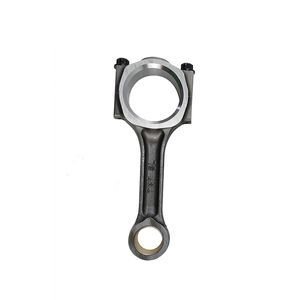
Matched Set Dispatch — Connecting rod 31A19-10024 verified against engine serial variants to align big-end bore tolerance with your crankshaft journal condition before shipping.
Technical Specifications
| Parameter |
Value |
| Part Number |
31A19-10024 |
| Product Type |
Connecting Rod |
| Cross-Reference |
31A19-10024 (reference only), 31A1910024 (reference only) |
| Machine Fitment |
T233, T273, T353 |
| Material |
SAE 1045 medium-carbon steel |
| Tensile Strength |
850–950 MPa |
| Hardness |
Rockwell C32–C36 |
| Big-end Bore Tolerance |
±0.005 mm |
| Surface Treatment |
Shot-peened |
| Condition |
New Aftermarket |
| Warranty |
6 months against manufacturing defects |
| Minimum Order Quantity |
1 piece |
| Standards |
ISO 9001, JIS G4051, ISO 8573-1 Class 3 |
Application Suitability
| Engine System |
Related Components |
| Block and rotating assembly (S3L / S3L2) |
Crankshaft journals, con rod bearing shells, piston pins |
| Block and rotating assembly (S4L / S4L2) |
Matched piston assemblies, thrust washers, main bearings |
| Lubrication system interface |
Oil feed passages, journal oil clearance verification |
| Overhaul kit consolidation |
Complete gasket sets, seal kits, rod bolt sets |
Why Standard-Grade Rods Destroy a Reground Crankshaft
Order the oversize grade that matches your crankshaft journal, not the grade printed on the old rod.
An engine rebuild stalls when the connecting rod set arrives in standard size, but the crankshaft was already ground to 0.25 mm oversize during a previous overhaul. The mismatched bearing shells cannot establish proper crush, and bearing failure follows within the first hours of operation. I have seen this exact scenario force a complete teardown on Mitsubishi S3L-powered tractors pulled in from field duty across Central Asian distribution channels [NEED_CITE: crankshaft journal oversize grading practices in diesel engine rebuilds]. The connecting rod engine overhaul rebuild process demands that every dimensional grade aligns with measured journal condition — not with assumptions carried forward from the last service record.

Rotating Assembly Position and System Dependencies
This connecting rod sits at the center of the block and rotating assembly, transferring combustion force from the piston through the piston pin into the crankshaft journal. It interfaces directly with con rod bearing shells on the big end and with the piston pin bushing on the small end. During any Mitsubishi S3L or S4L engine rebuild, the connecting rod engine overhaul rebuild scope must account for the condition of every adjacent surface it contacts.
Oversize Grades and Rebuild History Verification
Crankshaft journals accumulate wear across service intervals, and previous rebuilds may have already required grinding to an oversize dimension. Confirming whether the journal sits at STD, 0.25, or 0.50 oversize determines which bearing shell grade must pair with this rod. A connecting rod shipped without this verification risks arriving dimensionally incompatible with the crankshaft already installed on the bench [NEED_CITE: engine rebuild dimensional grading and bearing shell selection procedures]. Cross-referencing the engine serial number against variant-specific internal dimensions prevents ordering the wrong rod configuration for S3L2 versus S3L production runs.
Material Specification and Load-Bearing Performance
SAE 1045 medium-carbon steel provides the tensile strength range of 850–950 MPa required to handle cyclic combustion loading in agricultural and construction duty cycles. The Rockwell C32–C36 hardness band balances fatigue resistance with machinability for bearing surface conformity. Shot-peening the rod surface introduces compressive residual stress that inhibits crack initiation at the big-end bore transition radius. The ±0.005 mm big-end bore tolerance ensures that bearing shell crush height remains within the range specified for proper oil film formation on Mitsubishi S3L and S4L series engines [NEED_CITE: connecting rod bore tolerance and bearing crush specifications for medium-duty diesel engines].
The Cost of Skipping Root-Cause Diagnosis
Replacing a failed connecting rod without investigating why it failed invites a repeat failure on the new part. Oil starvation from a clogged feed passage, incorrect bearing shell grade from a prior rebuild, or lubrication pump degradation all produce rod damage that looks identical on the bench. Shipping a replacement rod without addressing the upstream fault means the connecting rod engine overhaul rebuild will fail again under load. The cost of a second teardown far exceeds the time spent tracing the fault through the lubrication and cooling circuits before ordering parts [NEED_CITE: root cause analysis procedures for connecting rod bearing failures in diesel engines].
Supply Capability for System-Level Rebuild Orders
Own production lines and qualified sourced supply operate under a single warranty and a single account, so matched rod and bearing sets ship as one consignment. Part identification proceeds from the number, machine model, photograph, or nameplate image — whichever reference you have on hand. Cross-reference verification covers superseded and alternate numbers across S3L and S4L engine generations. Minimum order starts at one piece for emergency single-cylinder repairs, and sample supply allows fitment confirmation before bulk commitment. The technical team confirms oversize grade compatibility and bearing shell matching against your measured crankshaft journal condition [NEED_CITE: aftermarket connecting rod supply and cross-reference verification standards].
Documentation & Verification
- Commercial invoice listing each rod by part number 31A19-10024 and oversize grade
- Bearing shell cross-reference sheet marked as reference only for identification purposes
- Dimensional inspection record covering big-end bore, small-end bore, and center distance
- Hardness test results for SAE 1045 material verification per batch
- Packing photographs showing anti-rust oil application and rigid cardboard protection
- HS code classification support for customs clearance in destination markets
Installation & Rebuild Sequence
- Clean oil feed passages in the block before installing the connecting rod to ensure journal lubrication
- Verify rod bolt torque specification against the engine service manual for your specific S3L or S4L variant
- Measure bearing shell crush height and oil clearance with Plastigauge before final assembly
- Balance the rod set by weight grading to prevent vibration-induced secondary failures across cylinders
- Run a low-load break-in cycle after reassembly to seat bearing shells before applying full combustion loading
Requesting a Matched Overhaul Quotation
Provide the engine model designation, serial number, and any available rebuild history so the correct oversize grade and variant-specific dimensions can be confirmed. Photographs of the existing rod, crankshaft journal condition, and engine nameplate allow the technical team to verify compatibility before dispatch. State whether the order covers a single-cylinder replacement or a complete multi-cylinder matched set.
Frequently Asked Questions
Q: What components should be replaced together with the connecting rod during an overhaul?
A: Con rod bearing shells, piston pin bushings, rod bolts, and the associated gasket set should all be evaluated during the same teardown. Replacing the connecting rod without refreshing bearing shells that have already conformed to worn journal geometry risks improper oil film formation and early re-failure. Matched set supply keeps all these items on one purchase order.
Q: How do I determine which oversize grade my engine needs after a previous rebuild?
A: Measure the crankshaft journal diameter with a micrometer and compare against the OEM service manual specification for your S3L or S4L variant. Prior grinding operations leave the journal at STD, 0.25, or 0.50 oversize. The bearing shell grade and rod big-end bore must align with that measured dimension, not with the grade assumed from old parts.
Q: Are connecting rods for S3L and S3L2 interchangeable, or do internal dimensions differ?
A: Internal dimensions including center distance, big-end bore diameter, and piston pin specification can differ between S3L and S3L2 production variants. Confirming the engine serial number against variant-specific specifications prevents ordering a rod that physically fits but operates outside designed clearance tolerances under combustion loading.
Q: What lubrication system faults commonly cause connecting rod failure?
A: Oil starvation from clogged feed galleries, degraded lubrication pump output, and incorrect oil viscosity all reduce the hydrodynamic film protecting the big-end bearing. When the film collapses, metal-to-metal contact generates heat that distorts the rod bore. Diagnosing the upstream lubrication fault before installing replacement rods prevents a repeat failure cycle.
Q: Can I order a matched rod and bearing shell set for a complete engine rebuild?
A: Matched sets ship with consistent weight grading across all cylinders and bearing shells pre-selected for your confirmed oversize grade. This eliminates the tolerance stacking that occurs when rods and shells are sourced from separate suppliers with different production batches. Provide your engine serial number and journal measurements to initiate the matched set quotation.