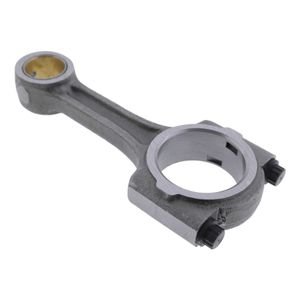
Matched Dimensions Confirmed — Every connecting rod 04287601 is verified against specific engine serial ranges before dispatch, ensuring piston-to-rod-to-bearing grade alignment across all cylinders in your Deutz overhaul.
Technical Specifications
| Parameter |
Value |
| Part Number |
04287601 |
| Product Type |
Connecting Rod |
| Cross-Reference (reference only) |
0428 7601, 4287601, 04272081, 0427 2081, 4272081, 0428 6649, 04286649, 4286649, 04272007, 0427 2007, 4272007 |
| Machine Fitment |
D4L2011, D3L2011, D2L2011, D2L2011I, D3L2011I, D4L2011I, F2L2011, F3L2011, F4L2011, F2M2011, F3M2011, F4M2011, F2L1011F, F3L1011F, F4L1011F, F3M1011F, F4M1011F |
| Material |
Forged 42CrMo alloy steel |
| Hardness |
28–32 HRC |
| Dimensional Tolerance |
±0.01 mm |
| Big-End Bore Out-of-Roundness |
≤0.005 mm |
| Tensile Strength |
>900 MPa |
| Surface Treatment |
Shot-peened big-end surfaces |
| Inspection Method |
Magnetic particle inspection (MPI) |
| Assembly State |
New Aftermarket |
| Standard Compliance |
ISO 9001, ISO 683-1:2018 |
| Warranty |
12-month manufacturing defect coverage |
| Minimum Order |
1 piece |
Application Suitability
| Engine System |
Related Components |
| Block & Internal Parts (Bottom End) |
Con rod bearings (STD / 0.25 / 0.50 oversize), thrust washers, main bearings |
| Cylinder Components |
Piston assemblies matched by weight class, piston rings, cylinder liners |
| Lubrication System |
Oil pump, pressure relief valve, oil filter elements |
| Overhaul Gasket Set |
Sump gasket, front/rear crankshaft seals, rod cap nuts |
Why Deutz Connecting Rod Engine Rebuild Parts Fail in Sets Rather Than Isolation
A single failed connecting rod usually signals a system fault that has already compromised adjacent cylinders.
In mining equipment running continuous RPM duty cycles, one seized or fractured rod often points to oil starvation across multiple journals, not just a localized defect. When a rebuild shop installs fresh Deutz connecting rod engine rebuild parts into one cylinder while ignoring scored journals in the next, the engine typically returns to the workshop within weeks. I have seen three-rod failures on F4M2011 blocks where the initial tear-down only replaced the one obviously broken component, leaving borderline bearing clearances unaddressed. The labor cost of a second teardown far exceeds the material cost of replacing all four rods and their matched bearing shells at the first opportunity. [NEED_CITE: Deutz 2011 series engine bottom-end failure mode analysis and lubrication starvation patterns]

The Bottom-End Rebuild as a System, Not a Single Part
When planning an overhaul for a D4L2011 or F4L2011, the connecting rod sits at the mechanical center of the bottom end. Its big-end bore must match the crankshaft journal condition — whether ground to standard, 0.25 mm, or 0.50 mm oversize — and the small-end pin bore must align with the piston weight class to maintain cylinder balance. Replacing a Deutz connecting rod engine rebuild parts set without verifying these adjacent dimensions creates mismatched clearances that accelerate wear on the fresh components from the first hour of operation.
Engine Serial Variants Change Internal Dimensions
The Deutz 2011 and 1011 families span production runs where internal components shifted between early and late serial blocks. A D4L2011I variant may carry different piston-to-rod mass balance requirements than a base D4L2011, even when the external block casting appears identical. Before confirming any connecting rod 04287601 order, I cross-check the full engine serial number against the parts book to rule out mid-production changes to rod length, bolt torque specification, or bearing shell seat geometry. [NEED_CITE: Deutz engine serial break points and internal component variant differences across 2011 series production runs]
Material and Tolerance Interpretation for Rebuild Shops
The 42CrMo forged alloy provides a tensile strength exceeding 900 MPa, which is essential for withstanding the compression and tension cycles in diesel combustion chambers operating at continuous high load. The big-end bore out-of-roundness tolerance of ≤0.005 mm ensures that the bearing shell crush height generates uniform contact pressure — any deviation here produces localized hot spots and accelerated shell wear. Shot-peening on the big-end surfaces introduces compressive residual stress, which retards fatigue crack initiation at the bolt hole roots, a common fracture origin point in cyclic loading applications like open-pit mining shovels. The ±0.01 mm dimensional tolerance across rod length keeps all pistons reaching consistent top-dead-center positions, preventing compression ratio variation between cylinders.
The Hidden Cost of Mismatched Bearing Grades After a Crankshaft Regrind
When a crankshaft has been ground undersize during a previous rebuild, the connecting rod must be paired with the corresponding oversize bearing shell. Shipping standard-grade shells with a reground journal produces excessive clearance, resulting in oil pressure loss and audible knock within the first hours. Conversely, fitting oversize shells on an unground journal crushes the bearing and blocks oil flow entirely. I have documented cases where this grade mismatch caused a second teardown before the engine even completed its initial break-in cycle, turning a planned overhaul into an unplanned project loss. [NEED_CITE: bearing shell grade selection and crankshaft journal regrind matching procedures for diesel engines]
Why Source This Connecting Rod Through a System-Matched Approach
The own-production and qualified-sourced supply lines both carry identical QC and warranty terms, so whether the rod or its matched bearings come from our facility or a partner plant, the tolerance stack is verified as a set. Eight product categories under one account mean the overhaul gasket set, piston rings, main bearings, and oil seals ship in a single consignment — eliminating the split-freight delays that hold up engine reassembly. Orders start from one piece, so a single isolated rod replacement is handled without minimum-order pressure. The Guangzhou warehouse maintains stock on common Deutz bottom-end items for fast dispatch, while the technical team verifies serial-range fitment and bearing grade before anything ships. Part identification works from the worn number, the machine model plate, or a workshop photograph, and cross-reference verification covers superseded alternate numbers like 04272081 and 04286649. A sample unit is available for fitment confirmation before any bulk commitment.
Documentation & Verification
- Commercial invoice listing every component in the matched overhaul set with individual line items
- Cross-reference sheet mapping 04287601 to alternate numbers, marked for identification purposes only
- Dimensional inspection record covering big-end bore roundness, rod length, and bolt hole MPI results
- Warranty terms document specifying the 12-month manufacturing defect coverage scope
- Packing photographs showing each rod individually wrapped and labeled before crating
- HS code and customs classification support for international freight clearance
Installation & Rebuild Sequence
- Measure crankshaft journal diameter with a micrometer before selecting bearing shell grade for each connecting rod 04287601
- Verify piston-to-rod weight class match across all cylinders to maintain dynamic balance after assembly
- Clean all oil galleries in the block and crankshaft to remove debris from the previous failure event
- Torque rod cap nuts to the Deutz specification in two stages using a calibrated wrench
- Rotate the assembled crankshaft by hand to confirm zero binding before installing the sump
- Run the initial break-in at moderate load to seat bearing shells and verify stable oil pressure
Request a Matched Rebuild Proposal
Provide the engine model designation, the full serial number from the block nameplate, and any records of previous crankshaft regrinds. If the original rod is still on the bench, a photograph of its part stamping and bearing shell grade mark allows cross-reference verification. For fleet operators planning multiple overhauls, share the equipment list and we can confirm serial-range coverage and matched kit availability across your Deutz engine population.
Frequently Asked Questions
Q: What other components should ship together with a replacement connecting rod?
A: A connecting rod 04287601 should be ordered with matched bearing shells at the correct oversize grade, piston assemblies balanced by weight class, piston rings, and a complete overhaul gasket set. Supplying these together ensures dimensional consistency and prevents split-shipment delays that hold up the rebuild timeline.
Q: How is the correct bearing shell grade determined after a crankshaft regrind?
A: The crankshaft journal diameter is measured with a micrometer at multiple points. The reading determines whether STD, 0.25 mm, or 0.50 mm oversize shells are needed. Each connecting rod is then paired with the shell grade matching its journal, not a generic standard set.
Q: Are internal parts identical between D4L2011 and D4L2011I variants?
A: Not always. Production serial breaks introduced changes to rod mass balance, bolt specification, and bearing seat geometry between base and "I" variants. The full engine serial number must be checked before confirming internal component compatibility for any Deutz connecting rod engine rebuild parts order.
Q: What root causes should be investigated before installing a new connecting rod?
A: Common failure origins include oil starvation from a blocked gallery or failed pump, incorrect bearing clearance from a previous rebuild, and bolt torque loss under cyclic loading. Addressing the root fault — not just swapping the broken rod — prevents the new component from failing again in service.