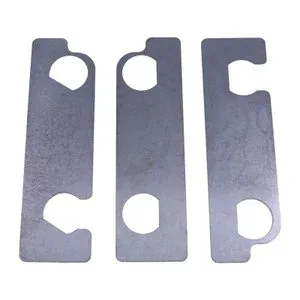
System-Matched — Camshaft holding tool kit cross-referenced to EN-48383 and EN-46105 keeps LP1 and HFV6 timing aligned during V6 overhaul sequences.
Technical Specifications
| Parameter |
Value |
| Product Type |
Camshaft Holding Tool Kit |
| Part Number |
EN-48383, EN-46105 |
| Cross-Reference |
EN-48383, EN-46105 (reference only) |
| Engine Fitment |
GM 2.8L, 3.0L, 3.6L V6 (LP1, HFV6, A30XH, Z32SE, Z28NET, Z28NEL, A28NER, B284E, B284L) |
| Brand Compatibility |
GM, Buick, Cadillac, Chevrolet, GMC, Pontiac, Suzuki, Saab, Saturn |
| Material |
Hardened alloy steel (HRC 42–46) |
| Clamping Load |
45 N·m |
| Contact Surface Diameter |
32 mm |
| Chamfer Angle |
12° |
| Locking Mechanism |
Spring-loaded locking lever with tactile feedback |
| Tolerance |
±0.05 mm |
| Surface Treatment |
Zinc-nickel plating (500-hour salt-spray resistance) |
| Condition |
New Aftermarket |
| Warranty |
3–12 months against manufacturing defects |
| Standards |
ISO 9001, SAE J2412 |
Application Suitability
| Engine System |
Related Components |
| Timing Drive Assembly |
Timing chain tensioners, guides, sprockets, chain |
| Cylinder Head Valvetrain |
Camshaft seals, valve cover gaskets, cam followers |
| Engine Block Rebuild |
Overhaul gasket kit, main and rod bearings, piston rings |
| Front Cover & Accessories |
Front crankshaft seal, water pump, harmonic balancer |
When Timing Alignment Fails on the Bench
A camshaft holding tool kit designed for GM V6 engines prevents valve-to-piston contact during timing chain replacement and camshaft service.
In rebuild shops handling high-output V6 platforms, I have watched technicians lose an entire morning because a universal holding fixture slipped on the cam sprocket under torque. The cam rotates just enough to throw off timing marks, and suddenly you are pulling the head to check for bent valves. This camshaft holding tool kit locks the 32 mm contact surface with a spring-loaded lever, giving tactile confirmation that the tool is fully seated before any wrench touches a bolt. Shops that skip purpose-built fixtures and rely on improvised clamps absorb repeat teardown costs that quickly eclipse the price of correct tooling. [NEED_CITE: camshaft timing misalignment consequences in interference engines]

Where the Holding Tool Sits in the Overhaul Sequence
Before any timing component comes off, the crankshaft must be pinned at TDC and both camshafts secured against rotation. The camshaft holding tool kit referenced as EN-48383 and EN-46105 bridges this exact step on LP1 and HFV6 engines. Without it, the cam lobes load the valvetrain unevenly, and the sprocket can spin the moment the chain tension releases. This tool engages the 12° chamfer on the camshaft nose, distributing the 45 N·m clamping load evenly so the sprocket bolt can be broken free safely.
Tolerance Stack-Up Across GM V6 Variants
The 2.8L through 3.6L V6 family spans several engine codes — Z28NET, Z28NEL, A28NER, B284E, and others — yet the camshaft nose geometry remains dimensionally consistent across these variants. The ±0.05 mm machining tolerance on this camshaft holding tool kit means no adapter shims or secondary collars are needed when switching between an A30XH block and an HFV6 head. This matters in rebuild shops running mixed fleets, because pulling the wrong adapter mid-job introduces the exact misalignment the tool is meant to prevent. [NEED_CITE: GM HFV6 engine family dimensional commonality across displacement variants]
Material and Surface Treatment Under Shop Conditions
The hardened alloy steel body at HRC 42–46 resists jaw deformation across repeated clamping cycles, which is critical when the same tool sees daily use on a production rebuild line. Zinc-nickel plating rated for 500 hours of salt-spray exposure protects the contact surfaces from coolant residue and solvent wash-down that are routine in engine machining environments. A tool that corrodes on the contact diameter loses its effective clamping surface, and the resulting micro-slip under torque can move timing marks by a degree or more — enough to cause rough idle and misfire codes on reassembly.
The Cost of Holding the Cam Wrong
Improvised holding methods — strap wrenches, vise grips on non-hardened journals, or undersized generic fixtures — deform the camshaft nose or fail to resist the breakaway torque on the sprocket bolt. When the cam shifts even one tooth on a 2.8L–3.6L interference engine, the valves contact the piston crowns, turning a chain service into a full top-end rebuild. Shops absorb these failures as internal rework rather than warranty claims, so the cost hides in lost bench time and scrapped head gaskets rather than appearing on a ledger. [NEED_CITE: interference engine valve-to-piston damage from timing misalignment during service]
Why Rebuild Shops Source This Tool Through XUNPO
Both self-produced and qualified sourced lines carry the same warranty terms, so a camshaft holding tool kit ordered alongside an overhaul gasket set ships under one account. The eight-category catalogue means timing components, seals, bearings, and service tools consolidate into a single consignment, eliminating split freight. Minimum order starts at one piece — useful when a shop replaces a worn-out holding fixture mid-job and cannot wait for bulk pricing tiers. Cross-reference verification covers superseded tool numbers, so an older reference on a shop order form gets matched to the current production identifier. Sample units are available for fitment confirmation on your specific engine code before a bench commits to a fleet quantity.
Documentation & Verification
- Commercial invoice listing each tool identifier separately for shop asset tracking
- Cross-reference sheet mapping EN-48383 and EN-46105 to current production numbers (reference only)
- Dimensional inspection record confirming 32 mm contact diameter and ±0.05 mm tolerance
- Warranty card covering manufacturing defects for 3–12 months from dispatch
- Packing photographs showing foam-cushioned individual boxes before carton closure
Installation & Rebuild Sequence
- Verify camshaft nose diameter matches 32 mm contact surface before engaging the tool on any LP1 or HFV6 variant.
- Confirm spring-loaded lever produces audible and tactile click, indicating full chamfer engagement at the 12° angle.
- Apply breakaway torque to the sprocket bolt only after the tool is locked, keeping load within the 45 N·m rating.
- Remove holding tool before rotating the engine by hand, then re-pin the crankshaft at TDC to verify timing marks align.
- Inspect tool contact surfaces for scoring after each use and clean with solvent to maintain plating integrity.
Request a Fitment Confirmation
Provide your engine code — such as LP1, HFV6, or A28NER — along with any previous rebuild history so we can confirm the camshaft nose dimension matches the tool contact surface. If your shop runs multiple V6 variants, share the full engine list so the correct holding tool configuration ships with your overhaul components.
Frequently Asked Questions
Q: What does the kit include and how do EN-48383 and EN-46105 differ?
A: The kit contains two holding tools — one for each bank of the V6. EN-48383 and EN-46105 (cross-reference only) address left and right camshaft positions respectively, since the cam nose orientation differs between banks on LP1 and HFV6 engines. Both tools share the same 32 mm contact diameter and 12° chamfer specification, ensuring consistent clamping across both cylinder heads.
Q: How do I confirm this tool fits my specific GM V6 engine code?
A: Send the engine code from the vehicle identification plate or the casting number on the block — codes like Z28NET, A30XH, or B284L. We cross-check the camshaft nose geometry against our fitment database covering all listed variants. If the engine has been through a prior rebuild with non-standard camshafts, a photograph of the cam nose helps verify dimensional compatibility before shipment.
Q: What other components should I order alongside this tool for a timing job?
A: A complete timing chain service on these V6 engines typically requires tensioners, guide rails, primary and secondary chains, camshaft seals, and a front cover gasket set. Ordering these with the holding tool kit consolidates the shipment and ensures all components arrive before the engine is torn down. Provide the engine code so matched sets are pulled from the correct variant.
Q: Can different engine codes within the 2.8L–3.6L range share one tool set?
A: Yes, the listed engine codes share the same camshaft nose dimensions, so one kit covers the full range without adapter changes. The ±0.05 mm tolerance accommodates the minor dimensional variation across generations. If your shop encounters an engine code not on the listed fitment chart, send us the code and we verify compatibility before you commit to the purchase.
Q: Is it possible to get a sample before ordering for the whole shop?
A: Sample units ship for fitment confirmation so your technicians can verify engagement on your specific engine bench before a bulk order is placed. This is particularly useful when transitioning from universal holding fixtures to purpose-built tooling. Contact us with your engine code and we arrange sample dispatch from Guangzhou stock.