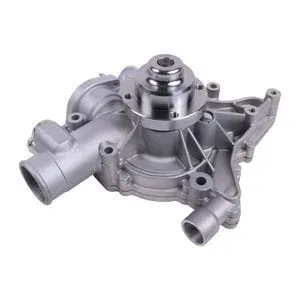
Matched Cooling Circuit Kit — Every gasket, seal, and fastener required for the Toyota 4Y water pump installation is verified against the engine build code before dispatch.
Technical Specifications
| Parameter |
Value |
| Part Number |
16110-78156-71 |
| Product Type |
Water Pump |
| Cross-Reference |
16110-78156-71 (reference only), 212T1-09451 (reference only), 90904-U9002-71 (reference only) |
| Engine Fitment |
Toyota 4Y, 4Y-ECS |
| Mounting Holes |
4 |
| Housing Material |
Precision-cast aluminum alloy |
| Impeller Material |
Hardened stainless steel blades |
| Housing Dimensional Tolerance |
±0.05 mm |
| Shaft Runout |
≤0.03 mm |
| Sealing Surface Finish |
Ra 0.8 μm |
| Operating Pressure |
up to 1.2 bar |
| Condition |
New Aftermarket |
| Warranty |
3–12 months against manufacturing defects |
| MOQ |
1 piece |
| Standards |
ISO 9001 |
Application Suitability
| Engine System |
Related Components |
| Coolant circulation (4Y / 4Y-ECS) |
Thermostat, radiator cap, coolant hoses |
| Cylinder head sealing |
Head gasket set, head bolt kit |
| Belt drive and accessory rotation |
Drive belt, tensioner bearing, pulley |
| Overhaul consumables |
Water pump gasket, sealant, coolant |
Why a Water Pump Replacement Rarely Fixes Overheating on Its Own
A water pump for Toyota 4Y engine rebuild only solves the symptom if the rest of the cooling circuit is ignored.
In the field, I have pulled apart 4Y engines in quarry yards across West Africa where the pump was swapped but the thermostat was left in place, already stuck half-open from years of scale buildup. The machine ran fine for two weeks, then the same overheat warning returned—this time warping the cylinder head and forcing a full teardown. The root cause was never the pump alone; it was a system where sediment, degraded hoses, and a tired radiator cap combined to push the new component past its operating limit within days [NEED_CITE: diesel engine cooling system root cause analysis procedures]. Treating the water pump for Toyota 4Y engine rebuild as an isolated part rather than a circuit-level intervention is the single most common reason engines come back to the bench.
The Cooling Circuit as a Matched System
Every water pump for Toyota 4Y engine rebuild operates within a loop that includes the thermostat housing, upper and lower radiator hoses, the radiator cap pressure relief, and the head gasket sealing face. When one of these adjacent components is out of tolerance, the new pump absorbs the imbalance—running at higher shaft load, cycling through wider temperature swings, or pushing coolant past a seal that was not designed for the pressure variation. Sourcing the pump alongside the thermostat, gasket set, and belt means the entire loop is refreshed to a known baseline.
Sizing, Grades, and Engine Serial Variants
Within the 4Y family, the 4Y-ECS variant carries differences in emission control hardware that can alter thermostat housing geometry and coolant port orientation. Confirming the engine serial and build code before ordering ensures the pump mounting face aligns without modification. After a previous rebuild, the block mating surface may have been machined, shifting the gasket compression requirement; an oversize or shimmed gasket compensates for this. Skipping this verification leads to coolant seepage at the timing cover joint under sustained 1.2 bar operating pressure [NEED_CITE: engine block resurfacing effects on gasket sealing].
Flow Stability and Impeller Integrity
The hardened stainless steel impeller blades and the ≤0.03 mm shaft runout specification are not cosmetic tolerances—they directly govern coolant flow uniformity across the engine speed range. An undersized or eroded impeller creates localized hot spots in the cylinder liners, accelerating bore wear even when the dashboard temperature gauge reads normal. The Ra 0.8 μm sealing surface finish ensures the mechanical seal maintains contact under thermal cycling, preventing the slow weep that drops coolant level below the thermostat sensor over successive shifts.

The Cost of Treating a Circuit Fault as a Single-Part Problem
When the cooling system is overhauled without replacing the thermostat or verifying hose integrity, the new water pump for Toyota 4Y engine rebuild absorbs the fault that destroyed the previous one. The result is a second teardown within months—head gasket replacement, possible liner scoring, and a machine pulled off revenue-generating work twice. In fleet operations running multiple 4Y-powered forklifts, this pattern compounds: each repeat failure consumes labor hours, coolant, and gasket sets that were not budgeted, while the machine sits idle waiting for a diagnosis that should have been done the first time [NEED_CITE: fleet maintenance repeat failure cost modeling].

What This Supply Arrangement Covers
Production on selected lines and qualified sourced supply sit under a single account and a single warranty, so a pump ordered alongside a thermostat and gasket set carries identical QC terms. Eight categories of engine and machine parts mean a complete overhaul list ships as one consignment—one invoice, one packing list, one customs entry. Minimum order starts at one piece, so a single emergency pump for a down machine is not blocked by volume thresholds. Guangzhou warehouse stock on common 4Y cooling items supports fast dispatch when the machine is already stopped. Part identification works from the part number, the machine model plate, or a photograph of the old component, and cross-reference verification covers superseded and alternate numbers so the correct variant ships regardless of which reference the service manual lists.
Documentation & Verification
- Commercial invoice and packing list itemizing pump, gasket, and adjacent cooling components
- Part compatibility sheet cross-referencing 16110-78156-71 against 4Y and 4Y-ECS build codes (reference only)
- Quality inspection record covering flow rate, pressure hold, and shaft runout measurement
- Warranty terms document specifying coverage period and claim procedure
- Packing photographs showing pump and matched components before crate closure
- HS code and customs documentation support for cooling system parts export
Installation & Rebuild Sequence
- Verify timing cover mating face flatness before mounting the precision-cast aluminum housing to prevent seepage at the Ra 0.8 μm seal surface.
- Torque the four mounting bolts in the specified sequence to avoid housing distortion that exceeds ±0.05 mm tolerance.
- Replace thermostat and inspect radiator cap pressure rating as part of the same cooling circuit refresh.
- Fill with coolant meeting the engine manufacturer specification to protect hardened stainless steel impeller blades from cavitation erosion.
- Run the engine to operating temperature and check all joints for leaks before returning the machine to service load.
Quoting a Complete Cooling Circuit Overhaul
Provide the engine model, serial number, and any previous rebuild history so the correct pump variant and gasket grade are confirmed. If the machine model plate is worn, send a photograph of the engine block casting number or the old pump housing for cross-reference verification. Request a consolidated quote that includes the thermostat, belt, and gasket set to ensure the full circuit ships together.
Frequently Asked Questions
Q: What other cooling system parts should be replaced together with the water pump?
A: The thermostat, radiator cap, upper and lower coolant hoses, and the water pump gasket should all be evaluated and typically replaced during the same service event. Reusing a degraded thermostat or a cap that no longer holds rated pressure transfers the fault that destroyed the previous pump onto the new unit, shortening its service life and risking repeat overheating within weeks.
Q: Does the 4Y-ECS variant use the same water pump as the standard 4Y?
A: The base pump architecture is shared, but port orientation and thermostat housing geometry can differ between 4Y and 4Y-ECS builds. Confirming the engine serial number and build code before ordering ensures the correct variant ships, preventing misalignment during reassembly and potential coolant seepage at the timing cover joint.
Q: How do I confirm the engine build code to ensure correct fitment?
A: The build code is typically stamped on the engine block near the oil filter housing or on the manufacturer data plate attached to the machine chassis. If the plate is worn or painted over, a photograph of the block casting number or the old pump housing allows cross-reference verification against superseded and alternate part numbers.
Q: Is this water pump included in a complete engine overhaul gasket kit?
A: Some full gasket sets include the water pump gasket, but the pump assembly itself is normally ordered separately. When requesting a quote, confirm whether the overhaul kit contents cover the thermostat seal and water pump gasket, or whether these need to be added as line items to avoid a missing component when the engine is on the stand.
Q: What coolant specification should be used after reassembly?
A: Use the coolant type and concentration specified in the engine service manual to protect the hardened stainless steel impeller blades and aluminum housing from corrosion and cavitation. Incorrect coolant chemistry accelerates impeller erosion and degrades the mechanical seal, leading to flow loss and premature pump failure even when the component itself is correctly installed.