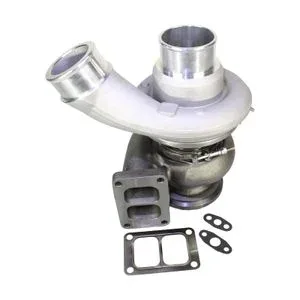
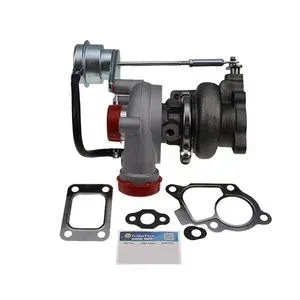
Matched system components — turbocharger, oil feed gaskets, V-band clamps and heat shields verified against engine serial variant and dispatched together.
Technical Specifications
| Parameter |
Value |
| Part Number |
631GC5172M5 |
| Product Type |
Turbocharger |
| Cross-Reference |
631GC5172M5 (reference only) |
| Turbo Model |
S300A113 |
| Compatible Engine |
Mack E7, AI427 |
| Machine Fitment |
CV713 Truck |
| Condition |
New Aftermarket |
| Warranty |
3–12 month warranty against manufacturing defects |
| Certification |
ISO-Certified |
Application Suitability
| Engine System |
Related Components |
| Intake and boost delivery |
Intake hoses, boost clamps, intercooler seals |
| Exhaust flow path |
Exhaust manifold gaskets, manifold studs and nuts |
| Oil supply and drain |
Oil feed line, oil drain gasket, return line fittings |
| Thermal protection |
Heat shields, thermal wrap, V-band clamps |
Why a New Turbo Fails Before the Oil Reaches Operating Temperature
A replacement turbocharger for Mack E7 AI427 engine rebuild fails early when the root cause lives in the surrounding system, not the unit itself.
In my time tearing down Mack E7 and AI427 engines pulled from mining and heavy-haul service, the pattern was consistent: a fresh S300A113 turbo installed on a CV713, back on the rack within weeks with burned bearings or a scored shaft. The turbo itself was not the problem. Carbon-blocked oil drain lines, warped exhaust manifold mating surfaces, or degraded oil feed gaskets were starving or overheating the new unit from the first startup [NEED_CITE: common root causes of turbocharger failure in heavy-duty diesel engines]. Swapping the turbo without diagnosing the system around it is the most expensive shortcut in an engine bay.
The Intake and Exhaust System This Turbo Lives Inside
The S300A113 turbocharger is not a standalone component — it sits at the junction of the intake and exhaust systems on Mack E7 and AI427 engines, and its service life depends entirely on what happens upstream and downstream. Exhaust manifold gaskets that leak will alter back-pressure and drive the turbine beyond its intended speed range. Intake hose connections that have hardened or cracked introduce unmetered air, forcing the compressor to work harder. Every turbocharger for Mack E7 AI427 engine rebuild must be evaluated as part of this system, not as an isolated swap.
Serial Variants and the Mounting Differences That Matter
Mack E7 and AI427 engines were produced across multiple build generations, and internal differences between serial ranges affect turbo mounting pattern, oil port alignment, and drain orientation. A turbo that physically bolts on can still be misaligned at the oil feed or drain port, leading to delayed lubrication on startup or incomplete oil return under load. Confirming the exact engine serial number against the build variant is the step that separates a reliable rebuild from a repeat failure [NEED_CITE: Mack E7 engine serial variant identification procedures].
Reading the Specs That Define Turbo Performance
The S300A113 designation tells the rebuild bay exactly which compressor and turbine wheel pairing is inside the housing, and this pairing must match the airflow demand of the specific E7 or AI427 build variant. The turbine housing geometry controls how exhaust gas energy is converted to shaft speed — too restrictive a housing on a high-output engine build causes excessive drive pressure, while too open a housing on a lower-output variant results in slow spool and poor low-end response. Bearing clearance specifications, verified during quality inspection, determine how the shaft behaves under thermal expansion at sustained load. Oil port size and orientation must match the engine block's supply and return passages precisely, because even a minor restriction in feed volume leads to bearing failure measured in hours, not months.

The Cost of Skipping the System Check
When a workshop installs a new turbo without replacing the oil feed gasket, cleaning the drain line, or checking exhaust manifold stud condition, the failure that returns is rarely identical to the first one — it is often worse. A carbon-restricted oil drain causes oil to back up into the turbine housing, pushing past the seal ring and into the exhaust, where it carbonizes further and accelerates the next failure. Foreign object damage from a deteriorating intake hose sends debris into the compressor wheel, nicking blades and creating imbalance that destroys the bearing system [NEED_CITE: turbocharger foreign object damage and intake system degradation]. The cost is not just the second turbo — it is the second teardown, the second set of gaskets, the second round of machine downtime, and the eroded trust of the fleet operator watching the same truck come back.
What Makes This Supply Chain Different for Engine Rebuild Shops
Our own production lines and qualified sourced supply operate under one account and one warranty, so the turbocharger and every matched gasket, clamp, and oil fitting carry the same quality terms. Eight product categories mean a complete top-end rebuild list — turbo, manifold gaskets, oil feed lines, V-band clamps, heat shields — ships as one consignment from the Guangzhou warehouse. Minimum order is one piece, so an emergency single-turbo purchase is never blocked by volume requirements. Part identification works from the part number, the engine model, a photograph of the nameplate, or an image of the old unit, and cross-reference verification covers superseded and alternate numbers so the right S300A113 variant is confirmed before dispatch. A sample can be supplied for fitment confirmation before a bulk commitment is made, and our technical team is available to verify compatibility and grade against the specific engine serial.
Documentation & Verification
- Commercial invoice and packing list itemizing turbo and matched installation hardware
- Part compatibility and cross-reference sheet for 631GC5172M5 (reference only) against engine serial
- Quality inspection record covering turbine wheel balance, bearing clearance, and housing dimensions
- Warranty terms specifying coverage for manufacturing defects across turbo and system components
- Packing photographs showing turbo protection and consignment completeness before dispatch
- HS code and customs documentation support for international engine parts shipments
Installation & Rebuild Sequence
- Clean oil feed and drain passages on the engine block before mounting the S300A113 turbocharger
- Replace oil feed gasket and drain gasket with new units from the matched kit at installation
- Verify V-band clamp torque and exhaust manifold stud condition before connecting turbine outlet
- Pre-lube turbo bearing housing with clean engine oil before first cranking to prevent dry startup
- Confirm oil return flow and check for boost leaks at intake connections during initial run-in
Preparing Your Rebuild Inquiry
When you need a turbocharger for Mack E7 AI427 engine rebuild, provide the engine serial number, build variant, and any previous overhaul history so we can confirm mounting pattern, oil port orientation, and matched component list. If the old unit is available, photographs of the data plate and mounting flange accelerate identification. For fleet-level rebuild programmes, share the engine population and service intervals so the supply plan covers matched gasket sets and installation hardware alongside each turbocharger.
Frequently Asked Questions
Q: What gaskets and oil line components should be replaced at the same time as the turbo?
A: Every turbocharger installation on a Mack E7 or AI427 should include new oil feed and drain gaskets, exhaust manifold gaskets, and V-band clamps. Oil feed lines that show internal varnish or carbon buildup should also be replaced. Sourcing these as a matched kit prevents partial deliveries and ensures every sealing surface is fresh at assembly.
Q: How do I confirm the turbo matches my specific Mack E7 or AI427 engine serial variant?
A: Provide the full engine serial number so we can verify the turbo mounting pattern, oil port position, and drain orientation against the build sheet. Cross-reference number 631GC5172M5 (reference only) and model S300A113 are confirmed against serial-specific data, not generic catalogues, before dispatch.
Q: What system-level faults should I diagnose before fitting a replacement turbocharger?
A: Check for oil contamination in the feed line, exhaust back-pressure anomalies, intake hose degradation, and carbon buildup in the oil drain passage. Foreign object damage patterns on the old compressor wheel indicate intake system failure. Correcting these faults before installation prevents the new turbo from inheriting the same failure mode.
Q: Can I source the full turbo installation kit in one order?
A: Yes. The turbocharger, oil feed and drain gaskets, V-band clamps, heat shields, and intake connection hardware are available as a consolidated order under one account and one warranty. This eliminates split shipments and ensures the rebuild bay has every component needed before the engine is opened.
Q: What does the quality inspection record cover for this turbocharger unit?
A: Each inspection record documents turbine wheel dynamic balance, bearing radial and axial clearance measurements, compressor and turbine housing dimensional checks, and oil port alignment verification. These records accompany the unit at dispatch and form part of the warranty documentation for the engine system component.