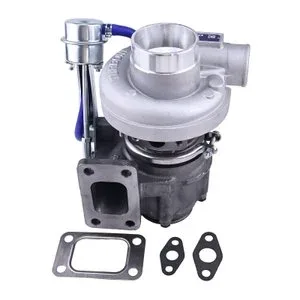
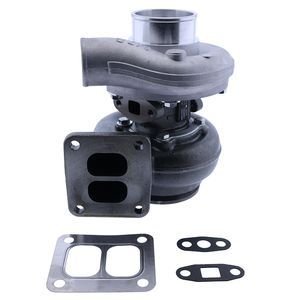
System-Matched Turbo HX55 Turbocharger — Compressor wheel balanced to G2.5 tolerance and Viton seals rated for sustained diesel oil exposure reduce vibration-induced bearing wear during ISM/M11 rebuild.
Technical Specifications
| Parameter |
Value |
| Product Type |
Turbocharger |
| Cross-Reference |
3590044, 3803938, 3536995 (reference only) |
| Machine Fitment |
ISM, ISME, M11, B5.9, B5.9-C |
| Turbo Model |
HX55-E9861L/H22E11D, HX55 |
| Turbine Housing Material |
Ni-Resist ductile iron |
| Compressor Wheel Material |
2618 aluminum alloy |
| Compressor Wheel Balance |
G2.5 tolerance |
| Bearing Type |
Dual ceramic ball bearings |
| Seal Material |
Viton fluoroelastomer |
| Max Exhaust Gas Temperature |
750°C |
| Dimensional Tolerance |
±0.02 mm |
| Condition |
New Aftermarket |
Application Suitability
| Engine System |
Related Components |
| Induction & Boost |
Oil feed lines, air filtration elements, intake manifold gaskets |
| Lubrication Circuit |
Oil cooler core, oil pump, turbo drain gasket |
| Exhaust Manifold |
Manifold-to-head gaskets, mounting studs, heat shields |
Why the Same Part Number Ships in Multiple Variants
Verifying the engine serial number prevents port orientation mismatch.
When sourcing a replacement HX55 Turbocharger for Cummins engines, relying solely on the model designation often leads to fitment issues. The ISM and M11 families have evolved through several production runs, resulting in variations in oil port positioning and exhaust flange patterns even within the same base engine block. [NEED_CITE: engine serial number verification for turbocharger fitment]
Mapping the Induction System During Overhaul
A turbocharger failure rarely occurs in isolation. For an HX55 Turbocharger compatible with Cummins M11 or B5.9 applications, the root cause frequently traces back to upstream lubrication degradation or particulate ingestion. Addressing the failed unit without inspecting the oil supply circuit and air intake path typically results in repeat failure within the same overhaul cycle.
Addressing Root Causes in Emission & Exhaust Systems
Replacing the turbo alone ignores the systemic issues that caused the bearing or seal failure. We recommend concurrent inspection of the oil cooler for flow restriction and the air filter housing for seal integrity. Ensuring the entire Emission & Exhaust system is matched prevents the new HX55 Turbocharger from being subjected to the same thermal and mechanical stresses that destroyed the previous unit. [NEED_CITE: turbocharger failure root cause analysis in diesel engines]
Material and Thermal Engineering for Heavy Duty Cycles
The turbine housing is cast from Ni-Resist ductile iron to withstand thermal cycling up to 750°C without warping, which maintains the critical clearance between the turbine wheel and housing. The compressor wheel, machined from 2618 aluminum alloy, retains structural integrity under high centrifugal loads. Dual ceramic ball bearings reduce friction at low RPM spool-up, while Viton fluoroelastomer seals resist coking from hot diesel oil.

The Cost of Ignoring Systemic Faults
Installing a new turbo on a compromised oil circuit leads to rapid journal bearing wear and shaft play. This secondary failure often damages the intercooler and intake valves, escalating a simple component swap into a top-end engine rebuild.
Sourcing Strategy for Engine Rebuilds
Our facility maintains production control over selected lines while vetting external partners to ISO 9001 standards. We consolidate turbochargers with associated gaskets and oil feed components under one warranty. Our technical team verifies cross-reference numbers against engine build records to ensure port alignment. We support single-piece orders for emergency repairs and provide samples for bench verification before bulk commitment.
Documentation & Verification
- Commercial invoice listing specific turbocharger variant and cross-reference.
- Dimensional inspection record for flange pattern and oil port spacing.
- Quality check covering rotor balance and seal integrity.
- Packing photographs showing protective casing for turbine housing.
- HS code classification support for customs clearance.
Installation & Rebuild Sequence
- Flush oil feed lines and replace restrictor fittings before mounting the HX55.
- Pre-lube the turbo bearings with clean engine oil prior to first start.
- Verify torque specs on exhaust manifold studs to prevent housing distortion.
- Check for boost leaks at the compressor outlet during initial run-in.
Inquiry Guidance
Provide the engine serial number and existing turbo nameplate details to confirm variant compatibility. Share any recent oil analysis reports or failure symptoms to assist in diagnosing systemic issues. Specify if a complete overhaul kit including gaskets and seals is required for the job.
Frequently Asked Questions
Q: What other components should be replaced alongside the turbocharger during an engine rebuild?
A: When replacing the HX55 Turbocharger, it is critical to install new oil feed and drain gaskets, inspect the oil cooler for blockages, and replace the air filter elements. We supply matched kits that include these adjacent components to ensure the new turbo is not compromised by contaminated oil or restricted airflow from the previous system state.
Q: How do I confirm which HX55 variant fits my specific engine serial number?
A: Engine serial variants within the ISM/M11 families often carry different turbo port orientations and flange patterns. By providing the full engine serial number or a photograph of the existing turbo nameplate, our technical team can verify the exact cross-reference and ensure the replacement unit aligns with your specific engine build record.
Q: What caused the original turbo to fail, and how do I prevent repeat failure?
A: Common failure modes include oil coking from degraded lubrication or foreign object damage from compromised filtration. To prevent repeat failure, the oil supply circuit must be flushed and the air intake system inspected for leaks. Our team can review the failure symptoms to recommend specific system-level checks alongside the turbo replacement.
Q: Does the overhaul gasket kit include all seals needed for turbo reinstallation?
A: Our overhaul kits are configured based on the specific engine build, including the turbo mounting flange gasket, oil feed line O-rings, and exhaust connection seals. We verify the kit contents against the engine serial number to ensure no critical sealing components are missing, preventing leaks that could lead to premature turbo failure.