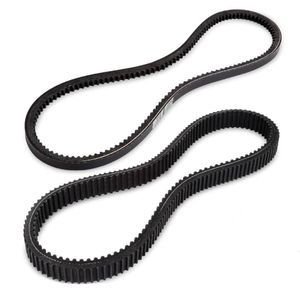
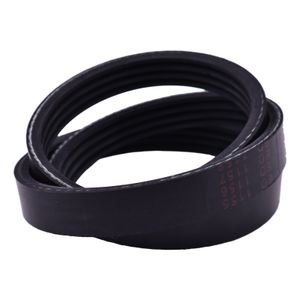
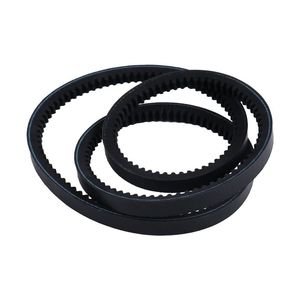
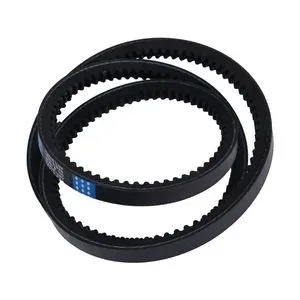
Matched Set Shipped — Both belts dispatched together after tolerance verification to prevent mixed-grade belt drive failures.
Technical Specifications
| Parameter |
Value |
| Product Type |
Belt |
| Part Number |
606136, 606138, 265-586, 265586, 16548G1 |
| Cross-Reference |
606136, 606138, 265-586, 265586, 16548G1 (cross-reference only) |
| Machine Fitment |
EZGO RXV, TXT, Workhorse, ST (2008–present) |
| Brand Compatibility |
E-Z-GO, Kawasaki |
| Starter Generator Belt Spec |
265-586 / 265586 — 1/2" W × 35.5" OD |
| Drive Belt Spec |
606138 / 16548G1 — 1" W × 35" OD |
| Starter Generator Belt Material |
EPDM rubber compound with aramid tensile cords |
| Drive Belt Material |
High-modulus polyester cord body with precision-molded trapezoidal profile |
| Dimensional Tolerance |
±0.5 mm on width and length |
| Condition |
New Aftermarket |
| Warranty |
6-month manufacturer defect warranty |
| MOQ |
1 piece |
| Standards |
ISO 9001, ISO 16890 |
Application Suitability
| Engine System |
Related Components |
| Belt drive system — Kawasaki 13 HP |
Starter generator pulley, drive clutch sheave, idler bearings |
| Accessory drive — EZGO RXV/TXT |
Tensioner assembly, mounting hardware, belt guard |
| Primary propulsion drive |
Primary and secondary clutch assemblies, crankshaft key |
Why a Matched Drive & Starter Belt Kit Prevents Repeat Failures
Treating one belt at a time leaves the root cause untouched — this kit replaces both to restore system balance.
In the workshops I worked through across the Yangtze Delta, I watched rebuilds fail not because the new part was wrong, but because the adjacent worn part was ignored. A glazed starter generator belt forces the drive belt to absorb uneven loading cycles, accelerating cord fatigue. Shops that swap only the snapped belt often see the second one fail within weeks, and the customer blames the replacement quality rather than the incomplete repair [NEED_CITE: belt drive system matched replacement principles for small displacement engines]. This Drive & Starter Belt Kit engine rebuild approach addresses that pattern directly by supplying both belts as a verified dimensional set.

The Belt Drive System Within the Kawasaki 13 HP Platform
The Kawasaki 13 HP engine used across EZGO RXV and TXT platforms routes power through two distinct belt paths: the starter generator circuit and the primary drive circuit. These two circuits share a common crankshaft pulley, meaning tension and alignment on one side directly influence loading on the other. Supplying a matched Drive & Starter Belt Kit engine rebuild set ensures both circuits start their service life at the same wear baseline, which matters considerably in fleet applications where vehicles complete repeated start-stop cycles throughout each shift.
Material Selection and What It Means for Belt Life
The starter generator belt uses an EPDM rubber compound reinforced with aramid tensile cords. EPDM resists the heat buildup that occurs during the high-current cranking phase, while aramid cords resist the flex fatigue that develops as the belt wraps and unwraps around small-diameter pulleys at each start event. The drive belt takes a different construction: a high-modulus polyester cord body with a precision-molded trapezoidal profile designed to seat fully in the clutch sheave groove. Mismatching these materials — for instance, fitting a standard V-belt in the starter generator position — leads to premature glazing and slippage [NEED_CITE: EPDM versus standard rubber compound performance in high-cycle small engine belt drives].
Tolerance, Alignment, and the ±0.5 mm Standard
Both belts in this kit are verified to ±0.5 mm on width and length. This tolerance band matters because the drive clutch sheave and the starter generator pulley on the Kawasaki 13 HP are not adjustable independently — the belt either seats correctly at both ends or it rides high on one pulley and digs into the other. A belt that is even slightly outside this tolerance window will produce a chirping noise under load, which technicians sometimes misdiagnose as a bearing fault. Confirming dimensional compliance before installation avoids this diagnostic trap and ensures the contact pattern distributes load evenly across the full belt width.

What Happens When Belts Are Sourced Separately
I once saw a fleet maintenance supervisor order the drive belt from one supplier and the starter generator belt from another, both referencing the correct OEM numbers. The parts arrived in separate shipments days apart. When installed, the drive belt tracked correctly but the starter generator belt ran slightly tighter, pulling the shared crankshaft pulley off-axis. The result was uneven wear on the drive belt within the first hundred hours — a failure the shop attributed to the belt itself rather than the tension imbalance [NEED_CITE: effects of mismatched belt tension on shared-pulley small engine systems]. Sourcing the Drive & Starter Belt Kit engine rebuild as a single matched set eliminates this variable entirely.
What We Bring to This Specific Rebuild Need
Our facility produces selected part lines in-house and sources the remainder from qualified ISO-certified manufacturing partners, with both channels carrying identical quality control and warranty terms. For this kit, dimensional verification covers both belts before they leave the Guangzhou warehouse, so the matched tolerance claim is backed by inspection records rather than assumption. Orders start from one piece, which matters when a single vehicle is down and the shop needs to confirm fitment before committing to a fleet-wide order. Technical support is available to verify compatibility against engine serial numbers, particularly on EZGO models produced during platform transition years where belt drive configurations shifted.
Documentation & Verification
- Commercial invoice listing both belt part numbers with individual dimensional results
- Cross-reference sheet mapping 606136, 606138, 265-586, 265586, and 16548G1 to specific EZGO model years
- Quality inspection record confirming ±0.5 mm width and length compliance on each belt
- Warranty terms covering the complete kit as a matched set for six months
- Packing photographs showing both belts secured together before dispatch
- HS code and customs documentation prepared for cross-border aftermarket parts shipment
Installation & Rebuild Sequence
- Clean crankshaft pulley and starter generator pulley grooves before fitting to remove old belt residue that affects seating
- Install the starter generator belt first, verifying full trapezoidal contact on both pulleys before applying tension
- Route the drive belt through the clutch sheave path, confirming the 1" width seats without riding the sheave lips
- Check idler bearing play and pulley runout — worn bearings will destroy a new belt set prematurely
- Run the engine at idle for several minutes, then recheck belt tracking and tension after initial heat cycle
Requesting a Fitment-Confirmed Quote
Provide the engine serial number and EZGO model year so we can verify which belt drive system variant your platform uses. If the nameplate is worn or painted over, a photograph of the pulley arrangement and the old belt part numbers allows our technical team to confirm the correct kit before shipping. For fleet orders, share the range of model years in service so we can identify any units that require a different variant.
Frequently Asked Questions
Q: Why replace both belts as a set instead of only the failed one?
A: The two belts share a common crankshaft pulley on the Kawasaki 13 HP. A worn belt that remains in service alters tension distribution across that shared pulley, forcing the new belt to operate under conditions it was not designed for. Replacing both simultaneously restores balanced loading and prevents the premature failure that typically follows a single-belt swap.
Q: How do I confirm which belt drive system variant my engine uses?
A: EZGO produced several platform transitions between 2008 and the present, and belt drive configurations shifted during some of those years. Provide the engine serial number or a photograph of the existing belts and pulleys. Our team cross-references these against the specific build record to confirm the correct variant before dispatch.
Q: What adjacent components should I inspect when replacing the belt kit?
A: Check the starter generator pulley for groove wear, the drive clutch sheave for scoring, and all idler bearings for axial and radial play. A worn pulley or a binding bearing will destroy new belts within a short operating period. Addressing these items during the belt replacement avoids a repeat visit and keeps the vehicle in service.
Q: How do I identify the correct kit when the engine nameplate is unreadable?
A: Send a clear photograph of the old belts showing any remaining part number markings, along with an image of the pulley layout. Belt width, length, and profile shape are sufficient in most cases to confirm the correct kit. This avoids guesswork and ensures the replacement set matches the specific engine build on your vehicle.