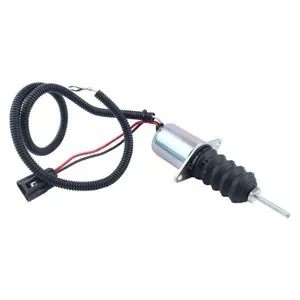
Matched Sets Shipped — AM124377 and AM102863 solenoids verified against engine serial variants before dispatch, ensuring the correct coil and connector reach your rebuild bench.
Technical Specifications
| Parameter |
Value |
| Part Number |
AM124377 AM102863 |
| Cross-Reference |
AM124377 (reference only), AM102863 (reference only) |
| Product Type |
Stop Solenoid |
| Machine Fitment |
375, 3375, 675, 675B, 4475, 5575, 6675, 7775, 655, 755, 756, 855, 856, 955, F935 |
| Condition |
New Aftermarket |
| Part Name |
Fuel Shut Off Solenoid |
| Warranty |
3-12 months against manufacturing defects |
| Certification |
ISO 9001 |
Application Suitability
| Engine System |
Related Components |
| Engine auxiliary control and fuel shutdown |
Fuel delivery lines, injection pump seals, electrical harness connectors |
| Electrical signal path from engine control module |
Wiring harness segments, relay modules, fuse links |
| Fuel metering and delivery subsystem |
Fuel filters, lift pump components, return line check valves |
| Scheduled engine overhaul refresh |
Overhaul gasket sets, bearing shells, piston ring sets |
Why a Fuel Shut Off Solenoid Fails Again Within Months
The solenoid itself rarely causes its own failure — the fault lives upstream in the fuel system or signal circuit.
Replacing the component without tracing the root cause means the replacement enters the same degraded environment that destroyed the original. Electrical harness insulation on older John Deere machines becomes brittle, increasing resistance and dropping the voltage that reaches the coil. [NEED_CITE: electrical resistance effects on solenoid coil performance in mobile diesel engines] Fuel delivery irregularities — contaminated lines, a weakening lift pump, a clogged return passage — place abnormal thermal and mechanical loads on the shutdown mechanism. Workshops that swap only the solenoid see repeat failures because the underlying system fault was never addressed. This Fuel Shut Off Solenoid engine replacement cycle becomes a recurring cost rather than a resolved repair.

Where This Solenoid Sits in the Engine Auxiliary System
The stop solenoid occupies a critical node between the engine control signal path and the fuel delivery subsystem. When the ignition key cycles off, the control module cuts power to the coil, and the solenoid plunger moves to block fuel flow — a sequence that must complete reliably every shutdown cycle. Any deviation in coil resistance, plunger travel, or spring tension compromises that sequence. Sourcing this Stop Solenoid rebuild component alongside adjacent engine electrical parts ensures the signal path and the mechanical actuator are matched for the same duty environment.
Electrical Connector Variants and Harness Compatibility
Across the John Deere model range — from 655 tractors to 7775 skid-steer loaders — the physical connector and pin configuration on this Fuel Shut Off Solenoid can differ even when the base part number appears identical. Engine serial number breaks often correspond to harness revisions, and a connector that physically plugs in may still have mismatched pin assignments. [NEED_CITE: engine harness revision tracking across John Deere serial number ranges] Confirming the correct variant requires cross-referencing the engine serial against the solenoid coil specification and connector type. Our technical team verifies this match before shipment so the part arriving at your bench connects directly to the existing harness without adapter wiring.
System-Level Fault Diagnosis Before Replacement
A solenoid that failed open-circuit points to coil burnout, often caused by sustained overvoltage or degraded insulation in the feed wire. One that failed mechanically — plunger stuck or sluggish — suggests fuel contamination or varnish buildup inside the bore. Each failure mode traces back to a different system fault. Simply installing a new unit without checking fuel cleanliness, wiring continuity, and control module output means the replacement inherits the same hostile conditions. A Stop Solenoid rebuild should trigger inspection of the fuel filter condition, lift pump pressure, and harness resistance values. [NEED_CITE: diesel fuel system contamination sources and solenoid bore varnish formation]
The Cost of Skipping Root-Cause Verification
An engine that restarts after solenoid replacement but fails again within weeks forces a second teardown — new gaskets, fresh fluid, another round of labor. The downtime compounds. Fleet machines sitting idle accumulate missed contract deadlines and rental obligations. When the second failure traces back to the same unresolved fuel system fault, the credibility of the repair shop erodes with the equipment owner. Matching the replacement to the engine serial variant and pairing it with adjacent fuel-system components during the same rebuild cycle eliminates this repeat-failure pattern. [NEED_CITE: cost impact of repeat diesel engine teardowns in fleet maintenance operations]
Why Procurement Starts With Engine Serial Verification
Every solenoid leaving our Guangzhou facility is matched against the buyer's engine serial number and model designation before packing. Self-produced lines and sourced supply carry identical QC protocols and warranty terms, so a single account covers the full engine electrical and fuel-system parts list. Minimum order is one piece — critical when a single machine is down and a full kit is not yet justified. Cross-reference verification covers superseded and alternate numbers, resolving the confusion that arises when parts catalogs carry forward outdated entries. Sample supply is available for fitment confirmation before you commit to bulk quantities. Technical support confirms connector type, coil specification, and compatibility grade for your specific engine build.
Documentation & Verification
- Commercial invoice listing AM124377 and AM102863 with engine serial cross-reference notation (reference only)
- Part compatibility sheet confirming solenoid variant against buyer-provided engine serial number
- Dimensional and electrical test record covering coil resistance and plunger stroke measurement
- Warranty terms document aligned with expected overhaul cycle intervals
- Packing photographs showing connector protection and anti-corrosion wrapping before crate closure
- HS code and customs documentation formatted for destination-country fuel-system component classification
Installation & Rebuild Sequence
- Verify coil resistance against specification before installing the Fuel Shut Off Solenoid into the fuel block
- Clean the solenoid bore and fuel passage to remove varnish or particulate contamination from prior operation
- Confirm connector pin alignment with the engine harness variant for the specific machine serial number
- Torque the mounting fastener to specification to prevent fuel leak at the body-to-block interface
- Perform a functional shutdown test with the engine at operating temperature before returning to service
- Inspect adjacent fuel filter and return line components for restriction during the same rebuild cycle
Confirm the Right Variant Before Ordering
Provide the engine model, serial number, and any previous rebuild history so we can match the correct solenoid variant and connector type. Include photographs of the existing unit and its wiring connector if the data plate is no longer legible. Specify whether this purchase is a single emergency replacement or part of a broader engine overhaul kit so we can align documentation and packing accordingly.
Frequently Asked Questions
Q: What engine system fault may have caused the original solenoid to fail?
A: Common root causes include degraded wiring harness insulation dropping voltage below coil requirement, fuel contamination introducing particulate into the solenoid bore, and lift pump failure causing abnormal fuel delivery pressure. Each fault mode leaves distinct evidence on the removed unit. Our technical team can help interpret those signs when you share photographs of the failed component.
Q: Does the connector match my engine harness variant?
A: Connector type and pin configuration can vary across engine serial ranges even when the base part number is shared. We verify the correct variant against your specific engine serial number before dispatch. If your harness has been modified during a prior repair, share photographs of the connector so we can confirm compatibility or recommend an adapter solution.
Q: Should I inspect other fuel-system components when replacing this solenoid?
A: Yes. The fuel filter, lift pump, return line check valve, and injection pump seals should all be evaluated during the same rebuild cycle. A Fuel Shut Off Solenoid that failed due to contamination or pressure irregularity signals a broader system issue. Addressing those adjacent components prevents the replacement from inheriting the same degraded operating environment.
Q: How do I confirm the correct solenoid variant for my engine serial?
A: Provide the complete engine model and serial number along with any known rebuild history. We cross-reference this against coil specification, connector type, and plunger configuration to identify the matching variant. Superseded part numbers and catalog discrepancies are resolved during this verification step so the correct unit ships without trial fitment.
Q: What test records accompany the shipment?
A: Each Fuel Shut Off Solenoid ships with a quality inspection record documenting coil resistance measurement, plunger stroke verification, and functional shutdown test results. These records are matched to the specific unit serial or batch number. Commercial invoice and packing list are included alongside compatibility documentation for customs and receiving verification at your facility.