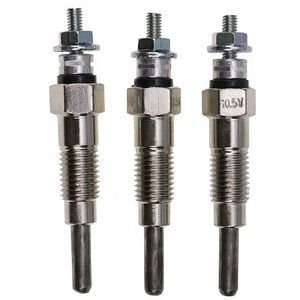
Matched Set Shipped — Plugs and wires supplied as a verified ignition set for Yanmar 3TNV70, heat range and impedance confirmed before dispatch.
Technical Specifications
| Parameter |
Value |
| Part Number |
MIU12783 MIA11722 |
| Product Type |
Spark Plug and Wire Kit |
| Cross-Reference |
MIU12783, MIA11722, MIA11723, MIA11724, BKR6EGP (reference only) |
| Machine Fitment |
GATOR, UV72, XUV 825E, XUV 825i, XUV 825M, XUV 825M S4, XUV 825I S4, XUV 835E, XUV 835M, XUV 835R, XUV 845E, XUV 845M, XUV 845R |
| Engine Compatibility |
Yanmar 3TNV70 |
| Center Electrode Diameter |
0.6 mm |
| Resistor Value |
5 kΩ |
| Dielectric Strength |
30,000 V |
| Thread Pitch |
14 mm × 1.25 mm |
| Hex Size |
16 mm |
| Boot Material |
Silicone-rubber |
| Wire Core |
Reinforced carbon-core |
| Condition |
New Aftermarket |
| Warranty |
6 months against manufacturing defects |
| MOQ |
1 piece |
| Standards |
ISO 9001, ISO 4042, ASTM B117, SAE J2030 |
Application Suitability
| Engine System |
Related Components |
| Ignition delivery |
Valve cover gasket set for resealing after plug access |
| Fuel metering |
Fuel filter and injector return line seals during tune-up |
| Emission and exhaust |
EGR passage inspection and gasket replacement if carbon-fouled |
| Cooling circuit |
Thermostat housing gasket when upper hose is removed for access |
| Crankcase ventilation |
PCV valve and breather hose condition check during service |
Why a Spark Plug and Wire Kit Must Be Treated as a System
Ignoring the wire set when replacing plugs leaves the root cause of misfire unresolved.
In rebuild shops I have worked with across the Yangtze River Delta region, a recurring pattern shows up: fresh plugs installed onto degraded carbon-core wires, and the unit returns with the same stumble within weeks. The ignition circuit on the Yanmar 3TNV70 operates under sustained vibration and thermal cycling common to utility vehicle platforms. A spark plug and wire kit engine rebuild approach treats the entire secondary ignition path as one wear system rather than isolated consumables. When the wire insulation breaks down or the boot loses dielectric integrity, the plug gap arcs unpredictably, causing incomplete combustion that no new plug alone will correct [NEED_CITE: secondary ignition system degradation patterns in multi-cylinder diesel-adjacent platforms]. Shops that replace both simultaneously report fewer comebacks tied to ignition faults.
How This Ignition Kit Sits Inside the Engine Auxiliary Subsystem
The spark plug and wire kit addresses the final stage of the ignition sequence, where stored coil energy crosses the plug gap under compression. On the Yanmar 3TNV0 platform, combustion chamber geometry and compression ratio dictate the required heat range. Supplying the plug and wire as a matched set ensures the resistor value and wire core impedance stay within the coil's expected load window. A spark plug and wire kit engine rebuild supply strategy means the rebuild shop receives components verified against each other, not just against a catalog number.
Engine Serial Variants and the Risk of Mismatched Heat Ranges
Across the 3TNV70 production run, minor revisions to piston crown design and combustion chamber volume shifted the recommended heat range for certain serial ranges. Ordering by machine model alone can land a plug that runs too hot or too cold for the specific build on the bench. The silicone-rubber boots and reinforced carbon-core wires in this spark plug and wire kit are paired to maintain dielectric strength through the vibration profile these utility vehicles produce. Confirming the engine serial number before dispatch prevents the scenario where a correct thread pitch masks an incorrect thermal characteristic [NEED_CITE: engine serial variant effects on ignition component specification].
Reading the Specification Sheet for Real-World Fitment
The 0.6 mm center electrode diameter concentrates the spark for reliable ignition at the compression pressures the 3TNV70 generates, while the 5 kΩ resistor value suppresses RF interference that disrupts digital instrumentation and GPS modules common on fleet-operated UTVs. The 14 mm × 1.25 mm thread pitch and 16 mm hex size must match the cylinder head specification exactly — a cross-thread event during rebuild sequencing damages the head and halts the job. The 30,000 V dielectric strength rating across the boot and wire assembly provides margin above the coil output, preventing voltage leakage that manifests as intermittent misfire under load.

What Happens When Heat Range or Wire Impedance Is Wrong
A plug running too hot in a high-compression variant causes pre-ignition, and the damage appears on the piston crown rather than the plug itself — making diagnosis difficult and the repair expensive. Conversely, a plug running too cold accumulates carbon deposits that short the gap, mimicking a coil or wire fault. Mismatched wire impedance loads the coil beyond its design duty cycle, leading to coil failure that gets blamed on the replacement parts rather than the selection error. These failures compound because the symptom points away from the actual cause [NEED_CITE: ignition component mismatch diagnostic confusion in small-displacement engines].
Sourcing From One Account With Verified Cross-Reference
This spark plug and wire kit ships under a single warranty and a single account, eliminating the situation where plug and wire warranties point to different suppliers when a fault arises. Cross-reference verification covers MIU12783, MIA11722, MIA11723, MIA11724, and BKR6EGP for identification purposes, so superseded numbers from earlier production runs are accounted for. The technical team confirms heat range and wire specification against your engine serial number before the order ships. Guangzhou warehouse stock on common configurations supports fast dispatch, and sample supply is available for fitment confirmation before a shop commits to bulk inventory for its rebuild pipeline.
Documentation & Verification
- Commercial invoice listing plug heat range and wire impedance matched to engine serial
- Cross-reference sheet for MIU12783 and MIA11722 variants marked reference only
- Resistance and continuity test records included with each kit shipment
- Warranty terms covering manufacturing defects for six months from receipt
- Packing photographs showing kit contents verified before carton seal
- HS code and customs classification support for international engine parts shipments
Installation & Rebuild Sequence
- Clean plug wells with compressed air before removal to prevent debris entering cylinders
- Verify thread pitch 14 mm × 1.25 mm against cylinder head before applying anti-seize
- Torque plugs to head specification using 16 mm hex, avoiding over-tightening on aluminum heads
- Route carbon-core wires away from exhaust manifold to preserve silicone-rubber boot integrity
- Apply dielectric grease inside boots before seating to prevent moisture ingress and sticking
- Perform resistance check across each assembled wire to confirm 5 kΩ circuit continuity
Requesting the Right Kit for Your Engine
Provide the Yanmar engine model, serial number, and any prior rebuild history so the correct heat range and wire specification are confirmed. If the nameplate is worn, a photograph of the existing plug and wire routing allows identification against the cross-reference table. Include the machine model and production year when known to address variant differences across the 3TNV70 platform.
Frequently Asked Questions
Q: What does the ignition kit include and is anything else needed for a complete tune-up?
A: The kit contains matched spark plugs and wires with silicone-rubber boots sized for the Yanmar 3TNV70. For a complete tune-up, shops typically add a valve cover gasket set, fuel filter, and air filter. Confirming these auxiliary items at the same time avoids split shipments and keeps the engine on the bench for one service window rather than two.
Q: How do engine serial variants affect plug heat range and wire specification?
A: Production revisions to the 3TNV70 altered combustion chamber geometry across serial ranges, shifting the recommended heat range. The wire impedance must also match the coil output for the specific build. Providing the engine serial number allows the correct variant to be selected from the cross-reference, preventing thermal mismatch that causes pre-ignition or fouling.
Q: What other engine auxiliary components should be inspected when replacing the ignition set?
A: Inspect the coil pack output, PCV valve condition, and throttle body for carbon buildup that affects idle quality. Check the wiring harness for chafing near the valve cover where heat and vibration degrade insulation. Addressing these adjacent items during the spark plug and wire kit engine rebuild service prevents comebacks tied to issues the new kit alone cannot resolve.
Q: How is the correct variant confirmed when only the machine model is known?
A: The machine model narrows the range, but serial number or a photograph of the existing plug and wire connector confirms the exact variant. The technical team cross-references the image against known configurations for XUV 825, 835, and 845 series platforms to verify thread pitch, hex size, and boot orientation before the kit ships.
Q: What testing documentation ships with the kit?
A: Each kit ships with resistance and continuity test records confirming the 5 kΩ resistor value and wire circuit integrity. Dielectric strength verification at 30,000 V is documented. These records travel with the shipment so the receiving shop has baseline data before installation, supporting traceability across the rebuild workflow.