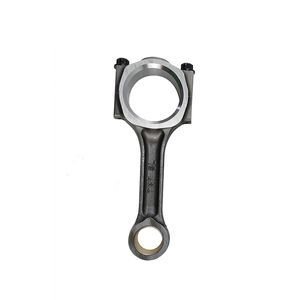
Dimensional Grade Confirmed — Every 97333173 connecting rod ships with matched bearing shells sized to your compressor's crankshaft regrind history, preventing assembly seizure from tolerance mismatch.
Technical Specifications
| Parameter |
Value |
| Product Type |
Connecting Rod |
| Part Number |
97333173 |
| Cross-Reference |
97333173 (for identification purposes) |
| Machine Fitment |
Ingersoll Rand SS5, SS5L5, SS5N5 Air Compressors |
| Condition |
New Aftermarket |
| Material |
SAE 1045 Medium-Carbon Forged Steel |
| Big-End Bore Tolerance |
±0.005 mm |
| Small-End Bushing Material |
Sintered Bronze |
| Small-End Bushing Wall Thickness Tolerance |
0.02 mm |
| Surface Finish (Sliding Interfaces) |
Ra 0.8 μm |
| Hardness |
HRC 38–42 |
| Max Cylinder Pressure |
14 bar |
| Max Operating Speed |
1,200 RPM |
| Applicable Standards |
ISO 9001, ISO 6336 |
| Warranty |
6 months against manufacturing defects |
| MOQ |
1 piece |
Application Suitability
| Engine System |
Related Components |
| Crankshaft & Rod Assembly |
Main bearings, rod bearings, thrust washers |
| Piston & Cylinder Group |
Pistons, piston pins, wrist pin bushings, cylinder liners |
| Lubrication Circuit |
Oil pump, oil filter, crankcase breather, oil pressure relief valve |
| Crankcase Sealing |
Base gaskets, crankshaft front and rear seals, side cover O-rings |
Why Compressor Rebuilds Fail After a Rod Swap
A connecting rod does not fail in isolation — it fails because the system around it already shifted out of spec.
In the Yangtze River Delta industrial belt, I have seen air compressor teardowns where a brand-new rod was installed on a reground crankshaft, only to seize within hours because the bearing shells were still standard grade. The fitter assumed the part number alone guaranteed fitment. The reality is that every prior overhaul leaves a dimensional footprint [NEED_CITE: compressor crankshaft regrind tolerance standards for reciprocating air ends]. When the crankshaft journal has been machined undersize, the mating bearing shells must step up to the corresponding oversize grade, and the connecting rod big-end bore must still fall within its own tolerance window to maintain oil film geometry. Skipping this verification chain turns a planned overhaul into a repeat teardown.

The Rod Inside the Crank-Link System
This connecting rod sits at the mechanical heart of the reciprocating air end. It transfers combustion-style compressive and tensile loads between the piston assembly and the crankshaft journal, completing the crank-link mechanism that defines compressor displacement and volumetric efficiency. When planning an engine rebuild, the rod must be evaluated as part of a matched set: piston, piston pin, small-end bushing, big-end bearing shells, and crankshaft journal condition all share the same tolerance stack-up. Replacing only the connecting rod engine rebuild component without inspecting adjacent surfaces invites accelerated wear on whichever element is now the weakest link in the chain.
Regrind History and Dimensional Grade Matching
Every Ingersoll Rand SS5 compressor that has been through a previous overhaul may carry a crankshaft that was machined to an undersize journal diameter. If the regrind was performed at 0.25 mm or 0.50 mm undersize, the bearing shells must match that grade — and the connecting rod big-end bore must still accept the shell's outer diameter without crush-height interference [NEED_CITE: bearing shell crush height and bore tolerance verification for reciprocating compressors]. I always pull the engine serial number and ask for the last overhaul record before confirming which grade of rod bearings to pair with this rod. Sending a standard-size shell to sit inside a rod that is mating with a reground journal is one of the most common causes of post-rebuild bearing spin in industrial air ends.
Reading the Specification Sheet for Real-World Behavior
The SAE 1045 forged steel body provides a balance of tensile strength and fatigue resistance suited to the reversing loads of a 1,200 RPM reciprocating compressor. The big-end bore tolerance of ±0.005 mm ensures that bearing shell crush height remains within the range needed to maintain hydrodynamic oil wedge formation — too loose and the shell frets; too tight and it distorts the bore roundness. The sintered bronze small-end bushing is selected for its conformability and embeddability, tolerating minor misalignment between the piston pin and rod axis. A surface finish of Ra 0.8 μm on the sliding interfaces keeps friction and heat generation low during the boundary lubrication phase at top and bottom dead center, where oil film velocity drops to zero before reversing direction.
The Cost of Skipping System-Level Verification
Installing a replacement rod without checking crankshaft journal roundness, bearing shell grade, and piston pin clearance is a gamble that usually loses within the first few hundred operating hours. A rod that is dimensionally correct on paper but paired with the wrong bearing grade will show early signs of wiping on the shell surface, followed by knocking, oil pressure drops, and ultimately a thrown rod that damages the crankcase, crankshaft, and cylinder bore. The labor cost of a second teardown in a mining or quarry operation far exceeds the cost of doing the dimensional homework upfront [NEED_CITE: cost impact of repeat compressor overhauls due to mismatched bearing grades]. I have opened compressors where the only root cause was a standard-grade shell sitting on an undersize journal — everything else in the system was fine.
How This Supply Chain Reduces Rebuild Risk
Our production and sourcing lines operate under a single quality account, so whether this connecting rod ships alone or as part of a complete overhaul kit, the warranty terms are identical. Buyers can start from a single piece for an emergency teardown or consolidate rods, bearings, piston sets, and gasket kits into one shipment. The Guangzhou warehouse holds common dimensional grades for fast dispatch on high-demand air-end configurations. Part identification works from the OEM reference number, the compressor model plate, or a photograph of the old rod next to a caliper — whichever is available on the shop floor. Cross-reference verification covers superseded numbers so that legacy SS5 units with updated part markings still receive the correct component. A sample unit can ship ahead of a fleet-quantity commitment so your rebuild team can confirm fitment on the bench before the main order is released.
Documentation & Verification
- Commercial invoice listing part number 97333173 with HS code for customs clearance.
- Cross-reference sheet confirming 97333173 (reference only) compatibility with SS5 series variants.
- Dimensional inspection record covering big-end bore and small-end bushing wall thickness.
- Six-month warranty terms document against manufacturing defects.
- Packing photographs showing anti-rust oil application and individual protective packaging.
Installation & Rebuild Sequence
- Verify crankshaft journal diameter with a micrometer before selecting bearing shell grade for this rod.
- Clean big-end bore and cap mating surfaces to ensure proper bearing shell crush height engagement.
- Install sintered bronze small-end bushing and ream to match piston pin clearance specification.
- Torque rod cap fasteners in the manufacturer-specified sequence and confirm big-end bore roundness.
- Perform initial run-in at reduced load to allow bearing surfaces to seat and establish full oil film.
Provide Your Compressor Details for Accurate Matching
Send us the Ingersoll Rand SS5 compressor serial number, any known crankshaft regrind history, and the current bearing shell grade markings if available. With this information we can confirm the correct dimensional grade for the connecting rod and associated bearing shells before anything ships, eliminating guesswork on the rebuild bench.
Frequently Asked Questions
Q: Does the overhaul kit include the connecting rod, or is it sold separately?
A: The connecting rod 97333173 can be supplied individually or bundled into a matched overhaul kit that includes piston assemblies, bearing shells, gaskets, and seals. We configure the kit based on your compressor serial number and known regrind history so every component shares the correct dimensional grade.
Q: My crankshaft was reground during the last rebuild — what bearing grade do I need with this rod?
A: The regrind amount must be measured or pulled from your last overhaul record. Common undersize grades include 0.25 mm and 0.50 mm. We match the bearing shell grade to your actual journal diameter and verify that the rod big-end bore still falls within tolerance for that shell's outer diameter.
Q: Do different production batches of the SS5 compressor use the same internal parts?
A: Internal component specifications can vary across SS5 production runs due to engineering revisions. Providing the compressor serial number allows us to confirm whether your unit uses the standard 97333173 configuration or a variant with updated dimensional specifications.
Q: What usually causes a connecting rod to fail in these compressors?
A: Rod failures typically trace back to system-level issues: lubrication starvation from a degraded oil pump, bearing spin caused by wrong-grade shells on a reground journal, or piston pin seizure transferring abnormal side loads. The root cause should be diagnosed before the replacement rod is installed to prevent repeat failure.
Q: How do I confirm my compressor model and serial number if the nameplate is worn?
A: Photograph whatever markings remain on the nameplate, along with the overall compressor frame and air-end casting. Our technical team can cross-reference visual details against known SS5 series configurations to identify your unit and confirm the correct connecting rod application.