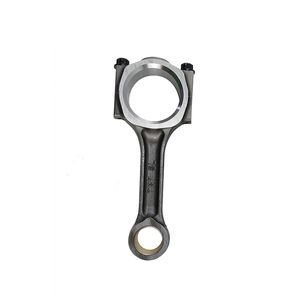
Matched Set Dispatch — Every connecting rod ships with verified oversize grading aligned to your crankshaft regrind history, preventing dimensional mismatch during D722 or D902 engine rebuilds.
Technical Specifications
| Parameter |
Value |
| Part Number |
16851-22010 |
| Product Type |
Connecting Rod |
| Cross-Reference (reference only) |
16851-22012, 16851-22015, 16851-22017, 110-3735, K168512201 |
| Material |
High-strength alloy steel |
| Surface Treatment |
Anti-corrosion coating |
| Assembly State |
New Aftermarket |
| Engine Compatibility |
Kubota D722, D902, Z482 |
| Warranty |
3-12 months against manufacturing defects |
| MOQ |
1 piece |
| Standards |
ISO-certified manufacturing |
Application Suitability
| Engine System |
Related Components |
| Block & Internal Parts |
Piston assemblies, con rod bearing shells, crankshaft, piston pin bushings |
| Lubrication System |
Oil pump, main bearings, oil filter, lubrication passages |
| Cylinder Components |
Cylinder head, head gasket, valve train components |
| Fuel System |
Injection pump, injectors, fuel filters |
Why Internal Dimensions Vary Across the Same Engine Model
An engine model designation alone does not guarantee internal part interchangeability.
A connecting rod for a Kubota D722 or D902 engine must match the exact oversize grade dictated by previous crankshaft regrind work. I have seen overhaul jobs in Indonesia stall for days because the connecting rod arrived in standard size while the crankshaft journals had already been ground to 0.25 mm oversize. The rebuild shop discovered the mismatch only after tearing down the block and measuring the journals, wasting both time and the gasket kit already installed [NEED_CITE: engine rebuild sequencing and oversize grade verification]. Generic overhaul kits often list a single connecting rod part number without addressing the serial variants that exist within the same engine family, leading to fitment surprises mid-job.

Sourcing the Connecting Rod Within a Complete Overhaul System
The connecting rod sits at the center of the reciprocating assembly, linking piston motion to crankshaft rotation. For a D722 or D902 engine rebuild, sourcing this component in isolation risks dimensional mismatch with adjacent parts. A connecting rod bearing shell must match the rod bore diameter, and the piston pin bushing must align with the small-end bore. When these three components arrive from different suppliers with different production batches, tolerance stacking can push clearances outside specification.
Matching Oversize Grades to Crankshaft Rebuild History
Every time a crankshaft is reground, the journal diameter decreases and the bearing shells must increase in thickness to compensate. The connecting rod bore itself may also require machining during a rebuild. Confirming whether the crankshaft has been ground to STD, 0.25, or 0.50 oversize before ordering a connecting rod prevents the costly discovery that new bearing shells will not achieve proper oil clearance [NEED_CITE: crankshaft regrind oversize grade standards for small diesel engines]. Engine serial numbers within the D722 and D902 families can also dictate different rod configurations, making serial-level verification essential before committing to a purchase.
Material and Dimensional Factors That Determine Service Life
High-strength alloy steel provides the tensile endurance needed to withstand repeated combustion loading cycles in compact diesel engines. The anti-corrosion coating protects the rod during storage and initial break-in before full oil film establishment. The big-end bore diameter, small-end bore diameter, and center-to-center distance are the three critical dimensions that determine whether this connecting rod achieves correct piston-to-valve clearance and proper bearing crush. Tight control on these dimensions ensures that matched piston sets and bearing shells produce uniform clearances across all cylinders, which is particularly important when rebuilding multi-cylinder engines like the D902 where one out-of-spec rod can create vibration that accelerates wear on the remaining cylinders.
The Hidden Cost of Grade Mismatch During Rebuild
Ordering a connecting rod without verifying the crankshaft regrind history often results in either excessive bearing clearance or insufficient oil film thickness. Excessive clearance produces audible knock within the first few hours of operation, while insufficient clearance generates localized overheating that scores the journal surface. Both outcomes force a second teardown, consuming another complete gasket set, new oil and coolant, and additional shop labor hours. The original failure root cause may also go unaddressed if the rebuild focuses only on replacing the damaged rod without inspecting the lubrication passages and oil pump output that likely contributed to the initial bearing failure [NEED_CITE: root cause analysis for connecting rod bearing failure in diesel engines].
Why Source This Part Through XUNPO
Our production lines and qualified sourced supply operate under a single warranty framework, so whether your connecting rod comes from our own facility or a partner plant, the quality inspection and coverage terms remain identical. We carry eight product categories under one account, allowing you to add piston sets, bearing shells, gasket kits, and seal kits to the same order. Minimum order starts at one piece, supporting emergency single-cylinder repairs without forcing unnecessary stock purchases. Our technical team cross-references superseded part numbers like 16851-22012 and 16851-22015 against your engine serial number to confirm the correct variant. Samples are available for fitment confirmation before you commit to a full overhaul kit quantity.
Documentation & Verification
- Commercial invoice listing each connecting rod with oversize grade notation
- Cross-reference sheet mapping 16851-22010 to alternate numbers (reference only)
- Dimensional inspection record covering big-end bore, small-end bore, and center distance
- Quality inspection report confirming alloy steel material certification
- Packing photographs showing anti-corrosion coating condition before crating
- HS code and customs documentation for international engine parts shipment
Installation & Rebuild Sequence
- Clean all oil passages in the block and crankshaft before fitting the new connecting rod to prevent startup starvation
- Verify bearing shell crush height and oil clearance with Plastigauge before torquing the rod cap
- Match piston pin bushing bore to the piston pin diameter for correct small-end clearance
- Torque rod bolts in the specified sequence to avoid cap distortion that shifts the big-end bore
- Prime the lubrication system and confirm oil pressure at idle before applying load during break-in
Request an Overhaul Compatibility Check
Provide your engine model, serial number, and any crankshaft regrind records so we can confirm the correct oversize grade and matching overhaul kit contents for your D722 or D902 rebuild.
Frequently Asked Questions
Q: What does a complete D722 or D902 overhaul kit include beyond the connecting rod?
A: A complete overhaul kit typically includes pistons, piston rings, piston pin bushings, con rod bearing shells, main bearings, a full gasket set, and valve train components. The exact contents depend on whether you are addressing only the bottom end or performing a top-to-bottom rebuild. We provide an itemized checklist matched to your engine serial number before dispatch.
Q: The crankshaft was reground previously — how do I determine the correct oversize grade?
A: Measure the crankshaft journal diameter with a micrometer and compare it against the standard specification. The difference indicates the regrind amount and the corresponding bearing shell oversize needed. Common grades include STD, 0.25 mm, and 0.50 mm. Share your measurements and we will confirm the matching connecting rod and bearing combination.
Q: Do different engine serial numbers within the D722 model use different connecting rods?
A: Yes, production changes across the D722 and D902 manufacturing run introduced variations in rod configuration. Providing your engine serial number allows us to verify the correct variant rather than relying on the model designation alone. Cross-reference numbers like 16851-22012 and 16851-22015 reflect these running changes.
Q: What other internal components should I inspect when replacing a connecting rod?
A: Inspect the crankshaft journals for scoring and out-of-round wear, verify oil pump output pressure, and check all lubrication passages for blockage. The initial connecting rod failure often traces back to oil starvation rather than the rod itself. Addressing the root cause prevents a repeat failure shortly after the rebuild.