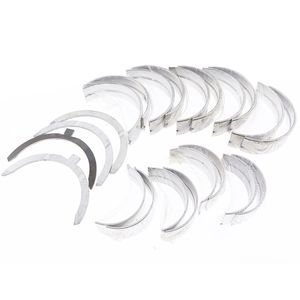
Matched Rebuild Sets — every 97333173 rod ships with verified bore and center-distance records so piston-to-crank alignment stays within overhaul tolerances.
Technical Specifications
| Parameter |
Value |
| Part Number |
97333173 |
| Product Type |
Connecting Rod |
| Cross-Reference |
97333173 (reference only) |
| Machine Fitment |
Ingersoll Rand SS5, SS5L5, SS5N5 air compressors |
| Condition |
New Aftermarket |
| Material |
Heat-treated alloy steel |
| Bearing Surface |
Precision-machined |
| Standard |
ISO 9001 |
| Warranty |
3–12 months against manufacturing defects |
| MOQ |
1 piece |
Application Suitability
| Engine System |
Related Components |
| Crankshaft assembly |
Crankshaft main bearings, thrust washers |
| Piston and cylinder group |
Piston pin, piston, cylinder liner |
| Connecting rod big end |
Rod bearing shells, rod bolts |
| Lubrication circuit |
Oil pump, oil filter, crankcase breather |
When a Connecting Rod Fails, the System Already Has a Story
Replacing the rod without tracing the failure root cause is how rebuild shops end up tearing down the same compressor twice.
A snapped or bent Connecting Rod for Air Compressor Overhaul & Rebuild rarely acts alone. Lubrication starvation, sustained overloading, or a partially blocked oil gallery usually sets the stage long before the metal gives way [NEED_CITE: reciprocating compressor lubrication failure modes and crankshaft bearing damage patterns]. I have walked into shops where the old rod sat on the bench next to a brand-new one, and nobody had checked whether the crankshaft journal was still round. The new Connecting Rod for Air Compressor Overhaul & Rebuild went in, the compressor ran for a few hundred hours, and then the big-end bearing spun again. The second teardown cost more than the first because the crankshaft had to come out for regrinding. Tracing the fault backward — oil pressure at the pump outlet, journal taper, pin bore ovality — turns a reactive parts swap into a genuine repair.

The Kinematic Chain Around the Rod
Every Connecting Rod for Air Compressor Overhaul & Rebuild sits inside a closed kinematic loop: crankshaft journal to big-end bearing, rod shank, small-end bushing, piston pin, and piston skirt running against the cylinder liner. If any one interface in that chain is out of tolerance, the load redistributes to the others. A worn piston pin bushing, for example, lets the pin rock inside the small end, and that rocking motion translates into alternating edge loads on the big-end shells. When we supply a rod, we recommend the rebuild shop measure the adjacent surfaces before deciding which companion parts to order — that single step prevents the mismatched-size-grade problem that forces a second teardown.
Size Grades, Rebuild History, and Serial Variants
Air compressor crankshafts do not always stay at standard journal diameter after their first regrind. If the SS5 unit in your shop has already been through one overhaul, the crankshaft may be running undersize journals, which means the rod big-end bore must accept thicker bearing shells or a different grade [NEED_CITE: reciprocating compressor crankshaft undersize journal grading and bearing shell selection]. The same logic applies to the small-end bushing: a piston pin that was replaced oversize in a prior rebuild demands a correspondingly reamed bushing. Between the SS5, SS5L5, and SS5N5, internal component revisions exist even though the external model family looks identical. Confirming the compressor serial number against the parts book revision prevents ordering a rod whose center distance or bolt-hole pattern belongs to an earlier or later build.
Reading the Spec Sheet Like a Rebuild Plan
The heat-treated alloy steel body of this Connecting Rod for Air Compressor Overhaul & Rebuild provides the tensile strength needed to survive thousands of compression cycles per hour in a reciprocating compressor. Heat treatment is what gives the shank its fatigue resistance — without it, cyclic bending loads at the transition radius between shank and big end would initiate cracks far earlier. The precision-machined bearing surface at the big end controls the oil-film geometry between rod and crankshaft journal; even minor deviations in surface finish or roundness translate directly into localized oil-film thinning and accelerated shell wear. Center distance — the dimension from big-end bore center to small-end bore center — governs piston stroke position and therefore compression ratio. A rod that is even slightly off on center distance shifts the piston's top-dead-center position, affecting volumetric efficiency and potentially causing the piston to contact the valve plate.
The Cost Nobody Puts on the Purchase Order
When a Connecting Rod for Air Compressor Overhaul & Rebuild is ordered without checking the crankshaft journal condition or the piston pin grade, the hidden cost surfaces on the rebuild bench. The shop presses in the new rod, torques the cap bolts, and turns the crank — only to feel a tight spot that means the big-end bore is not clearing a reground journal. The compressor comes back apart, the rod goes back in the box, and now the shop is waiting on undersize shells that were never on the original order [NEED_CITE: compressor overhaul teardown cost due to mismatched bearing grades]. In the worst scenario, a rod is forced onto a marginal journal, the compressor runs briefly, and the resulting bearing failure damages the crankshaft beyond salvage. The purchase-order savings on a single rod are wiped out many times over by the scrap crankshaft and the second full teardown.
Why Rebuild Shops Source This Rod Through One Account
Our own production lines and qualified sourced supply sit under a single warranty and a single account, so the rod, the piston, the pin, and the bearing shells all carry the same quality terms. Eight product categories mean a complete overhaul list — engine internals, seals, gaskets, and lubrication components — consolidates into one consignment instead of arriving on staggered schedules from different vendors. We accept orders from one piece upward, so an emergency single-rod replacement ships without forcing you to buy a full set you do not need. Our Guangzhou warehouse holds stock on fast-moving items for rapid dispatch, and our technical team will confirm serial-range compatibility and size-grade matching before the order goes to packing.
Documentation & Verification
- Commercial invoice listing each rod by part number and serial-range applicability
- Cross-reference sheet (reference only) mapping superseded and alternate numbers
- Dimensional inspection record covering big-end bore, small-end bore, and center distance
- Warranty terms covering manufacturing defects for 3–12 months
- Packing photographs taken before crate closure
- HS code and customs classification support for international shipments
Installation & Rebuild Sequence
- Clean all oil galleries in the crankshaft before installing the rod to prevent trapped debris from scoring the new bearing shells
- Verify big-end bore diameter against the actual crankshaft journal measurement, selecting bearing shell grade accordingly
- Torque rod cap bolts in the specified sequence and recheck big-end roundness with a bore gauge before proceeding
- Confirm small-end bushing inner diameter matches the piston pin grade already installed in the piston
- Rotate the crankshaft by hand through several full revolutions to check for binding before installing the cylinder head
- Run the compressor under no-load conditions during initial break-in to allow bearing surfaces to seat properly
Send Us the Details That Matter
To get the right rod for your compressor, share the Ingersoll Rand model designation, the compressor serial number, and any prior overhaul records that note crankshaft journal sizes or piston pin grades. If the nameplate is unreadable, a clear photograph of the old rod next to a tape measure lets our technical team confirm center distance and bolt pattern. We will reply with fitment confirmation and a companion-parts list matched to your machine's actual rebuild state.
Frequently Asked Questions
Q: What companion parts should be replaced alongside the connecting rod during a compressor overhaul?
A: Rod bearing shells, rod bolts, piston pin bushings, and main bearings should all be inspected and typically replaced as a matched set. Reusing old shells on a new rod risks mismatched wear profiles, and old bolts may have stretched beyond their elastic limit. We supply all of these as a consolidated overhaul package matched to your compressor serial number.
Q: What system-level causes lead to connecting rod failure in reciprocating compressors?
A: Lubrication starvation from blocked oil galleries, sustained overloading beyond design pressure, and crankshaft journal wear creating uneven bearing loads are the most common root causes. Replacing the rod without correcting the underlying fault leads to repeat failure. We recommend a full lubrication circuit inspection and crankshaft measurement before fitting the new rod.
Q: Are connecting rods for SS5, SS5L5, and SS5N5 fully interchangeable?
A: While the three models share the same family designation, internal revisions across production runs can affect center distance, bolt-hole spacing, and bearing shell grade. Always confirm the compressor serial number against the applicable parts book revision before ordering. Our team verifies serial-range compatibility before dispatch.
Q: Can I install a standard connecting rod on a crankshaft that has already been reground undersize?
A: No — a reground crankshaft requires thicker bearing shells or a corresponding undersize grade to maintain correct oil-film clearance. Installing a standard rod with standard shells on an undersize journal will produce excessive clearance and rapid bearing failure. Measure the journal diameter first and specify shell grade accordingly.