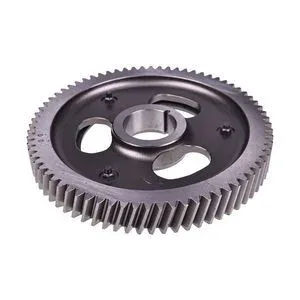
System-Matched Timing Components — Camshaft Gear 3946436 verified against engine serial variants and rebuild history to prevent tolerance stack-up in Cummins B-series and QSB timing trains.
Technical Specifications
| Parameter |
Value |
| Part Number |
3946436 |
| Product Type |
Camshaft |
| Cross-Reference |
3946436 (reference only), J946436 (reference only), K3946436 (reference only) |
| Machine Fitment |
Hyundai HL757-7, HL757TM-7, 100D-7, 120D-7, 135D-7, 160D-7 |
| Brand Compatibility |
Fits Cummins, Hyundai applications |
| Condition |
New Aftermarket |
| Material |
High-grade steel |
| Hardness |
HRC 58–62 |
| Dimensional Tolerance |
±0.02 mm |
| Warranty |
3–12 months against manufacturing defects |
| Quality Standard |
ISO 9001 |
Application Suitability
| Engine System |
Related Components |
| Cummins 4B3.9 timing train |
Camshaft gear, crankshaft gear, timing chain, chain tensioner, front cover gasket set |
| Cummins 6B5.9 valve timing |
Camshaft gear, idler gear, thrust plate, cam bearing set, oil pump drive gear |
| QSB / ISB CM550 overhead |
Camshaft gear, fuel pump drive coupling, injector timing pin, cam seal |
| QSB3.9 / QSB4.5 / QSB5.9 30 CM550 |
Camshaft gear, timing gear cover, related seal kits, matched bearing shells |
Why a Camshaft Gear Fails Months After a Rebuild
A replacement Camshaft Gear engine rebuild part that fails early is rarely a gear problem — it is a system problem. The root cause usually sits upstream or downstream: a stretched timing chain throwing load onto one tooth face, a worn tensioner letting slack hammer the gear flanks, or an oil gallery partially blocked by debris from the previous failure.
In Guangzhou warehouse operations over the years, the most expensive comebacks I have seen were not caused by the gear itself. A shop would order the Camshaft Gear 3946436 for a Cummins 6B5.9, install it cleanly, and have it back on the stand within months because the idler gear bore was oval or the front oil gallery still held metallic debris from the original failure [NEED_CITE: root cause analysis practices for diesel engine timing gear failures]. The gear is the messenger; the system writes the message.
Timing System Context for the 3946436
This Camshaft Gear engine rebuild component sits at the top of the timing train, driven by the crankshaft gear either directly or through an idler depending on the B-series variant. Its job is to hold cam-to-crank phase within a tight angular window so that valve events align with piston position across the full RPM range. When the phase drifts — even by a fraction of a degree — combustion efficiency drops, exhaust temperature rises, and the engine begins to load adjacent components with forces they were not designed to absorb.
Engine Serial Variants and Rebuild History Matter
Cummins 4B3.9 and 6B5.9 blocks were produced across multiple generations, and the Camshaft Gear tooth count and hub configuration can shift between serial ranges. A gear that physically bolts on may still produce incorrect valve timing if the variant does not match the camshaft and crankshaft gear pair. Beyond factory variants, a previous rebuild may have changed the dimensional baseline: a block that has been line-bored, a crankshaft ground to an undersize, or a cam journal bored to accept an oversized bushing all alter how the new gear meshes and where it sits axially [NEED_CITE: Cummins B-series engine serial range variant documentation]. That is why confirming the engine serial number and the rebuild record is non-negotiable before releasing the part from the shelf.
Reading the Specifications That Actually Matter
The HRC 58–62 hardness range targets a balance between tooth flank wear resistance and core toughness — hard enough to resist pitting under continuous mesh loading, yet tough enough that a sudden torsional spike from a cylinder misfire does not chip a tooth root. The ±0.02 mm dimensional tolerance governs the gear bore and tooth profile, directly controlling backlash between the Camshaft Gear and its mating crankshaft or idler gear. Backlash that runs wide lets the gear rattle and accelerates flank wear; backlash that runs tight generates heat and risks seizure under thermal expansion at operating temperature. High-grade steel with controlled carbon content allows consistent case depth through heat treatment, which matters because timing gears carry continuous cyclic loading unlike components that see intermittent stress.
The Cost of Skipping the System Check
When a shop replaces only the Camshaft Gear engine rebuild item without inspecting the idler bore, chain free length, and tensioner travel, the new gear inherits every fault the old one absorbed. The result is not immediate failure but accelerated flank wear that shows up as timing drift at the next service interval. The machine returns to the stand, the cylinder head comes off again, and the labor cost dwarfs the price of the matched components that should have been replaced together. Unplanned downtime multiplies when the same system is opened twice for what should have been one complete pass [NEED_CITE: cost of repeat diesel engine disassembly for timing correction].
Why Source This Timing Gear Here
Eight product categories under one account means the Camshaft Gear ships in the same consignment as the cam bearings, front cover seal kit, and tensioner — one dispatch, one freight charge, one warranty start date. Guangzhou warehouse stock covers common B-series timing components for fast release on standard variants. Part identification works from the part number, machine model, a photograph of the old gear, or a nameplate image when the casting number is worn beyond reading. Cross-reference verification covers 3946436, J946436, and K3946436 against specific engine serial ranges so superseded numbers and alternate listings are resolved before the order ships. A sample unit can be supplied for fitment confirmation before a bulk commitment locks in inventory the shop may not need.
Documentation & Verification
- Commercial invoice listing each timing component by verified part number
- Cross-reference sheet mapping 3946436 interchange numbers to engine serial ranges
- Dimensional inspection record covering bore tolerance and tooth profile check
- Warranty terms document specifying manufacturing defect coverage period
- Packing photographs showing gear protection and consignment contents before dispatch
- HS code and customs classification support for cross-border engine parts shipments
Installation & Rebuild Sequence
- Clean all timing gear housing surfaces and oil galleries before Camshaft Gear installation to remove metallic debris from the prior failure
- Verify backlash between the new Camshaft Gear and mating gear using a dial indicator at three points around the circumference
- Install the chain tensioner and confirm travel range before fitting the timing cover to avoid interference with the gear hub
- Torque the gear retaining fastener to specification and stake or lock-wire as the engine variant requires
- Prime the lubrication system and confirm oil flow reaches the timing gear mesh before first start to prevent dry running
- Run the engine through a graduated load break-in and re-check backlash after the initial thermal cycle
Requesting a Quotation
To move forward, share the engine model and serial number so the correct Camshaft Gear variant can be confirmed against the serial range. Include any known rebuild history — oversize bearings, line-bored mains, previous undersize crankshaft grind — so matched components are sized correctly. If the old gear is available, a photograph of the tooth face and hub casting helps cross-reference verification before the order is released.
Frequently Asked Questions
Q: Which other timing system components should be replaced alongside the camshaft gear?
A: The timing chain or gear set, tensioner, idler gear bushing, front cover gasket, and camshaft seal are typically replaced together during a Camshaft Gear engine rebuild job. Replacing only the gear leaves worn mating surfaces that accelerate flank wear on the new part. A matched set ensures consistent backlash and phase alignment across the entire timing train.
Q: Does the same part number fit all 4B3.9 and 6B5.9 serial ranges?
A: No. Tooth count and hub configuration can vary across Cummins B-series production runs. The cross-reference numbers 3946436, J946436, and K3946436 may map to different serial ranges. Confirming the engine serial number is essential to ship the correct variant rather than a gear that bolts on but produces incorrect valve timing.
Q: Is the camshaft gear included in a standard overhaul kit?
A: Standard overhaul kits typically contain pistons, rings, bearings, and gaskets but not timing gears. The Camshaft Gear engine rebuild component is usually ordered separately. Verify the kit contents against your engine build requirements before placing the order to avoid delays once the block is on the stand.
Q: How can I confirm the exact engine variant when the nameplate is unreadable?
A: Provide a photograph of the old camshaft gear showing the casting marks and tooth count, along with the machine model such as HL757-7 or 120D-7. Cross-referencing the physical gear features against known serial range variants allows identification even when the engine dataplate is painted over or missing entirely.
Q: What causes a new camshaft gear to fail prematurely after installation?
A: Premature failure usually traces to a system root cause rather than the gear itself. Stretched chains, worn tensioners, blocked oil galleries feeding the timing mesh, or mismatched gear variants all load the new Camshaft Gear engine rebuild part beyond its design intent. A system-level inspection before reassembly prevents repeat teardowns.