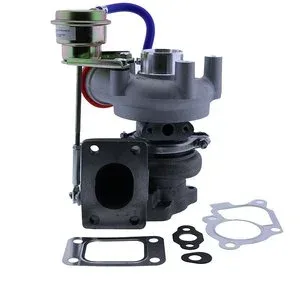
System-Level Overhaul Verification — Every turbocharger replacement we dispatch includes an engine serial variant check to prevent mismatched mating surfaces and gasket grades.
Technical Specifications
| Parameter |
Value |
| Part Number |
1J716-17010 |
| Product Type |
Turbocharger |
| Cross-Reference |
1J71617010 (reference only) |
| Machine Fitment |
Kubota Loader SVL65-2, SVL65-2C |
| Condition |
New Aftermarket |
| Turbine Wheel Material |
Inconel 713C alloy |
| Internal Seals Standard |
SAE J1922 |
| Air Purity Compliance |
ISO 8573-1 Class 2 |
| Warranty |
6 months against manufacturing defects |
| MOQ |
1 piece |
Application Suitability
| Engine System |
Related Components |
| Intake & Forced Induction |
Intercooler piping, intake manifold gaskets, air filter assembly |
| Lubrication Supply & Return |
Oil feed lines, drain tubes, engine oil filter |
| Emission & Exhaust |
EGR valve and cooler, exhaust manifold studs and gaskets |
| Thermal Management |
Coolant hoses adjacent to center housing, heat shields |
Why a Turbo Failure Is Rarely the Whole Story
A failed turbocharger engine rebuild part is usually the final symptom of a deeper system fault, not the root cause. [Replacing the unit without diagnosing the oil supply or intake tract guarantees a repeat failure within the first operating cycle.]
In my time handling rebuild logistics across Southeast Asian workshop networks, I have seen new units destroyed in weeks because the original oil coking or carbon ingestion issue was never addressed. The bill for a second teardown dwarfs the cost of the initial diagnosis [NEED_CITE: turbocharger failure root cause analysis in off-highway diesel engines].
Systemic Context of This Replacement
This turbocharger engine rebuild part does not operate in isolation. It draws filtered oil from the main gallery, relies on a clear drain path back to the sump, and pushes charge air through intercooler and intake tract components. Inspecting every upstream and downstream interface before installation prevents the common pattern where a new unit ingests debris left behind by the previous failure.
Matching the Rebuild Grade to Engine History
Engines that have undergone a prior rebuild may already be running oversize pistons or different head gasket thicknesses, which alter compression ratios and exhaust gas profiles. Confirming the engine serial number and variant ensures the turbocharger selected handles the actual boost demand, not just the factory baseline. Mismatched boost pressure against an altered compression setup accelerates turbine and bearing wear.
Specification Impact on Field Performance
The Inconel 713C turbine wheel retains structural integrity at sustained high exhaust temperatures, a critical property for loaders operating in quarry and demolition zones where ambient heat compounds thermal load. Internal seals built to SAE J1922 prevent oil migration past the center housing into the charge air stream, which would otherwise cause blue smoke on startup and carbon buildup on intake valves [NEED_CITE: SAE J1922 turbocharger oil seal performance criteria]. Air purity compliance at ISO 8573-1 Class 2 means the charge air path is validated against particulate contamination levels that would score bearing surfaces over time.
The Cost of Skipping System-Level Diagnosis
Workshops that swap the unit without tracing the failure origin face predictable callbacks. Oil starvation from a clogged feed line will burn through the new center housing bearings. Carbon chunks from a failing EGR cooler will pit the compressor wheel. These repeat failures are not defective parts — they are unresolved system faults presenting as turbocharger engine rebuild part failures [NEED_CITE: common turbocharger warranty claim rejection causes].
Sourcing from an Engine-System Perspective
We maintain production oversight on selected lines and source the remainder from ISO-certified partners under a single account and warranty structure. Eight product categories mean a complete overhaul kit — gaskets, seals, bearings, and this turbocharger — ships as one consignment rather than staggered deliveries. Our technical team verifies engine serial variants before dispatch, not after the crate arrives. Guangzhou warehouse stock on common items allows rapid turnaround, and a single piece can be ordered for fitment confirmation before bulk commitment.
Documentation & Verification
- Commercial invoice listing 1J716-17010 with HS code for customs clearance
- Cross-reference sheet mapping 1J71617010 interchange numbers for identification (reference only)
- Quality inspection record covering boost pressure test and oil leak rate
- Warranty terms document specifying the six-month coverage scope
- Packing photographs showing anti-static foam and sealed bag condition pre-dispatch
Installation & Rebuild Sequence
- Flush oil feed and drain lines before connecting the new unit to prevent debris ingestion.
- Verify center housing bolt torque to specification using a calibrated wrench.
- Prime the oil cavity manually before first crank to avoid dry-start bearing damage.
- Run the engine at idle for a set break-in period before applying load.
Requesting a System-Matched Quote
Provide your engine model, serial number, and any known rebuild history so we can confirm variant compatibility and advise on which adjacent gaskets and seals should ship in the same overhaul consignment.
Frequently Asked Questions
Q: What other engine components should be inspected when replacing this turbocharger?
A: Oil feed and drain lines, intake tract and intercooler piping, EGR cooler condition, and exhaust manifold gaskets all require inspection. Contamination or restriction in any of these systems caused the original failure and will repeat it if unaddressed during the turbocharger engine rebuild part replacement.
Q: How do I confirm the correct turbo variant for my engine serial number?
A: Kubota engines across different production runs may carry variant differences that affect turbocharger mating flanges or oil port orientations. Providing the full engine serial number allows cross-referencing against build records to confirm the 1J716-17010 fits your specific configuration.
Q: What caused the previous turbo to fail and how do I prevent recurrence?
A: Common root causes include oil starvation from clogged feed lines, carbon ingestion from a failing EGR system, or foreign object damage from a compromised air filter. Diagnosing and resolving the originating fault during the rebuild prevents the new unit from suffering the same failure mode.
Q: Is this turbocharger included in a complete engine overhaul kit?
A: We supply overhaul kits matched to specific engine serial variants. The kit contents are verified against the engine build record to ensure gaskets, seals, and bearings match your rebuild scope, avoiding the common problem of incomplete kits that halt a teardown mid-job.