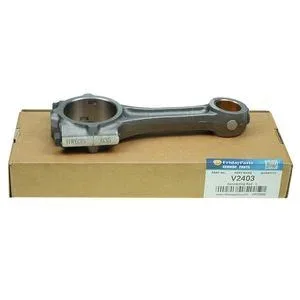
System-Matched Supply — every connecting rod ships with crankshaft journal condition verified to ensure correct bearing grade pairing.
Technical Specifications
| Parameter |
Value |
| Part Number |
17311-22010 17311-22012 |
| Product Type |
Connecting Rod |
| Cross-Reference |
17311-22010, 17311-22012, 17331-22010, 17311-22013 (reference only) |
| Machine Fitment |
KX91-3, KX121-2, KX121-3, KX161-2, KX161-3, U35, U45S, R420, R520, L2250DT, L2550DT, L2800DT, L2900DT, L3010, L3400, L39, L4200DT, L4240, L4610, L48, M4700, M4900, M5400, M5700, MX5000, GV-1125Q, KJ-S130D-USA, KJ-T210VX-USA |
| Material |
Forged steel with precision heat treatment |
| Condition |
New aftermarket |
| Standards |
ISO 9001, ISO 683-4 |
| Bearing Grade Options |
available in STD, 0.25 and 0.50 oversize |
| Warranty |
3–12 months against manufacturing defects |
Application Suitability
| Engine System |
Related Components |
| V1500 / V1702DI bottom-end assembly |
Crankshaft, main bearings, con-rod bearing shells |
| V1902DI / V2003-T rotating group |
Piston assemblies, piston pins, snap rings |
| V2203 / V2403 overhaul sequence |
Thrust washers, oil pump, crankshaft seals |
| V3307 / V3800 heavy-duty rebuild |
Cylinder liners, head gasket set, valve train kit |
When the Connecting Rod Arrives but the Rebuild Still Fails
Correct bearing grade must match crankshaft journal condition, not just the part number.
A connecting rod ordered by cross-reference alone often arrives STD grade while the crankshaft was ground to 0.25 oversize during a previous rebuild. The clearance mismatch starves the bearing shell of oil within the first hours of operation, producing rod knock that gets misdiagnosed as a defective part. In Latin American mining operations where I have stood next to dismantled Kubota engines, this scenario repeats with frustrating regularity — the rod itself is dimensionally sound, but the system around it was never reconciled. [NEED_CITE: engine rebuild bearing clearance tolerance standards]

The Rotating Assembly Where This Part Lives
The connecting rod sits at the heart of the bottom-end rotating assembly in Kubota V-series diesel engines. It transfers combustion force from the piston to the crankshaft journal, cycling through thousands of load reversals per minute. Any dimensional drift in the big-end bore or pin bush translates directly into bearing wear, oil pressure loss, and eventual seizure. Selecting the correct Connecting Rod engine overhaul rebuild component means accounting for every adjacent surface it touches.
What Crankshaft History Changes About Your Order
Engines that have already passed through one rebuild frequently carry reground crankshafts, meaning standard-size bearing shells no longer fit the journal diameter. Ordering a replacement connecting rod without confirming whether the crankshaft remains at STD or has been machined to an oversize dimension leads to immediate incompatibility. This is particularly common on V1500 and V1702DI units that see heavy excavation duty and have been field-repaired more than once. [NEED_CITE: crankshaft regrind oversize bearing grade identification procedures] Always measure journal diameter before committing to a bearing grade.
Forged Steel and Heat Treatment in Cyclic Loading
The connecting rod is forged from steel and heat-treated to withstand the repeated tensile and compressive loads generated during each combustion cycle. Forging aligns the grain structure along the rod's stress axis, providing higher fatigue resistance compared to cast alternatives. Precision heat treatment ensures the big-end and small-end maintain dimensional stability under sustained thermal load. Shot-peened fillet areas at the transition zones reduce stress concentration points where micro-cracks typically initiate. An anti-corrosion coating protects the rod surface in high-humidity environments and salt-exposed coastal mining sites, preventing surface pitting that could become a crack origin.
The Rework Cost When Grade and Clearance Do Not Match
Shipping a standard connecting rod into an engine with a reground crankshaft forces the rebuild shop to halt assembly, source the correct oversize bearings under time pressure, or return the entire order. The machine sits on the bench while logistics catch up. In remote mining camps where I have worked, that delay stretches from days into weeks because replacement stock is not locally available. The labour cost of a second teardown often exceeds the rod's value several times over. [NEED_CITE: engine overhaul rework cost from incorrect component grade selection]
Why This Supply Channel Fits Rebuild Planning
Production on selected connecting rod lines runs in-house, with remaining volumes sourced from ISO-certified partners — both covered under the same warranty terms. Engine system components across all eight core categories ship from one account, so the overhaul kit, gasket set, bearing shells, and fasteners leave as a single consignment. Orders start from one piece, removing the minimum quantity barrier that blocks emergency single-rod replacements. Part identification works from the OEM cross-reference number, engine model, photograph of the worn nameplate, or a serial number image. Cross-reference verification covers superseded and alternate numbers so older V1500 and V1702DI variants are correctly matched. Technical support is available to confirm bearing grade compatibility before the order ships.
Documentation & Verification
- Commercial invoice listing each connecting rod variant and bearing grade ordered
- Cross-reference sheet mapping 17311-22010 and superseded numbers (reference only)
- Dimensional inspection record covering big-end bore and pin bush tolerances
- Warranty terms specifying coverage period and manufacturing defect scope
- Packing photographs showing rod protection and crate condition before dispatch
- HS code and customs documentation for cross-border engine parts shipment
Installation & Rebuild Sequence
- Clean the big-end bore and cap mating surfaces to remove any protective coating residue before assembly
- Verify crankshaft journal diameter with a micrometer to confirm STD or oversize bearing grade selection
- Install matched con-rod bearing shells and check oil clearance with plastigauge before final torque
- Torque the cap bolts in the specified sequence to achieve correct clamp load on the connecting rod
- Rotate the crankshaft by hand after assembly to confirm free movement without binding
- Run the engine under graduated load during the initial break-in period to seat bearing surfaces
Request the Right Configuration for Your Overhaul
Provide the engine model, serial number, and any known crankshaft regrind history so the correct bearing grade and connecting rod variant can be confirmed before shipment. If the engine has been rebuilt previously, share the teardown measurements or photos of the existing bearing shells. This ensures the Connecting Rod engine overhaul rebuild package matches the actual condition of the rotating assembly inside your engine.
Frequently Asked Questions
Q: What other components should be replaced together with the connecting rod during an overhaul?
A: A reliable bottom-end rebuild typically requires new con-rod bearing shells matched to crankshaft journal condition, piston rings if cylinders are being honed, thrust washers, and a full gasket set. Reusing old bearing shells or fasteners introduces unknown fatigue history into the assembly and compromises the rebuild outcome.
Q: How do I determine whether STD or oversize bearings are needed after crankshaft regrind?
A: Measure the crankshaft journal diameter with a micrometer at multiple points and compare against the engine manufacturer's specification table. If the journal has been ground undersize during a previous rebuild, the corresponding oversize bearing grade must be selected to maintain correct oil clearance.
Q: Do different engine serial ranges within the same model use different connecting rod variants?
A: Yes. Production changes across Kubota V-series engine generations can alter big-end bore diameter, cap bolt specification, or pin bush dimensions even when the external engine model designation remains unchanged. Confirming the engine serial number ensures the correct variant is supplied.
Q: What system-level fault should be diagnosed before replacing a failed connecting rod?
A: Before installing a new rod, investigate whether oil starvation, contaminated lubricant, overheating, or over-speed caused the original failure. Addressing only the damaged component without correcting the root cause will produce a repeat failure within a short operating period. [NEED_CITE: diesel engine connecting rod failure root cause analysis]
Q: How do I confirm the exact engine model and serial number from the machine?
A: The engine serial number is stamped on the block, typically near the oil filter housing or on the rear flange. If the nameplate is worn or painted over, a clear photograph of the stamping area allows the technical team to cross-reference the correct engine build variant and matching components.