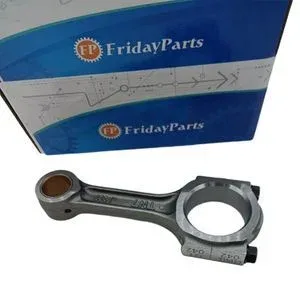
Matched Overhaul Sets — every connecting rod ships with verified bearing grade and piston assembly to match your crankshaft journal condition.
Technical Specifications
| Parameter |
Value |
| Part Number |
719810-23100 |
| Product Type |
Connecting Rod |
| Cross-Reference (reference only) |
71981023100, YM719810-23100, YM71981023100, YMR000995, YM719810-23700, YM71981023700, 719810-23700, 71981023700 |
| Engine Models |
3TNE78, 3TNE78A |
| Condition |
New Aftermarket |
| Material |
High-strength steel |
| Machine Fitment |
3D75N-1YC (S/N 01661-UP), 3D78AE-3A (S/N 00715-UP), 3D78AE-3B (S/N 00101-UP), 3D78AE-3C (S/N 00101-UP), 3D78AE-3D (S/N 02552-UP), 3D78N-1A (S/N 00101-UP), 3D78N-1C (S/N 00715-UP), 3D78N-1E (S/N 03598-UP), 3D80-1 (S/N 00501-UP), 3D82AE-3C (S/N 01208-UP), 3D82AE-3D (S/N 00101-UP), 3D82AE-3E (S/N 04840-UP), 3D82AE-3F (S/N 04840-UP), 3D82AE-3G (S/N 04840-UP), 3D82AE-3H (S/N 04840-UP), 3D82AE-3HB (S/N 04840-UP), 3D82AE-3HC (S/N 04840-UP), 3D82AE-5M-BA (S/N 00246-UP), 3D82AE-5P-CB (S/N 00246-UP), 3D82AE-6 (S/N 04634-UP, For PC27MR-3), 3D82AE-6BM-DA (S/N 04634-UP), 3D82E-3A (S/N 00101-UP), 3D82E-3B (S/N 00101-UP), PC20R-8 (S/N F30001-Up, F30791-Up), PC27MR-2 (S/N F00103-Up), PC27R-8 DELUXE (S/N F30671-Up, F31103-Up), PC27R-8 (S/N F30001-Up, F31103-Up, F32154-Up) |
| Brand Fitment |
Compatible with Yanmar, Komatsu equipment |
| Warranty |
3-12 months against manufacturing defects |
| Certification |
ISO-certified manufacturing |
Application Suitability
| Engine System |
Related Components |
| Crank-slider mechanism |
Con rod bearings (STD / 0.25 / 0.50 undersize), piston assembly, wrist pin, crankshaft |
| Lubrication system |
Oil pump, main bearings, oil filter, oil cooler — verify flow before reassembly |
| Cylinder and head assembly |
Head gasket, cylinder liner, valve stem seals, injector copper sleeves |
| Full overhaul kit |
Gasket set, seal kit, thrust washers, snap rings — confirm contents against engine serial |
Why the Connecting Rod for Yanmar 3TNE78 Engine Rebuild Fails Before the Part Does
Most rod failures trace to lubrication starvation, bearing fatigue, or a previous rebuild that skipped root-cause diagnosis.
In teardown yards across Central Asia, I have seen engines come back with spun bearings within weeks of a rebuild. The connecting rod itself was dimensionally sound — the problem was a crankshaft ground to 0.25 undersize paired with standard-grade bearing shells, or an oil pickup screen clogged with debris from the original failure that nobody cleaned. [NEED_CITE: common root causes of connecting rod bearing failure in industrial diesel engines]
Ordering a replacement rod without confirming journal condition, bearing clearance grade, and oil system integrity invites the same failure to repeat. The connecting rod for Yanmar 3TNE78 engine rebuild must be spec'd as part of a system, not as an isolated line item.

System Context — Where This Rod Sits in the Crank-Slider Assembly
The connecting rod transfers combustion force from the piston to the crankshaft journal. In the Yanmar 3TNE78 and 3TNE78A, this connecting rod for Yanmar 3TNE78 engine rebuild operates alongside matched piston assemblies, wrist pins, and con rod bearings that must all share compatible dimensional grades. A rod pulled from a different engine serial variant may carry a slightly different big-end bore diameter or bolt torque specification, causing premature bearing crush or cap walk under load.
Oversize Grade and Engine Serial Variants — Two Variables That Must Align
Crankshaft journals on these engines are frequently reground during a prior overhaul. If the crankshaft is now at 0.25 undersize but the new bearing shells ordered alongside this rod are STD grade, the clearance gap will be excessive and oil pressure at the big end will bleed off. Conversely, pairing an undersize crankshaft with correctly graded shells requires confirming the rod big-end bore has not been resized beyond tolerance. [NEED_CITE: crankshaft journal regrind standards and bearing shell grade matching for compact diesel engines]
The 3TNE78 and 3TNE78A share external dimensions but differ in internal component specifications across serial ranges. Komatsu machine serial numbers further narrow the valid engine build. Always confirm engine serial and prior rebuild history before finalizing the order.
Dimensional and Material Parameters That Matter at Rebuild
The high-strength steel construction of this connecting rod must maintain big-end bore roundness and small-end bushing alignment through thousands of combustion cycles. Bearing clearance is typically measured in thousandths of an inch — even minor distortion from improper bolt torque during a previous rebuild can push the big-end bore out of round, making new bearing shells seat unevenly. Bolt stretch method is preferred over torque-only tightening to achieve consistent clamp load across both rod bolts. [NEED_CITE: connecting rod bolt torque versus stretch method for medium-duty diesel engines]
Material grade directly affects fatigue life under the cyclic loading of a three-cylinder engine, where each cylinder fires at closer intervals than a four- or six-cylinder layout. The thermal load from combustion also transfers through the rod, making material consistency critical when sourcing aftermarket replacements.
The Hidden Cost of Grade Mismatch and Unchecked Root Cause
Shipping a connecting rod without verifying the crankshaft journal grade means the rebuild shop may open the box to find STD bearings that cannot be used on a reground crank. The engine stays on the stand while correct-grade shells are sourced, and the machine sits idle. Worse, if someone forces the assembly together with mismatched clearance, the bearings overheat and spin within hours of restart — damaging the new rod, the crankshaft journal, and potentially scattering debris through the entire lubrication circuit. [NEED_CITE: consequences of incorrect bearing clearance in rebuilt diesel engines]
Failing to investigate why the original rod failed means the underlying fault — a blocked oil gallery, a failing oil pump, or contaminated oil from a previous breach — remains active in the rebuilt engine.
Why Source This Connecting Rod Through This Channel
Our selected production lines and qualified sourcing partners operate under one account with unified warranty terms, so a connecting rod ordered alongside piston assemblies and gasket sets carries the same quality commitment. Part identification is confirmed from engine serial number, machine model, or a photograph of the existing nameplate — critical when paint and corrosion have obscured markings on site. Cross-reference verification covers superseded numbers such as YM719810-23700 and YMR000995 to prevent ordering errors across engine generations. Sample units are available for fitment confirmation before bulk commitment, letting your rebuild shop verify big-end bore dimensions and bolt pattern against your crankshaft before the full set ships. Technical support is available to confirm bearing grade coordination based on your crankshaft's current journal condition.
Documentation & Verification
- Commercial invoice listing part number 719810-23100 with cross-reference sheet marked reference only
- Dimensional inspection record covering big-end bore roundness, small-end bushing diameter, and center distance
- Bearing grade compatibility sheet matching rod assembly to crankshaft journal undersize condition
- Warranty terms covering manufacturing defects for 3-12 months from dispatch
- Packing photographs showing rod bolts, bearing shells, and piston assemblies consolidated per order
Installation & Rebuild Sequence
- Clean oil galleries and pickup screen thoroughly to remove debris from the original failure before installing the new connecting rod for Yanmar 3TNE78 engine rebuild
- Measure crankshaft journal diameter with a micrometer to confirm undersize grade before selecting bearing shells
- Verify rod bolt stretch using manufacturer specification rather than torque-only method for consistent clamp load
- Check bearing crush height and oil clearance with plastigauge before final cap installation
- Run initial break-in at reduced load with fresh oil and monitor oil pressure at the big-end gallery
Inquiry Guidance
Provide the engine model (3TNE78 or 3TNE78A), engine serial number, and any known crankshaft regrind history so we can confirm the correct connecting rod and matching bearing grade. If the nameplate is worn, send a photograph of the block casting marks or the existing rod stamping. For fleet overhauls, share the machine serial range so we cross-check Komatsu-specific engine build variants.
Frequently Asked Questions
Q: What other components should be replaced together with the connecting rod during an overhaul?
A: Con rod bearings matched to your crankshaft journal grade, piston rings, wrist pin bushings, head gasket, and the full seal and gasket set. On engines with high hours, inspect the oil pump and replace the oil cooler if contamination is suspected. Ordering these as a matched set prevents the rebuild from stalling over a missing item.
Q: How do I confirm the correct oversize grade if the crankshaft has been previously reground?
A: Measure each crankshaft journal with a micrometer and record the diameter. Compare against the Yanmar service manual specifications for STD, 0.25, and 0.50 undersize grades. Provide these measurements when ordering so the correct bearing shells ship with your connecting rod. Never assume grade based on a previous rebuild invoice — always measure.
Q: Are internal parts identical across all Yanmar 3TNE78 and 3TNE78A engine serial variants?
A: No. The 3TNE78 and 3TNE78A differ in certain internal dimensions and component specifications depending on serial range. Komatsu machine serial numbers further narrow which engine build was installed at the factory. Provide both engine serial and machine serial to confirm fitment before ordering.
Q: What system-level failures commonly cause connecting rod damage?
A: Lubrication starvation from a clogged oil pickup, oil pump wear reducing gallery pressure, bearing shell fatigue from extended service intervals, or over-torque during a previous rebuild. Address the root cause — not just the failed rod — before reassembly to prevent the same failure from recurring within the first service cycle.
Q: How do I identify the exact engine model and serial when the nameplate is worn or painted over?
A: Send a photograph of the block casting, the injection pump mounting face, or the stamping on the existing connecting rod. These locations often retain legible marks even when the external plate is gone. Our team can cross-reference these against the 3TNE78 and 3TNE78A build records to confirm the correct variant.