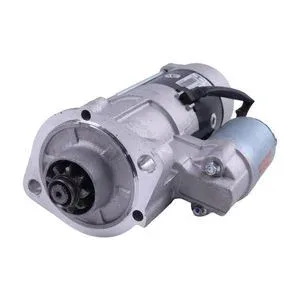
Engine Sequence Variants Verified — every 1G023-63010 shipment is cross-checked against your specific Kubota D722, D782, or D722E-GX serial build before dispatch.
Technical Specifications
| Parameter |
Value |
| Part Number |
1G023-63010 |
| Product Type |
Starter Motor |
| Cross-Reference (reference only) |
67980-31151, 67980-31150, 67980-31152, KEARS-67980 |
| Machine Fitment |
BX1500D, G2160, GR2100, GR2110, GR2120, TG1860, ZD18, ZD21, ZD221, ZD321, ZD323 |
| Voltage |
12V |
| Pinion Teeth |
9T |
| Condition |
New Aftermarket |
| Engine Fitment |
Kubota D722, D782, D722E-GX (21HP / 18HP) |
| Warranty |
6-month standard warranty against manufacturing defects |
| Quality Standard |
ISO 9001 |
Application Suitability
| Engine System |
Related Components |
| Starting circuit |
Solenoid relay, battery cables, ignition switch |
| Flywheel engagement |
Ring gear, flywheel housing, mounting bolts |
| Charging system |
Alternator, voltage regulator, drive belt |
| Cold-start support |
Glow plugs, glow plug relay, coolant temperature sensor |
When a Starter Motor Replacement Is Not Enough
Diagnose the circuit before you swap the unit.
In the Yangtze Delta workshops where I spent my early career, I watched too many technicians pull a starter, bolt in a replacement, and wonder why it failed again within a season. The root cause often sits elsewhere — a degraded solenoid contact, a battery that cannot sustain cranking amperage, or a ring gear with chipped teeth that shreds every pinion it meets. Replacing a Starter Motor engine rebuild replacement for Kubota D722 D782 without tracing the full starting circuit is treating the symptom while the disease remains [NEED_CITE: electrical starting system diagnostic procedures for small diesel engines].
System Context for the Starting Circuit
A Starter Motor engine rebuild replacement for Kubota D722 D782 sits at the intersection of the battery circuit, solenoid relay, and flywheel ring gear. When an engine rebuild shop reassembles a D722 or D782, the starter is among the last components installed but the first one energized — making it the initial proof of whether the electrical auxiliary system was put together correctly. If the battery cannot deliver sufficient cold-cranking amps or the solenoid engages late, the new starter absorbs the stress.
Copper-Wound Coils and Repeated Cranking Cycles
The field coil construction matters when a machine faces frequent start-stop duty or cold ambient starts. Copper-wound field coils maintain thermal stability across repeated cranking attempts, whereas aluminum-wound alternatives tend to lose efficiency as internal temperature climbs. For zero-turn mowers like the ZD321 that may start and stop dozens of times per working day, this thermal behavior directly affects whether the Starter Motor engine rebuild replacement for Kubota D722 D782 survives the season or returns under warranty [NEED_CITE: thermal degradation characteristics of starter motor field coil materials].
Voltage, Tooth Geometry, and Engagement Depth
The 12V rating and 9-tooth pinion are not arbitrary specifications — they define how the starter interacts with the entire starting system. The 9T pinion must mesh cleanly with the flywheel ring gear at a precise engagement depth; too shallow and the teeth grind on every start, too deep and the pinion binds against the ring gear face. Voltage draw during cranking reveals whether the battery, cables, and solenoid contacts can sustain the current the starter demands. A voltage drop below the threshold during cranking typically points to cable corrosion or undersized wiring rather than a defective starter unit.
The 12V system on Kubota D722 and D782 platforms requires the starter to produce sufficient torque to overcome compression across two or three cylinders depending on the variant. The D722E-GX, rated at 21HP, demands slightly higher cranking torque than the 18HP configurations, and the starter must be matched accordingly to avoid sluggish engagement during cold starts.

The Cost of Skipping System-Level Diagnosis
Replacing a failed starter without investigating why it failed leads to predictable comebacks. A workshop that installs a new unit on a D782 without checking the ring gear may find the new pinion worn within weeks. An overhaul that ignores the solenoid timing may subject the starter to prolonged engagement after the engine fires, overheating the armature. These repeat failures are rarely the fault of the replacement part — they reflect an incomplete diagnosis that treats the starter as an isolated component rather than part of an interconnected electrical system [NEED_CITE: root cause analysis methodology for diesel engine starting system failures].
What Sets This Supply Channel Apart
Our selected production lines and qualified sourced supply both carry identical QC and warranty terms, so you receive consistent quality regardless of which facility built your starter. Eight product categories under one account mean the starter, solenoid, glow plugs, and gaskets for a complete D722 rebuild ship as one consignment. Orders start from a single unit — useful when one mower in a fleet needs immediate attention. Guangzhou warehouse stock on common Kubota electrical components supports fast dispatch. Part identification works from your old part number, machine model, or a photograph of the nameplate when corrosion has made the original stamping unreadable. Cross-reference verification covers superseded and alternate numbers, and sample units are available for fitment confirmation before you commit to fleet-level quantities.
Documentation & Verification
- Commercial invoice listing exact engine variant and cross-reference numbers for customs clearance
- Part compatibility sheet confirming D722, D782, or D722E-GX fitment with reference-only OEM numbers
- Functional bench test record showing voltage draw, cranking torque, and solenoid engagement timing
- 6-month warranty terms covering manufacturing defects under stated operating conditions
- Packing photographs documenting protective wrapping and terminal cap installation before dispatch
- HS code and customs documentation support for international shipment of electrical starting components
Installation & Rebuild Sequence
- Clean the flywheel housing mating surface thoroughly before mounting to prevent misalignment of the starter body
- Verify ring gear tooth condition by rotating the flywheel and inspecting for chips or uneven wear patterns
- Torque mounting bolts to specification in the correct sequence to avoid housing distortion under load
- Test battery voltage and cable continuity before connecting the starter to rule out upstream circuit issues
- Perform a no-load bench spin after installation to confirm smooth armature rotation before first engine start
- Monitor cranking time during initial engine fire — prolonged engagement indicates solenoid or relay adjustment needed
Request a System-Matched Quote
Provide your engine model, serial number, and any previous rebuild history so we can confirm the correct starter variant and related electrical components for your specific build.
Frequently Asked Questions
Q: What other engine electrical components should I inspect when changing the starter motor?
A: Inspect the solenoid relay contacts for pitting, test battery cold-cranking amps, and examine the flywheel ring gear for chipped or worn teeth. Check cable terminals for corrosion and verify voltage drop across the positive and ground circuits during cranking. Replacing a Starter Motor engine rebuild replacement for Kubota D722 D782 without addressing these related items risks repeat failure within weeks of installation.
Q: How do Kubota D722, D782, and D722E-GX variants affect starter fitment?
A: Mounting bolt patterns and pinion engagement depth can differ between these engine variants despite sharing the same base starter design. The D722E-GX at 21HP may require higher cranking torque than the 18HP D722 configuration. Provide your exact engine serial number so we can verify the correct variant before shipment and avoid fitment issues on the bench.
Q: How do I distinguish starter failure from a solenoid or battery circuit issue?
A: Measure voltage at the starter terminal during cranking — if it drops significantly below battery voltage, the fault likely sits in cables, connections, or the solenoid rather than the starter itself. A starter that spins freely on the bench but struggles on the engine typically indicates insufficient current delivery from the upstream circuit, not a defective armature or field coil.
Q: Can I get a sample unit to verify fitment before ordering for my fleet?
A: Sample units are available for fitment confirmation before you commit to bulk quantities. We recommend testing the sample on your specific machine variant, checking mounting alignment, pinion engagement with the ring gear, and terminal orientation. Once fitment is confirmed, we match production to the same specification across your entire fleet order.
Q: What is the correct cross-reference number for my machine and engine build?
A: Cross-reference numbers such as 67980-31151 and KEARS-67980 are for identification purposes and must be verified against your specific engine serial variant. Numbers can be superseded across production runs, and the same base starter may appear in several variants across different machine models. Send us your machine model and engine plate details for accurate cross-reference confirmation.