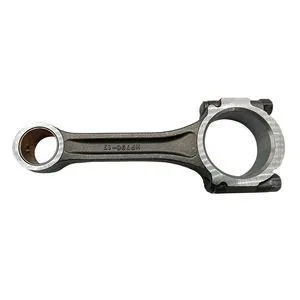
System-Matched Grade Verification — Every Kubota connecting rod we dispatch is cross-checked against the specific engine rebuild history and crankshaft journal state to ensure bearing grade alignment before shipping.
Technical Specifications
| Parameter |
Value |
| Part Number |
15471-22012 / 15471-22013 |
| Product Type |
Connecting Rod |
| Cross-Reference (reference only) |
15471-22012, 15471-22013 |
| Machine Fitment |
Kubota D1301, D1302 DI, D1402, D1402-BBS, KH-101, KH-151, KH-191, KX151, KX101, L1500, L175, L295DT, L295F, L405, L405DT, L2350DT, L2350F, L245-IIDT, L245-IIF, L2550, M4950, M4950DT, M4950-S, M4950DT-S, R410, R410B, RW25, RW30, Bobcat 225, Bobcat 643 |
| Material |
Forged steel (ISO-certified heat-treated alloy) |
| Condition |
New Aftermarket |
| Warranty |
3–12 months against manufacturing defects |
| MOQ |
1 piece |
| Quality Standard |
ISO 9001 |
Application Suitability
| Engine System |
Related Components |
| Block rotating assembly |
Crankshaft, main bearings, con rod bearings, piston, piston rings, cylinder liner |
| Engine overhaul kit |
Gasket set, seal kit, thrust washers, connecting rod bolts |
| Single-cylinder repair |
Matched bearing shells (STD / 0.25 / 0.50 oversize), piston pin, circlips |
| Generator set rebuild |
Full engine gasket set, oil pump, water pump service kit |
When a Complete Overhaul Kit Still Leaves You With a Torn-Down Engine
A Kubota Connecting Rod 15471-22012 engine rebuild fails when the rod and bearing grade do not match the crankshaft's actual journal diameter after prior machining.
In Shandong's engine repair workshops, I have opened Kubota D1301 and D1402 blocks where the connecting rod looked correct, but the con rod bearings were standard grade on a crankshaft ground to oversize during a previous rebuild. The result is metal-on-metal contact within hours of startup, and the entire rotating assembly comes back out [NEED_CITE: engine bearing clearance failure modes in reground crankshafts]. A Kubota Connecting Rod 15471-22012 engine rebuild requires verifying every mating surface dimension before any component goes back into the block.

Where the Connecting Rod Sits in the Kubota D-Series Power Assembly
The connecting rod links the piston to the crankshaft inside the block, transferring combustion force into rotational motion. In Kubota D1301 and D1402 engines, this component operates under continuous thermal and mechanical cycling that affects every adjacent part. When a Kubota Connecting Rod 15471-22012 engine rebuild is planned, the rod must be evaluated alongside the piston, cylinder liner, and bearing shells as a single tolerance stack — not as an isolated replacement.
How Prior Rebuilds Change What You Need to Order
Every time a crankshaft journal is reground, the bearing clearance envelope shifts. If a D1402 was rebuilt previously with 0.25 oversize bearings, sending standard-grade shells with a new connecting rod guarantees early failure. Engine serial variants within the D1301 and D1402 families also differ in bore and stroke dimensions, meaning the same base part number can correspond to different journal specifications [NEED_CITE: Kubota D-series engine serial variant identification procedures]. Always confirm the crankshaft's current machining state before locking in bearing grade for the connecting rod assembly.
Reading the Specs That Actually Matter for Rebuild Success
The forged steel construction provides the fatigue strength needed for continuous compression and tension loading inside the cylinder block. Heat treatment to ISO-certified standards ensures the big-end bore maintains dimensional stability under operating temperature, which directly controls bearing oil film thickness. The rod's big-end bore tolerance must match the crankshaft journal diameter within the specified clearance band — too tight and the bearing starves for oil, too loose and impact loading accelerates wear on both surfaces. These dimensional relationships are why the connecting rod cannot be sourced independently of its matched bearing set.
The Hidden Cost of Skipping the Crankshaft Measurement Step
Ordering a connecting rod without confirming the crankshaft journal state leads to a predictable sequence: the engine goes together, runs briefly, then develops a knock that grows louder with each hour. The teardown reveals scored bearing shells and a damaged rod journal, meaning the new connecting rod is now scrap along with the bearings [NEED_CITE: connecting rod bearing failure root cause analysis in diesel engines]. The second round of parts ordering costs more time than the original repair window allowed, and the machine sits idle while the correct oversize components are sourced.
Why Rebuild Shops Source This Rod Through Our System
Our own production lines and qualified sourced supply carry the same QC and warranty terms, so whether your Kubota Connecting Rod 15471-22012 engine rebuild needs one piece or a full fleet quantity, the dimensional inspection standard does not change. Eight product categories under one account means the connecting rod ships in the same consignment as the gasket set, piston rings, and seal kits — eliminating split deliveries. We verify cross-reference numbers including superseded variants, and our technical team confirms bearing grade compatibility against the crankshaft journal state you report. Sample units are available for fitment confirmation before you commit to bulk.
Documentation & Verification
- Commercial invoice listing each connecting rod by part number and matched bearing grade
- Cross-reference sheet marking 15471-22012 and 15471-22013 as interchange reference only
- Dimensional inspection record covering big-end bore tolerance and journal diameter match
- Warranty terms document specifying coverage period for manufacturing defects
- Packing photographs showing anti-rust wrap and foam insert protection before crate closure
- HS code and customs documentation for international engine parts shipment
Installation & Rebuild Sequence
- Clean block interior and oil galleries thoroughly before connecting rod installation to prevent contaminant ingestion
- Verify crankshaft journal diameter with micrometer and select bearing shells matching the measured oversize grade
- Check connecting rod big-end bore roundness and alignment before fitting new bearing shells
- Torque rod bolts to specification in staged increments and confirm side clearance with feeler gauge
- Prime oil system and verify pressure at idle before applying load during initial break-in period
Provide Your Engine Details for Grade Confirmation
Share your Kubota engine model, serial number, and any known crankshaft regrind history so we can confirm the correct bearing grade and connecting rod specification for your rebuild. Photographs of the existing rod stamping and crankshaft journal markings help us verify the exact variant before dispatch.
Frequently Asked Questions
Q: What other components should be replaced together with the connecting rod during an overhaul?
A: During a Kubota D-series overhaul, the connecting rod should be replaced alongside matched con rod bearings, piston, piston rings, cylinder liner, and the full gasket and seal kit. Main bearings and thrust washers should also be evaluated. Replacing the rod alone while reusing fatigued bearings or worn liners invites repeat failure within the same service interval.
Q: How do I determine the correct bearing grade if the crankshaft was reground previously?
A: Measure the crankshaft rod journal diameter with a calibrated micrometer and compare the reading against the Kubota service manual clearance table. If the journal was ground to 0.25 or 0.50 oversize during a prior rebuild, the connecting rod must be fitted with bearing shells of the corresponding undersize grade — not standard.
Q: Are internal parts identical across all D1301 and D1402 engine serial variants?
A: No. While the D1301 and D1402 share a common architecture, bore diameter, stroke length, and rod journal specifications can differ between serial ranges. Confirming the exact engine serial number prevents ordering a connecting rod variant that physically fits but operates outside the designed clearance envelope.
Q: What system-level fault should I check before installing a new connecting rod?
A: Investigate oil delivery pressure, oil pump condition, and gallery blockage before installing a new connecting rod. Rod bearing failure often traces to oil starvation rather than component defect. If the root cause is not corrected, the replacement connecting rod and bearings will follow the same failure path within a short operating window.
Q: How do I confirm my exact engine model when the nameplate is worn or painted over?
A: Send clear photographs of any casting numbers on the block, the existing connecting rod stamping, and the piston crown marking. These identifiers allow our technical team to cross-reference the engine family and serial range, confirming the correct connecting rod and bearing specification even without a readable nameplate.

![10080 → 1+0+0+8+0 = 9 9 mod 6 = 3 → 句式: [品牌/机型]-Compatible [品类词] – [站点修饰词] 站点: xunpomachineryparts.com → 池: Engine Grade / Rebuild Kit / Matched Set / Overhaul Component / Powertrain / System-Matched (6个) 9 mod 6 = 3 → Overhaul Component Connecting Rod 8980139624 for Isuzu 4JG1 4JG2 Engine John Deere 75C 80C Excavator 实词提取: Connecting Rod, 8980139624, Isuzu, 4JG1, 4JG2, Engine, John Deere, 75C, 80C, Excavator 套用句式3: [品牌/机型]-Compatible [品类词] – [站点修饰词] 尝试: Isuzu 4JG1 4JG2-Compatible Connecting Rod – Overhaul Component 字符数: I-s-u-z-u(5) + 空格(1) + 4-J-G-1(4) + 空格(1) + 4-J-G-2(4) + --(1) + C-o-m-p-a-t-i-b-l-e(10) + 空格(1) + C-o-n-n-e-c-t-i-n-g(10) + 空格(1) + R-o-d(3) + 空格(1) + –(1) + 空格(1) + O-v-e-r-h-a-u-l(8) + 空格(1) + C-o-m-p-o-n-e-n-t(9) = 62字符 ✓ 检查合规: 无genuine/original/OEM authorized;无价格;无emoji/书名号/引号/句号/井号;非全大写;无连续标点。 Isuzu 4JG1 4JG2-Compatible Connecting Rod – Overhaul Component](https://xunpomachineryparts.com/wp-content/uploads/2026/08/10080-e28692-10080-9-9-mod-6-3-e28692-e58fa5e5bc8f-e59381e7898c-e69cbae59e8b-compatible-e59381e7b1bbe8af8d-e7ab99e782b9e4bfaee9a5b0-628f2e.webp)