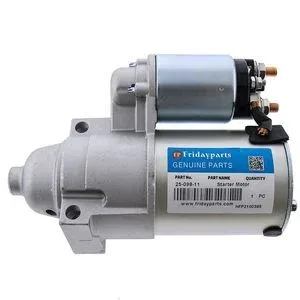
Engine Series Variants Verified — This starter motor matches Kawasaki FX-series electrical draw profiles across FX801V, FX850V, and FX921V builds, confirmed against engine serial prefix before dispatch.
Technical Specifications
| Parameter |
Value |
| Part Number |
21163-7025 |
| Product Type |
Starter Motor |
| Cross-Reference |
21163-7025, 21163-7021, 211637025, 211637021, 99996-6121, 999966121, 21163-0757, 211630757 (reference only) |
| Machine Fitment |
John Deere Z830A 54 Gas, Z850A 60 Gas, Z860A 60 Gas, Z910A 60, Z925A 54, Z930A 60 FX801V, Z930M 60 ECV749, Z930M 72 FX801V, Z930R 54 FX801V, Z930R 60 FX801V, Z950A 60, Z950M 60 FX850V, Z950M 72 FX850V, Z950R 54 FX850V, Z960A 60 FX921V, Z960M 60, Z960M 72, Z960R 60 FX921V, Z960R 72 FX921V, Z970A 72, Z970R 60, Z970R 72, Toro Z Master G3, New Holland G5030, New Holland G5035 |
| Condition |
New Aftermarket |
| Warranty |
6 months against manufacturing defects |
| Insulation Class |
Class H (rated to 180°C) |
| Housing Material |
Die-cast aluminum alloy A380 |
| Solenoid Wire |
Oxygen-free copper wire |
| Brush Material |
High-tensile copper |
| Actuation Life |
Beyond 12,000 actuations |
| Cold-Start Tested |
-10°C |
| Standards |
ISO 9001, SAE J1171, ISO 16750-2 |
Application Suitability
| Engine System |
Related Components |
| Cranking & Starting Circuit |
Battery terminals, starter relay, main fuse block, ignition switch harness |
| Flywheel Engagement |
Ring gear tooth condition, flywheel runout, pinion clearance shim |
| Engine Management Interface |
ECM communication circuit, safety interlock switches, PTO engagement relay |
| Charging System Recovery |
Alternator output, voltage regulator, drive belt tension |
Why a New Starter Fails Within Weeks of a Rebuild
Most repeat starter burnouts trace back to an electrical fault that was never diagnosed before the engine went back on the bench.
I have handled warranty returns where a perfectly good Starter Motor engine rebuild replacement came back melted at the solenoid terminal. The engine shop replaced the failed unit but never checked whether the battery was sulfated, the ground strap was corroded, or the starter relay was sticking closed. The new motor absorbed the full consequence of a fault it did not create [NEED_CITE: common causes of starter motor electrical failure in small engine fleets]. Across dozens of such cases, the pattern is consistent: the root cause lived in the wiring, not in the motor itself. A systematic pre-fitment electrical check prevents the machine from returning to the workshop within the warranty window.

The Cranking System as an Interdependent Loop
This Starter Motor engine rebuild replacement sits at the cranking end of a circuit that begins at the battery post and ends at the engine block ground. Every connection in between carries full cranking amperage, and any resistance point generates heat that degrades the motor over time. When an FX801V or FX850V engine is already disassembled for overhaul, the starter is one of several cranking-system components that should be bench-tested or replaced as a matched set to protect the rebuilt assembly.
Matching Electrical Draw to Engine Variant
The FX801V, FX850V, and FX921V each present different cranking loads due to displacement and compression ratio differences. A starter sized for a lower-output variant may overheat when asked to turn a higher-compression engine repeatedly during a hot summer mowing season [NEED_CITE: starter motor amp draw matching to engine displacement in commercial turf equipment]. Confirming the exact Kawasaki engine serial prefix ensures the unit supplied matches the cranking torque and current draw profile required by that specific build.
Insulation and Thermal Endurance Under Sustained Duty
Class H insulation withstands continuous winding temperatures that standard Class B insulation cannot survive in sustained cranking scenarios. Commercial zero-turn mower fleets often crank a hot engine five or six times per shift during refueling stops, and each cycle pushes winding temperature upward. Oxygen-free copper solenoid wire resists the thermal oxidation that causes conventional copper windings to develop high-resistance joints over repeated heat cycles. These material selections address the failure mode most commonly seen in municipal park and golf course fleet operations where daily start counts are high.
The Cost of Skipping the Root-Cause Diagnosis
When a workshop replaces this Starter Motor engine rebuild replacement without verifying battery health, relay condition, and ground integrity, the new unit inherits the same electrical abuse that destroyed its predecessor. The machine returns to the customer, fails again within a few weeks, and the shop absorbs a second teardown under warranty [NEED_CITE: repeat starter failure diagnostic protocol for small engine repair centres]. The hidden cost is not the part itself — it is the labor, the freight, and the eroded trust from a customer whose mower sat idle twice for the same symptom.
Supply From a Facility That Understands Engine-System Context
Selected part lines are produced in-house while the remainder is sourced from ISO-certified manufacturing partners, and both carry identical warranty terms — so a starter and its matching relay arrive under one account with one guarantee. The eight-category inventory means cranking components, gasket sets, and overhaul hardware consolidate into a single shipment. Minimum order begins at one piece, which matters when a single mower is down and the fleet cannot wait for batch quantities. Guangzhou warehouse stock enables fast dispatch on common Kawasaki FX-series references. Part identification works from the OEM number, the machine model, a photograph of the nameplate, or an image of the old unit on the bench. Cross-reference verification covers superseded and alternate numbers so that a discontinued Kawasaki reference still resolves to the correct current-production unit.
Documentation & Verification
- Commercial invoice listing Kawasaki FX engine variant and serial prefix
- Cross-reference sheet mapping 21163-7025 to superseded and alternate numbers (reference only)
- Bench test record covering cranking torque and pull-in voltage
- Warranty terms document specifying six-month manufacturing defect coverage
- Packing photographs showing starter motor housing and pinion condition pre-dispatch
- HS code and customs documentation for international engine parts clearance
Installation & Rebuild Sequence
- Verify battery state of charge and terminal cleanliness before connecting the new starter to prevent immediate thermal overload
- Inspect flywheel ring gear teeth for chipping or uneven wear that indicates prior pinion misalignment
- Confirm ground strap resistance from engine block to chassis frame is within specification before final torque
- Torque starter mounting bolts to Kawasaki service manual specification to maintain pinion-to-ring-gear alignment
- Perform three consecutive hot-start cycles after reassembly to validate solenoid engagement and cranking speed under operating temperature
Requesting a System-Matched Quotation
Provide the Kawasaki engine model, serial prefix, and any history of prior starter replacements or electrical system repairs. If the machine nameplate is worn, a photograph of the old starter label or the engine block casting number allows variant confirmation. Include the equipment brand and model — such as John Deere Z950M or Toro Z Master G3 — so that cross-reference verification covers both the engine and the machine builder's electrical configuration.
Frequently Asked Questions
Q: What other engine-start system components should I inspect when replacing this starter?
A: Check battery load-test results, starter relay contact condition, main fuse integrity, and ground strap resistance. A degraded relay that sticks closed will hold the starter engaged after the engine fires, burning out the new unit quickly. Verify the ignition switch harness for chafed insulation that could cause intermittent cranking signal loss.
Q: How do I match the correct starter variant to my specific Kawasaki FX engine serial?
A: Provide the engine serial prefix from the nameplate or valve cover stamping. Kawasaki FX801V, FX850V, and FX921V variants differ in cranking torque requirement and solenoid configuration. We cross-reference the serial against build records to confirm electrical draw compatibility before shipping.
Q: My machine has a different OEM number listed — is this starter still compatible?
A: Kawasaki has superseded several starter part numbers across FX-series production runs. Numbers such as 21163-7021 and 99996-6121 serve as interchange references for this unit. Send the old label photograph and engine serial so we can verify whether the supersession applies to your specific build.
Q: What causes repeated starter failure on FX-series engines and how do I prevent it?
A: Most repeat failures originate in the charging or cranking circuit — not the motor. Sulfated batteries, corroded ground straps, and sticking relays force the starter to operate outside its design envelope. Diagnose the full circuit before installing the replacement to break the failure cycle and protect the rebuilt engine assembly.
Q: Can I order a sample unit for bench and fitment verification before a bulk purchase?
A: Sample supply is available for fitment and electrical verification on your bench before fleet-scale commitment. This lets your workshop confirm pinion engagement, mounting pattern, and terminal orientation against the specific Kawasaki FX variant in your fleet before ordering production quantities.