Matched Assembly Grade — Connecting rod dimensional tolerance verified against crankshaft journal condition and piston pin bore for DEUTZ 2011/1011 series rebuilds.
Technical Specifications
| Parameter |
Value |
| Part Number |
04287602 |
| Product Type |
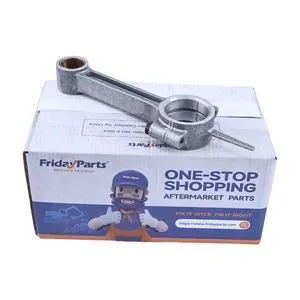
Connecting Rod |
| Cross-Reference |
0428 7602, 0417 4410, 4287602, 4174410 (reference only) |
| Machine Fitment |
F4M2011, F4L2011, BF4M1011, BFL1011 |
| Brand Compatibility |
DEUTZ |
| Application |
Construction machinery, mining equipment, agricultural machinery |
| Quality Standard |
ISO-certified manufacturing |
| Warranty |
3-12 months against manufacturing defects |
Application Suitability
| Engine System |
Related Components |
| Block rotating assembly |
Crankshaft, main bearings, piston cooling jets |
| Reciprocating mass |
Piston, piston pin, piston rings, circlips |
| Lubrication feed path |
Con rod bearing shells, oil pump, gallery pressure |
| Cylinder sealing interface |
Cylinder liner, head gasket, head bolts |
Why the Wrong Connecting Rod Triggers a Second Teardown
A connecting rod ordered without verifying rebuild history often forces the engine back onto the stand.
In mining and heavy construction environments, DEUTZ 2011/1011 engines frequently see multiple overhauls across their service life. Each rebuild can alter the internal dimensional landscape — a crankshaft ground to an undersize, pistons swapped to an oversize grade, or bearing shells stepped up to compensate for journal wear. When a replacement connecting rod arrives without accounting for these changes, bearing clearances fall outside specification and the engine fails within hours of restart [NEED_CITE: engine bearing clearance standards for medium-duty diesel rebuilds]. The machine goes down again, the workshop tears it apart a second time, and the cost of the downtime dwarfs the part cost many times over.

The Rotating Assembly as a Matched System
The connecting rod does not work in isolation. It sits at the center of a matched rotating assembly — linked upward through the piston pin to the piston and rings, and downward through the con rod bearing shells to the crankshaft journal. During a Connecting Rod engine rebuild DEUTZ F4M2011 procedure, every interface in this chain must be dimensionally compatible. A rod with a standard big-end bore paired with a reground crankshaft journal produces excessive oil film thickness and audible knock under load. The system must be verified as a complete set before any component is installed.
Rebuild History Changes the Required Specification
Previous overhauls leave dimensional fingerprints that must be read before ordering replacement parts. If a crankshaft was ground to 0.25 mm undersize on a prior rebuild, the connecting rod big-end bore and bearing shells must match that grade — not the original factory specification. Similarly, if cylinders were honed and oversize pistons fitted, the small-end bush and piston pin diameter may have shifted [NEED_CITE: diesel engine crankshaft regrind grade identification practices]. The F4M2011 and BF4M1011 share base architecture, but internal specifications can diverge across production runs and serial number breaks. Confirming the engine serial number and measuring existing components eliminates guesswork.
Dimensional Grade and Clearance Verification
The connecting rod big-end bore must fall within a specific tolerance band that corresponds to the crankshaft journal diameter and the selected bearing shell grade. Bearing shells are manufactured in color-coded or stamped thickness grades, and the correct combination produces the oil clearance specified for the engine. Too tight, and the oil film shears under thermal load; too wide, and oil pressure bleeds off at the bearing, starving downstream galleries. Rod straightness and twist also matter — a bent rod shifts the piston crown angle, causing uneven liner wear and ring scuffing that appears weeks after the rebuild. These parameters are measurable and should be confirmed against the inspection record before installation.
The Cost of Skipping Root-Cause Analysis
When a connecting rod fails, the instinct is to replace the damaged part and restart. But rod failure in the DEUTZ 2011/1011 family typically traces to a system-level cause: lubrication starvation from a blocked oil gallery, bearing shell spin from improper crush height, or sustained overloading beyond rated torque output [NEED_CITE: connecting rod failure modes in four-cylinder diesel engines]. Replacing the rod without addressing the underlying cause leads to repeat failure — often on the same cylinder, sometimes taking the crankshaft journal with it. A thorough rebuild examines the oil pump output, gallery condition, and bearing shell witness marks to identify what killed the original rod.
Sourcing System-Matched Components from One Supply Point
This connecting rod is supplied with dimensional verification documentation so the rebuild team can confirm grade match against measured crankshaft journals and piston pin bores. The supply covers the full rotating assembly — matched sets of rods, bearing shells, pistons, and pins ship under one account with consistent warranty terms. Whether the requirement is a single replacement rod after an isolated failure or a full four-cylinder matched set for a complete overhaul, the order is fulfilled from the same quality-controlled production line. Technical support is available to confirm compatibility against engine serial numbers and prior rebuild records, reducing the risk of grade mismatch before the crankcase is closed.
Documentation & Verification
- Commercial invoice listing part number 04287602 with cross-reference identification
- Dimensional inspection record showing big-end bore and small-end bush tolerances
- Compatibility sheet mapping rod grade to crankshaft journal condition and bearing shell options
- Warranty certificate covering manufacturing defects for 3-12 months
- Packing photographs confirming part identity and protective packaging before dispatch
- HS code documentation supporting customs clearance for international engine parts shipments
Installation & Rebuild Sequence
- Clean rod and cap mating surfaces thoroughly; any debris distorts bearing shell crush height.
- Match-mark rod to cap before separating — caps are line-bored as a pair and cannot interchange.
- Plastigauge bearing clearance at the big-end with the selected shell grade installed to verify oil film specification.
- Confirm piston pin slides freely through the small-end bush without binding or excessive lateral play.
- Torque rod bolts to specification in staged increments, then rotate the crankshaft by hand to check for binding before proceeding to the next cylinder.
Requesting the Correct Grade for Your Engine
Provide the engine model, serial number, and any known crankshaft regrind history so the correct connecting rod grade and matching bearing shell thickness can be confirmed. If the crankshaft condition is unknown, photographs of the existing bearing shells and journal surfaces help determine the required dimensional match before dispatch.
Frequently Asked Questions
Q: What else should be replaced together with the connecting rod during an overhaul?
A: During a DEUTZ 2011/1011 overhaul, the con rod bearing shells, piston rings, piston pin, and circlips are typically replaced as a matched set. Main bearings and thrust washers should also be inspected and replaced if worn. Gaskets, seals, and head bolts complete the list. Shipping everything together avoids partial reassembly and second teardowns caused by missing components.
Q: How do I know if my crankshaft has been reground and what grade bearing I need?
A: Check for stamped markings on the crankshaft counterweight indicating undersize grade, or measure journal diameter directly with a micrometer. Bearing shells are available in standard and oversize thickness grades to match. If previous rebuild records are unavailable, measurement is the only reliable method to determine the correct connecting rod and bearing combination.
Q: Are connecting rods interchangeable between F4M2011 and BF4M1011?
A: These engines share base architecture but may differ in internal component specifications across production runs and serial number ranges. Turbocharged variants can carry different reciprocating mass requirements. Always confirm by engine serial number rather than assuming model-level interchangeability. A quick cross-reference check against your specific serial number eliminates the risk of installing a dimensionally incompatible rod.
Q: What caused the original connecting rod to fail and how do I prevent recurrence?
A: Common causes include lubrication starvation from blocked oil passages, bearing shell spin due to incorrect crush height or bolt torque, and sustained overloading. Inspect the failed bearing shell witness marks, verify oil pump pressure, and confirm gallery flow before reassembly. Addressing the root cause rather than only replacing the damaged rod prevents repeat failure after the rebuild.
Q: Can I get a matched set of rods, bearings, and pistons in one order?
A: Yes. Matched rotating assembly components — connecting rods, bearing shells, pistons, pins, and rings — can be supplied together under one order with verified dimensional compatibility. Providing the engine serial number and any known rebuild history ensures every component in the set matches the crankshaft journal condition and cylinder bore grade of your specific engine.


![10437 → 数字之和:1+0+4+3+7 = 15 句式结构:15 % 6 = 3 → [品牌/机型]-Compatible [品类词] – [站点修饰词] 目标站 xunpomachineryparts.com 措辞池:Engine Grade / Rebuild Kit / Matched Set / Overhaul Component / Powertrain / System-Matched (6个) 修饰词选取:15 % 6 = 3 → Overhaul Component Kubota-Compatible Connecting Rod Bolt 16851-22140 – Overhaul Component](https://xunpomachineryparts.com/wp-content/uploads/2026/09/10437-e28692-e695b0e5ad97e4b98be5928cefbc9a10437-15-e58fa5e5bc8fe7bb93e69e84efbc9a15-6-3-e28692-e59381e7898c-e69cbae59e8b-compatible-caf57e.webp)