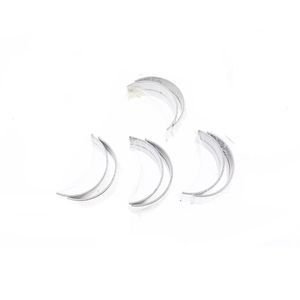
Oversize grades matched to crankshaft history — Each connecting rod bearing set ships with grade confirmed against measured journal diameter, preventing the STD-on-reground mismatch that forces a second teardown.
Technical Specifications
| Parameter |
Value |
| Part Number |
16241-22310 |
| Product Type |
Con Rod Bearing |
| Cross-Reference |
16241-22310 (reference only), 1624122310 (reference only), KBME5003CR (reference only), 16241-22311 (reference only), 1624122311 (reference only), 16292-22312 (reference only), 1629222312 (reference only) |
| Compatible Engine |
Kubota D1105 |
| Assembly State |
Set |
| Condition |
New Aftermarket |
| Oversize Availability |
STD, 0.25, 0.50 |
| Warranty |
3–12 months against manufacturing defects |
| Manufacturing Standard |
ISO-certified facility |
Application Suitability
| Engine System |
Related Components |
| Bottom-end rotating assembly |
Main bearings, thrust washers, crankshaft seals |
| Piston and cylinder group |
Piston rings, cylinder liner, wrist pin bushings |
| Lubrication circuit |
Oil pump, oil filter, gallery gaskets |
| Full overhaul package |
Complete gasket set, valve stem seals, con rod bolts |
Why the Wrong Bearing Grade Halts a D1105 Rebuild Mid-Job
Measure the crankshaft journals before ordering, not after the block is on the bench.
I have opened Kubota D1105 blocks on Middle East job sites only to find the crankshaft was already ground to 0.25 undersize during a previous overhaul, yet standard-grade bearings were on the shelf. The rebuild stalls, the machine sits idle, and the crew waits for the correct oversize set to arrive. Con rod bearing failure on these engines often traces back to oil starvation from a degraded pump or blocked gallery rather than the bearing itself — replacing the shell without diagnosing the root cause invites repeat failure [NEED_CITE: common root causes of premature con rod bearing failure in small diesel engines]. When an engine rebuild shop quotes a D1105 overhaul, the connecting rod bearing set must be spec'd alongside the main bearings and thrust washers as a matched bottom-end package so every clearance falls within the service manual tolerance.

Bottom-End System Matching for the D1105 Platform
The connecting rod bearing set sits at the heart of the D1105 bottom-end assembly, riding directly on the crankshaft rod journals. A proper overhaul treats these bearings as part of a matched system — main bearings, thrust washers, and con rod bearings must all reflect the same crankshaft regrind level. Ordering one grade for the mains and another for the con rods is a mismatch that shows up as uneven oil film thickness and early wear on the tighter pair.
Crankshaft Regrind History and Oversize Selection
Every D1105 that has been through a prior rebuild may carry reground journals, and the oversize grade must match what the machinist actually cut. A crankshaft ground to 0.25 mm undersize needs 0.25 oversize bearings; fitting STD shells leaves excessive oil clearance, drops oil pressure at operating temperature, and accelerates shell wear. Always mic the rod journals before committing to a grade [NEED_CITE: crankshaft journal measurement procedure for small-bore diesel engines]. Engines pulled from tractors in the B2100 series often arrive with one prior rebuild already logged, while units from compact excavators like the KX71-3 may have seen higher load cycles and deeper journal wear.
Dimensional Accuracy and Oil Clearance Control
The bearing shells in this set are manufactured to hold wall thickness within a tight tolerance band so assembled oil clearance stays within Kubota's published specification. Consistent wall thickness across all shells prevents one cylinder from running tighter than the rest, which would otherwise concentrate load and heat on a single journal. The bearing material is selected for embeddability and conformability — traits that allow the shell to absorb minor surface irregularities on the crankshaft during the initial run-in period and maintain a stable hydrodynamic oil film under the D1105's typical operating load.
The Hidden Cost of Skipping Grade Verification
Fitting a standard-grade connecting rod bearing set onto a crankshaft that has already been reground is not a minor inconvenience — it forces a complete teardown after the engine has been buttoned up and possibly fired. The labor cost of pulling the sump, dropping the crank, and replacing crushed shells dwarfs the time it takes to measure journals before ordering. Worse, if the grade mismatch goes undetected, the excessive clearance produces a knock that is easily misdiagnosed as piston slap, sending the diagnostic effort in the wrong direction [NEED_CITE: diagnostic pitfalls from excessive bearing clearance in inline diesel engines]. Every hour the D1105 runs with the wrong grade erodes the journal surface further, potentially converting a simple bearing replacement into a second crankshaft regrind or a scrap crankshaft.
Why Rebuild Shops Source This Bearing Set Here
Our own production lines and qualified sourced partners operate under one warranty and one quality standard, so the con rod bearing set carries the same inspection rigor regardless of which line produced it. Engine system components — main bearings, thrust washers, piston rings, and gasket sets — ship under a single account against one invoice, removing the coordination overhead of multiple suppliers. Minimum order is one set, which matters when a single D1105 comes in for an emergency bottom-end refresh. We identify the correct variant from an engine serial number, a photograph of the old bearing shell, or a nameplate image when the tag is too weathered to read. Cross-reference verification covers superseded numbers so a bearing set listed under 16241-22311 or 16292-22312 is correctly mapped to the current production part. Technical support confirms oversize grade against your measured journal dimensions before the order ships.
Documentation & Verification
- Commercial invoice listing each bearing grade and oversize separately for rebuild records
- Cross-reference sheet mapping 16241-22310 to alternate numbers (reference only)
- Dimensional inspection record showing wall thickness and crush height per shell
- Warranty terms covering manufacturing defects for 3–12 months from delivery
- Packing photographs documenting anti-corrosion wrapping before crate closure
- HS code and customs paperwork supporting agricultural and industrial parts clearance
Installation & Rebuild Sequence
- Clean all oil galleries in the block and crankshaft before fitting new shells
- Verify each connecting rod bearing shell back matches the rod bore diameter
- Apply assembly lubricant to shell faces before torquing rod caps to specification
- Check assembled oil clearance with Plastigauge on every journal pair
- Prime the lubrication system and confirm oil pressure before first load
Request a Quote With the Right Details
Send the D1105 engine serial number and any known crankshaft regrind history so the correct oversize connecting rod bearing set is quoted from the start. If the nameplate is missing or illegible, a photograph of the old bearing shell or the rod cap casting mark is enough to confirm the variant. Include the full bottom-end parts list if you want main bearings, thrust washers, and seals consolidated into one shipment.
Frequently Asked Questions
Q: What oversize grade do I need if the crankshaft was reground last rebuild?
A: The only reliable method is measuring the rod journals with a micrometer. If the previous rebuild ground the crankshaft to 0.25 mm undersize, you need 0.25 oversize bearings. Sending us the measured diameter or a photo of the old bearing shell's grade marking lets us confirm the match before shipping.
Q: Does the D1105 overhaul kit include main bearings and thrust washers, or are they separate?
A: Main bearings and thrust washers are typically listed as separate line items. We can consolidate the connecting rod bearing set, main bearing set, thrust washers, piston rings, and full gasket set into one shipment so nothing is missing when the block is on the stand.
Q: Why did the previous con rod bearings fail early — what else should I check?
A: Early con rod bearing failure on the D1105 commonly traces to oil pump wear, blocked oil galleries, or incorrect rod bolt torque rather than bearing quality alone. Inspect the oil pump gears, flush all gallery passages, and verify rod bolt stretch or torque values during reassembly to address the root cause.
Q: Do all Kubota D1105 variants across tractors and excavators use the same bearing set?
A: Internal specifications can vary between D1105 variants fitted to different platforms — a tractor B2100 and a KX-series excavator may carry different rod bolt sizes or journal configurations. Providing the engine serial number confirms which exact bearing set variant your build requires.
Q: How do I confirm the correct bearing set when only the machine model is known?
A: Send the machine model along with any readable engine code or a photograph of the nameplate area. We cross-reference the machine configuration to the D1105 variant and then verify the bearing specification against the engine serial range associated with that model.