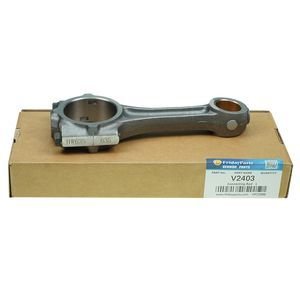
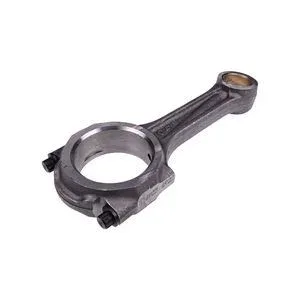
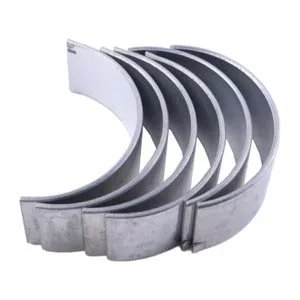
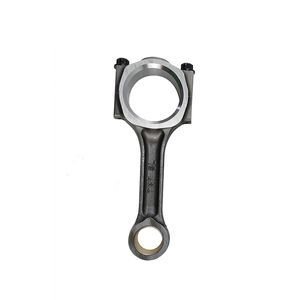
Matched Tolerances Verified — Every connecting rod is cross-checked against crankshaft journal condition and engine serial variant before dispatch.
Technical Specifications
| Parameter |
Value |
| Part Number |
1G924-22014 |
| Product Type |
Connecting Rod |
| Cross-Reference (reference only) |
1G924-22014, 1G924-22013, 1G924-22012, 1G924-22010 |
| Machine Fitment |
Kubota V2003, V2203, V2403; R430, KX040-4, L5040GST, L5240HST, L5460HST, L5740HST, MX5100, MX5200, MX5400, M5140, M5640SU, M59, M62 |
| Material |
Forged alloy steel with micro-alloying elements |
| Condition |
New Aftermarket |
| Warranty |
12-month warranty against manufacturing defects |
| Standards |
ISO 9001, ISO 6892-1 |
Application Suitability
| Engine System |
Related Components |
| Reciprocating assembly |
Pistons, piston pins, piston rings, con rod bearings |
| Crankshaft journal interface |
Main bearings, crankshaft thrust washers, bearing grade selection |
| Lubrication feed path |
Oil pump, oil filter, gallery plugs, con rod oil squirt hole |
| Fastener and retention system |
Rod bolts, rod nuts, split-pin or stretch-bolt hardware |
Why an Engine Rebuild Stalls at the Rotating Assembly
A Kubota V2203 V2403 connecting rod engine rebuild succeeds only when the rod, bearings, and crankshaft journal dimensions are verified as a matched set.
Too often, an overhaul kit arrives with standard-grade bearings while the crankshaft was already reground during a previous repair. The engine goes on the test bench and seizes within minutes. I have seen this exact scenario — a workshop in the Middle East received standard shells for a crank that had been machined to 0.25 mm undersize, and the entire rotating assembly locked up under initial cranking [NEED_CITE: engine rebuild bearing grade selection and crankshaft regrind matching procedures]. The root cause is rarely the rod itself; it is the assumption that part number alone guarantees fitment when the real variable is the accumulated repair history of that specific engine block.

The Reciprocating Assembly as a Tolerance Chain
Every Kubota V2203 V2403 connecting rod engine rebuild sits inside a tolerance chain that runs from the crankshaft main journal through the rod bearing, the big-end bore, the piston pin bushing, and up to the piston-to-cylinder clearance. Changing any single component without confirming the others shifts the entire chain. A connecting rod that measures within factory specification on its own can still produce inadequate oil film thickness if the crankshaft journal has drifted toward the upper limit of its tolerance band after thousands of operating hours.
Serial-Level Differences Across the V-Series Platform
The Kubota V2203 and V2403 share a common architecture, yet rod bolt thread specification, bearing shell part number, and big-end bore diameter have shifted across production runs [NEED_CITE: Kubota V-series engine serial variant identification for rotating assembly components]. Ordering by engine family alone risks receiving a rod with the wrong bolt pattern or a bore that does not accept the bearing shell your overhaul kit contains. Confirming the full engine serial number — not just the model stamp — is the only reliable way to lock down the correct variant before the engine is torn down.
Reading the Specs That Actually Matter on the Bench
The forged alloy steel construction with micro-alloying elements provides the fatigue strength needed to survive the compression and tension cycles of a four-cylinder diesel operating under continuous heavy load. What matters more at the rebuild bench is the journal diameter tolerance held on the big-end bore. That tolerance determines whether the bearing crush height produces the correct interference fit when the rod cap is torqued down. Too loose and the shell spins; too tight and the bore distorts, starving the journal of oil [NEED_CITE: connecting rod big-end bore tolerance and bearing crush height specifications].
When Grade Mismatch Turns Into a Second Teardown
Shipping a standard-grade bearing into an engine whose crankshaft has already been reground is the most common — and most expensive — mistake in a Kubota V2203 V2403 connecting rod engine rebuild. The shop pays for a second teardown, a second set of gaskets, a second fill of oil and coolant, and another round of labor hours. The machine owner pays in lost production days. None of this appears on the original parts invoice, but the total cost dwarfs what a simple journal measurement and grade confirmation would have prevented.
Sourcing the Rod Inside a Complete System Match
We produce selected part lines in our own facility and source the remainder from qualified ISO-certified manufacturing partners, so every connecting rod carries the same quality control and warranty terms regardless of production origin. Eight component categories sit under one account, meaning the rod, bearings, piston set, gasket kit, and oil pump can ship as a single consignment rather than arriving from multiple suppliers on different schedules. Minimum order is one piece, so a single emergency replacement does not force a bulk commitment. Our technical team verifies rod bolt specification and bearing cross-reference against your engine serial number before anything leaves the Guangzhou warehouse, and we support cross-reference verification that covers superseded and alternate part numbers including the full 1G924-22010 through 1G924-22014 sequence.
Documentation & Verification
- Commercial invoice and packing list matching rod quantity to engine cylinder count
- Part compatibility and cross-reference sheet showing 1G924-22014 lineage (reference only)
- Dimensional inspection record covering big-end bore and journal tolerance
- 12-month warranty terms covering manufacturing defects in forged alloy steel
- Packing photographs showing anti-rust oil application and individual protective packaging
Installation & Rebuild Sequence
- Clean the rod and cap as a matched pair; never interchange caps between rods
- Verify bearing shell grade against measured crankshaft journal diameter before assembly
- Torque rod bolts to the specification for your engine serial variant in two stages
- Confirm big-end side clearance with a feeler gauge after all rods are installed
- Prime the lubrication system and verify oil pressure before first loaded run
Requesting the Correct Match for Your Engine
Send us the full engine model and serial number from the nameplate, along with any known crankshaft regrind history or previous bearing grade used. If the nameplate is unreadable, a photograph of the existing rod stamping and the bearing shell back allows us to confirm the correct variant and matching overhaul components before you commit to the order.
Frequently Asked Questions
Q: What else should be replaced together with the connecting rod during an overhaul?
A: The con rod bearings, piston rings, main bearings, and full gasket set should be replaced as a matched set. Reusing old bearings on a new or reconditioned rod introduces unknown wear patterns that compromise oil film integrity. The overhaul kit should be verified against your specific engine serial to ensure all required items are included.
Q: My crankshaft was reground last time — how do I pick the right bearing grade for this rod?
A: Measure the crankshaft journal diameter with a micrometer and compare it against the bearing manufacturer's grade chart. The bearing shell grade must match the reground journal, not the original factory specification. Providing us the measured diameter and your engine serial number allows us to confirm the correct shell.
Q: Do V2203 and V2403 use the same connecting rod, or are there serial-level differences?
A: While the V2203 and V2403 share platform architecture, rod bolt specification and bearing part numbers have varied across production runs. Confirming the full engine serial number is essential to verify the correct rod variant and avoid fitment issues during reassembly.
Q: What caused the original rod to fail, and how do I prevent it from happening again?
A: Common root causes include oil starvation from a blocked gallery, bearing clearance drift from extended service intervals, and over-torque during a previous rebuild. Replacing the rod without diagnosing the underlying fault risks repeat failure. Inspect the oil pump, filter, and gallery plugs as part of the rebuild.