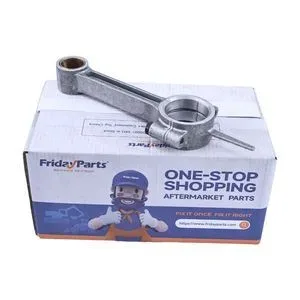
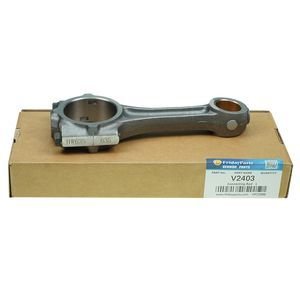
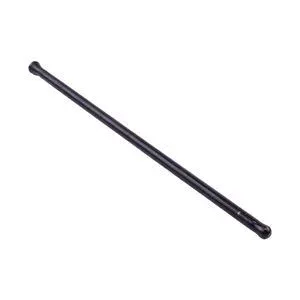
Matched Tolerances Confirmed — Each connecting rod is weight-balanced and paired with correct bearing grades for V2403 series engines based on rebuild history.
Technical Specifications
| Parameter |
Value |
| Product Type |
Connecting Rod |
| Machine Fitment |
Kubota V2403, V2403-M, V2403M |
| Material |
High-strength alloy steel |
| Condition |
New Aftermarket |
| Warranty |
3-12 months against manufacturing defects |
| Standard |
ISO 9001 certified manufacturing |
| Minimum Order |
1 Piece |
Application Suitability
| Engine System |
Related Components |
| Cylinder Block Assembly |
Main bearings, con rod bearings, piston pin bushings |
| Rotating Assembly |
Pistons, piston rings, crankshaft, flywheel |
| Lubrication Circuit |
Oil pump, oil filter, gallery seals, crankshaft oil seals |
| Cooling System |
Water pump, thermostat, head gasket, cylinder liner |
Why Connecting Rod Failures Demand Root-Cause Analysis Before Rebuild
Replacing a bent or fractured rod without diagnosing the system failure guarantees a repeat teardown.
A connecting rod does not fail in isolation. Lubrication starvation, over-torque on cap bolts during a previous service, or a crankshaft journal that has moved beyond standard tolerance all leave signatures on the failed component. I have opened V2403 blocks where the Connecting Rod Kubota V2403 engine rebuild teams pulled out showed bearing shell spalling on one side only — a clear sign the crankshaft journal had been ground to an undersize that was never recorded. The new rod went back in with STD bearings, and the engine lasted a few hundred hours before the knock returned [NEED_CITE: connecting rod bearing failure modes in industrial diesel engines].
The cost of a second teardown is never just the parts. It is the machine sitting idle, the labor pulled from another job, and the credibility lost with the equipment owner who expected the first rebuild to hold.

The Rotating Assembly as a Matched System
A connecting rod works inside a system where every clearance interacts. The big-end bearing shell thickness must match the crankshaft journal diameter — standard, 0.25 mm undersize, or further depending on how many regrinds the crank has seen. The small-end bushing must accept the piston pin with the correct interference fit. When a Connecting Rod Kubota V2403 engine rebuild is quoted, these matching dimensions need to be confirmed before anything goes into the block.
Weight Matching and Balance Across the Four Cylinders
Kubota V2403 series engines run at governed speeds where even small weight differences between rods create vibration that accelerates main bearing wear. Each replacement rod should be weighed and compared to the remaining three. If one rod is meaningfully heavier, the rotating assembly will carry an imbalance that no amount of crankshaft balancing can fully correct [NEED_CITE: rotating assembly balance requirements for four-cylinder industrial diesel engines]. This is why sourcing a single rod from one supplier and the other three from a different batch often introduces problems that do not appear until the engine is under load.
Dimensional Grades and Previous Rebuild History
Every time a V2403 crankshaft is reground, the journal diameter shrinks and the bearing shells must step up in thickness to compensate. A rod that was fitted with 0.25 mm oversize bearings in a past rebuild cannot accept standard shells when the next teardown happens. Confirming the oversize status from the engine service log — or measuring the journal directly — is the only way to order the correct bearing grade alongside the new Connecting Rod Kubota V2403 engine rebuild components.
What Happens When Grades and Tolerances Are Mismatched
I once traced a V2403-M pulling excessive oil consumption back to a previous rebuild where the pistons and liners had been sourced separately, and the clearance between them fell outside specification. The same principle applies to rods. If the big-end bearing clearance is too tight, oil cannot form a full hydrodynamic film and the shell overheats. If it is too loose, oil pressure drops at idle and the knock comes back within weeks. Either scenario forces the engine back onto the bench, and the Connecting Rod Kubota V2403 engine rebuild cost doubles because the gasket set, seals, and labor must all be repeated [NEED_CITE: hydrodynamic bearing clearance effects on diesel engine service life].
Why Source the Rebuild From One Account
Our selected production lines and qualified sourced supply both carry the same quality control and warranty terms, so a rod ordered alongside a piston set, ring set, and gasket kit ships under one warranty reference. The eight engine sub-categories we cover — from belt drive through to lubrication and cooling — mean a complete V2403 overhaul list can be fulfilled as one consignment, avoiding the mismatched lead times that split an engine teardown across several deliveries. Part identification works from the engine serial plate, a photograph of the old component, or the existing part number. A dimensional and weight inspection record accompanies each dispatch. Sample supply is available for fitment confirmation before any bulk commitment, which matters when a rebuild shop is qualifying a new supplier for repeat Kubota work.
Documentation & Verification
- Commercial invoice listing each rod by engine variant and bearing grade
- Cross-reference sheet for V2403 internal dimension differences (reference only)
- Dimensional and weight matching inspection record included with dispatch
- Warranty terms covering manufacturing defects for 3 to 12 months
- Packing photographs showing rod protection and box labeling before sealing
- HS code and customs documentation support for international consignments
Installation & Rebuild Sequence
- Verify crankshaft journal diameter with a micrometer before selecting bearing shell grade for the new rod
- Clean all oil galleries in the block and crankshaft with pressurized solvent and verify flow through each journal
- Torque connecting rod cap bolts to Kubota specification in the stated sequence and confirm big-end clearance with plastigauge
- Match-weight each rod against the remaining three in the rotating assembly and document the variance
- Rotate the assembled crank by hand after all rods are fitted to confirm no binding before installing the head
- Run the first start with a primed lubrication system and monitor oil pressure at idle for the initial break-in period
Requesting a Rebuild Quote
Provide the engine serial number and confirm whether the crankshaft has been reground previously, along with any oversize bearing grades already in use. This allows us to match the connecting rod, bearing shells, and complementary overhaul components to the actual condition of your V2403 block rather than assuming standard dimensions.
Frequently Asked Questions
Q: What internal components should be replaced alongside the connecting rod during a V2403 overhaul?
A: Bearing shells at the big end, the small-end bushing, piston pin circlips, and the rod bolt set should all be renewed. If the crankshaft journal shows scoring, matching the new shell grade to the reground diameter is essential. Gasket sets and crankshaft seals complete the system-level refresh needed to prevent early return to the bench.
Q: How do I determine whether STD or oversize bearings are needed for the V2403 crankshaft?
A: Measure each crankshaft journal with a micrometer and compare against Kubota specification tables. Any previous regrind will have reduced the diameter, requiring thicker shells. The engine service log may record the oversize grade used last time, but direct measurement is the only reliable confirmation.
Q: Are there internal differences between V2403 and V2403-M that affect connecting rod selection?
A: The V2403-M variant may use different piston and liner configurations that change the compression height and pin position. While the rod big-end may be common across variants, the small-end bushing and piston pin diameter should be confirmed against the specific engine serial number before ordering matched sets.
Q: What typically causes a connecting rod to fail in Kubota V2403 applications?
A: Lubrication starvation from a blocked oil gallery or failed pump, over-torque or under-torque of cap bolts during a previous service, and crankshaft journal wear beyond the bearing clearance limit are common causes. Identifying and correcting the root cause before installing replacement components prevents repeat failure within the first service interval.